
Browse Items (970 total)
Sort by:
-
"Meticulous engineering."
The need for high reliability and great care in modern engineering is stressed. Disciplines to eliminate or decrease errors are described. College courses should interweave this approach into study projects. -
"A Study of Saturn V and Intermediate Vehicle Improvement Programs Executive Summary Report."
The abstract notes, "The purpose of this report is to summarize the results of three companion studies designed to investigate both the performance growth potential of the Saturn V and the utilization of Saturn V equipment to fill the performance gap in the intermediate payload range between the Saturn IB and the Saturn V. This report includes significant data which is intended to aid the planning of future missions. This data reflects some of the various vehicle configurations which can be used by mission planners to satisfy payload desires in excess of the Saturn IB and Saturn V." -
"Saturn IB inflight photographic instrumentation system."
This Internal Note presents the development of the Saturn inflight photographic instrumentation program from its original development requirement concept to the flight hardware application on Saturn vehicles. A comprehensive description of the infight photographic instrumentation system is given along with data concerning testing, operation, application, and evaluation of the system after recovery. This Internal Note shows that the system has been successfully developed,that valuable information has been obtained from film retrieved from recovered capsules, and that the system can be used with a high degree of reliability. -
"Furnace Brazing the F-1 Thrust Chamber for Apollo."
This work described in this report was performed for the National Aeronautics and Space Administration under contract NASw-16. Rocketdyne is now building the F-1 engine for the Apollo lunar mission. Five F-1 engines, each capable of developing 1-1/2 million pounds of thrust will power the first stage of the launch vehicle of Saturn V. -
"The significance of parameters affecting the heat transfer to the liquid hydrogen in the Saturn S-IVB stage for the lunar orbit rendezvous mission."
The Saturn S-IVB stage has a requirement for orbiting around the earth for up to 4.5 hours with approximately 60 percent of its initial propellant remaining at the end of the coast (prior to restart) . Extensive analyses must be performed to insure that this requirement is met. Both the maximum and minimum heat transfer rates are important because the maximum rates affect the hydrogen boiloff losses and thus the initial propellant loading requirements. The minimum rates are important because the boil off gases are used to maintain a minimum axial thrust level by venting the gases continuously through aft facing nozzles. This provides for a settling of the propellant throughout the orbital coast and alleviates the need for periodically venting the tank under zero gravity. -
"Development of the Saturn S-IV and S-IVB Liquid Hydrogen Tank Internal Insulation."
In April of 1960 the Douglas Aircraft Company was awarded a contract to develop the second and uppermost stage for the Saturn I space booster. In order to realize the high specific impulse available, this stage, called the S-IV, was to utilize liquid hydrogen and liquid oxygen as the propellants. After burn-out of the first stage, the S-IV Stage was to ignite its engines at an altitude of approximately 200,000 feet, burn for approximately 8 minutes, and inject a 20,000 lb spacecraft into a low earth orbit. This program represented Douglas's first major endeavor with liquid hydrogen. It was necessary to develop an insulation for the S-IV Stage that was capable of withstanding the thermal shock associated with loading, could provide adequate insulative properties to limit the flow of heat into the hydrogen, and was of minimum weight. This latter fact cannot be over emphasized because every extra pound of insulation is one less pound of available payload weight. -
"Project Dynasoar (u): a report bibliography."
Projected by D.L. Christiansen, DLC- 5/2/69-Memo.; Search control No. 015416.; For Scientific and Technical Information, Cameron Station, Alexandria, Virginia.; Unclassified.; Pages in this bibliography are not numbered. -

"Project Thor (u): a report Bibliography."
Unclassified control No. 015415.; Requested by D.L. Christensen, DLC-5/2/69-Memo for Scientific and Technical Information, Cameron Station, Alexandria. -
"Pershing (u): a report bibliography."
List of unclassified reports. -
Space Stations/Platforms/Workshop (U): A Report Bibliography.
The document is an annotated bibliography of reports from Requested by D. L. Christiensen. 2 -
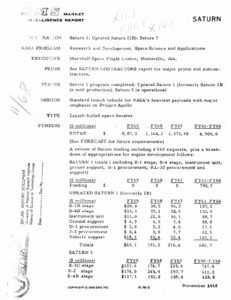
"Saturn : DMS market intelligence report."
Lists numerous costs. -
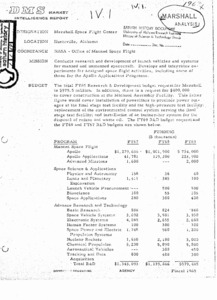
"Marshall analysis : DMS Market Intelligence Report."
Lists numerous costs. -
Preservation, shipment & recovery of the Saturn booster.
The purpose of this report is to present the shipping and recovery procedures for the Saturn booster. -
"A Discussion of the Lunar Landing Problem."
Digesu worked in the Astrionics Division of MSFC. This paper was presented at the AIAA Guidance & Control Conference, Massachusetts Institute of Technology, Cambridge, Massachusetts, August 12-14, 1963. -
"Manned Lunar Landing via Rendezvous."
Paper to be presented at the IAS National Meeting on Manned Space Flight. Focuses on operations leading to injection of the space craft into the lunar transfer trajectory. -
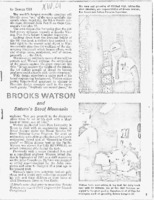
"Brooks Watson and Saturn's Steel Mountain."
Included are a copy of page 7 of the December 1963 publication of Pan Am (GMRD) Clipper magazine and a letter from Pan American World Airways to David Christensen. The magazine article briefly describes the gantry that surrounded Saturn-V and Pan American's Saturn complex Supervisor, Brooks Watson. -
"Pumping boiling liquid hydrogen without cavitation."
Article containing diagrams about the pumping and boiling process of water. -
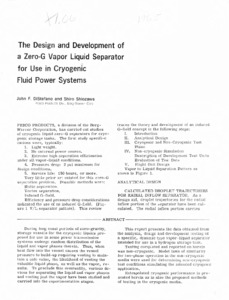
"Design and Development of a Zero-G Vapor Liquid Separator For Use in Cryogenic Fluid Power Systems."
During long coast periods of zero-gravity, storage vessels for the cryogenic liquids proposed for use in some power transmission systems undergo random distribution of the liquid and vapor phases therein. Thus, when heat flow into the vessel causes the vessel pressure to build-up requiring venting to maintain a safe value, the likelihood of venting the valuable liquid phase, as well as the vapor, results. To preclude this eventuality, various devices for separating the liquid and vapor phases and venting just the vapor have been studied and carried into the experimentation stages. -
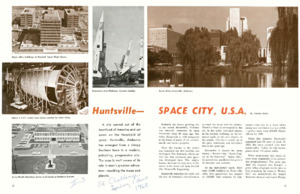
"Huntsville: Space City, U.S.A."
An article describing Huntsville's role in various space related projects. -
"Saturn S-IV first firing."
Press release detailing the firing of the Saturn S-IV in California.