
Browse Items (970 total)
Sort by:
-
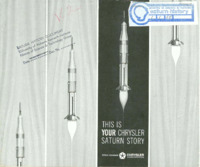
"This is Your Chrysler Saturn Story."
The document is a booklet created as part of the NASA/Chrysler Corporation Space Division manned flight awareness program. It discusses Chrysler's role in manufacturing and testing the Saturn and includes photographs and diagrams of Saturn stages, operations at Michoud, testing, and future missions. The section headings included in this booklet are "Chrysler and the Saturn," "Saturn at Michoud," "The Voyage of Saturn," "Saturn Firings," and "Saturn's Missions." -
"Design, Development, and Fabrication of a Prototype Hydraulic Transformer."
For presentation to the Society of Automotive Engineers, 16 September 1964, Boston, Massachusetts. ABSTRACT: This paper discusses the design, development and fabrication of a prototype hydraulic transformer, Hydro-Aire Model No. 05-055, performed in fulfillment of the requirements of Contract No. NAS 8-5264 for NASA Marshall Space Flight Center. The Hydraulic Transformer described is designed to pump hydraulic oil at a flow of 100 GPM with a pressure rise of 4000 psi, and does this work by utilizing as a power source the flow of RP-1 rocket fuel at a pressure of 1900 psig. The Hydraulic Transformer built to handle this combination of flows and pressures, unprecedented in such devices, has a weight of only 70 pounds for the first development model. The development of this unit is discussed and future development improvements are mentioned. -
"Development Effort to Achieve Reliability."
Presented at the 6th West Coast Reliability Symposium, University of California at Los Angeles, Los Angeles, California, 20 February 1965.The development of a large liquid rocket engine can represent the expenditure of several hundred million dollars of effort. Before 30 percent of the contracted development funds have been expended, however, the engine will probably have operated for the mission duration. The capability to operate at least one successful test early in a development program is evidence of achieving a minimal reliability level, but the major objective of the development program is producing a design which performs reliably. A rocket engine reliability prediction must view reliability as a dynamic concept, constantly being altered by development effort. -
"The Challenge of Change vs the Control of the Process."
The introduction states, "This paper is designed to present the Rocketdyne engine program as it applies to the Saturn launch vehicles and will apply to the Apollo program of manned flight to the moon (Fig. 1). The vehicle that will launch this flight is the Saturn V, the largest and most powerful of the Saturn family. This vehicle, 362 feet tall and 33 feet in diameter, will be capable of sending a 45-ton payload to the moon or placing a 120-ton payload in earth orbit. Five F-1 engines power the first stage of the Saturn V; five J-2 engines, the second stage; and one J-2 engine, the third stage. The thrust of the first-stage engines alone will be equivalent to 160 million horsepower. Both of these engines, the F-1 and the J-2, were designed at, and are currently being produced by Rocketdyne." -
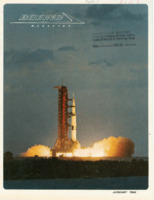
Boeing Magazine, vol. XXXVIII, no. 1, January 1968.
The magazine includes the articles "'A Pleasure to Our Eyes'", "New Paint Job", "Six-year Gasp", "Wings on the Nose", "How is SRAM Doing", "Flying Carpet", "A Citizen's Debt", and "Investment in Bonds". Also included is a briefing of events in the Boeing Company. -
"Film script for Saturn I/IB quarterly film report no. 15."
Unclassified film script of the Saturn I/IB Quarterly Film Report covering January, February, March, 1963. There are handwritten notes and edits throughout the document. -
"Film script for Saturn I/IB quarterly film report no. 16."
Unclassified film script of the Saturn I/IB Quarterly Film Report covering April, May, June, 1963. There are handwritten notes and edits throughout the document. -
"Film script for Saturn quarterly film report no. 18."
Unclassified film script of the Saturn I/IB Quarterly Film Report covering October, November, December, 1963. A handwritten note at the top of the title page lables this copy as the "Final Draft". -
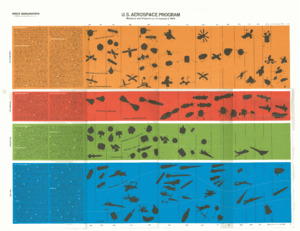
"U.S. Aerospace Program: missions and projects as of January 1, 1966."
The document contains four charts labeled "Investigation", "Exploration", "Utilization", and "Control". Each chart is organized chronologically, contains drawings of U.S. Aerospace Program Projects, and incudes written descriptions of each project. -
"Saturn S-IV cryogenic weigh system. Part IV : safety."
During cryogenic weigh system operation, hydrogen when combined with oxygen can create an unsafe condition. Therefore the concentration of the residual oxygen and hydrogen from leaks in the cryogenic weigh environmental bags must be known at all times during the cryogenic weigh. Hydrogen and oxygen detectors will provide the optimum method for maintaining safe conditions. Hydrogen properties and safe mixtures are reviewed. The method selected to analyze the oxygen content is discussed. The selection, development, and testing of a hydrogen detector system is examined. -
"Development of Separable Connectors for the Saturn S-IV Stage."
The purpose of this paper is to present information, in the area of separable connectors as they pertain to the Saturn S-IV Program. -
"Memorandum to Mr. Hal Seawright, TS-PP, from Norman L. Cropp, Jr., Film Coordinator. Declassification of S-I/IB quarterly film report #18."
Memorandum declassifying "Quarterly Film Report #18." -
"Capabilities and Limitations of Space Communication Systems."
The paper "Capabilities and Limitations of Space Communication Systems" is part of a General Electric Technical Information Series prepared for the Apollo Support Department. The abstract states "A survey and study of the basic parameters of information transfer systems for space communications is presented in this paper, to familiarize systems checkout and on communication engineers with the state-of-the-art and trends in this field. Both current and anticipated requirements for space communication systems are briefly considered. Some of the problems that exist in space communication are presented, along with a general review of current communication systems, their capabilities, and limitations as well as possible improvements in the areas of spacecraft directional antennas, ground stations and antennas, spacecraft transmitter power, and telemetry systems. It is concluded that the increased capabilities expected by the end of this decade should make adequate and reliable space communication possible for most predicted communication needs of future space missions at lunar and near-planet ranges." -
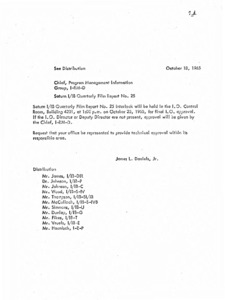
"Saturn I/IB quarterly film report no. 25."
Memo gives dates and times of the interlock for final I.O. approval. -
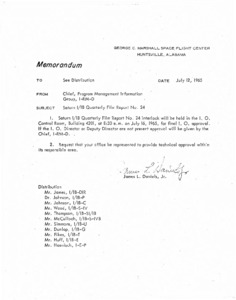
"Saturn I/IB quarterly film report no. 24."
Gives dates and time of interlock for final I.O. approval. -
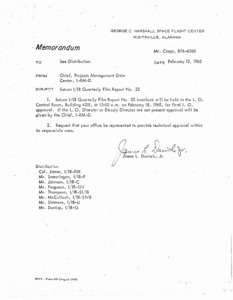
"Memorandum : Saturn I/IB quarterly film report no. 22."
Memorandum includes date and time of interlock for final I.O. approval. -
"Memorandum : Saturn I/IB quarterly film report no. 23."
Memorandum includes date and time for interlock and final I.O. approval.; Archive copy is a photocopy. -
"Memorandum : Saturn I/IB quarterly film script review."
Memorandum pertains to the review draft script. -
"Memorandum : Saturn I/IB quarterly film report no. 21."
Memo gives date and time of interlock for final I.O. approval. -
Saturn and lunar flight.
Speech by K.K. Dannenberg at American Society of Civil Engineers, Huntsville, November 2.; Projectionist's copy (photocopy) - slide numbers are included.