
Browse Items (970 total)
Sort by:
-
"Saturn IB : presentation to Little Rock Group."
Speech by H.D. Lowrey, SAE Meeting, Detroit, Michigan. Focuses on the Apollo project, the technology involved and what the goals of the project are. -
"Saturn I/IB quarterly film report no. 26."
Memo is from Chief, Program Management Information, I-RM-D.; The date and time of the interlock for the final I.O. approval is given. -
"Development of LOX-Hydrogen Engines for the Saturn Apollo Launch Vehicles."
During the development of the RL-10 and J-2 engines, many problems were encountered. Solutions to the significant problems are contained. A description of these LOX-Hydrogen engines, outlining the unique features of each will be given. Performance parameters for both engine systems are tabulated. Specific applications to various stages are shown. -
Advanced Astrionics project review.
Given at the IRAD Technical Seminar, Gaithersburg, Maryland, January 30, 1968. F. L. Pugh, Principal investigator; E. C. Caldwell, Advanced IU Systems, IBM Huntsville. -
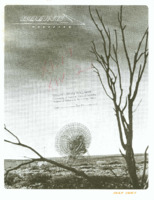
Boeing Magazine, vol. XXXVII, no. 7, July 1967.
The magazine includes the articles "Cut-stone Castles and Opal Fields", "Fast and Loose", "The Barefoot Flyer", "This Is Your Life, Paul Jones", "Boat in a Bottle", "Making the Right Thing Happen", and "The Guard Goes Global". Also included is a briefing of events in the Boeing Company. -
"Saturn: draft."
Report on the history of the Saturn program. -
"All Digital Simulation of Saturn I, IB, and V: Boost Vehicle and Guidance Control Systems."
The introduction notes, "The Saturn V launch vehicle is being developed by the National Aeronautics and Space Administration's George C. Marshall Space Flight Center for Project Apollo; Saturn I and Saturn IB vehicles are providing the early testing and support for Project Apollo. The nerve center of the Saturn is its guidance and control system. An airborne digital computer provides the link which closes both the guidance and control loops,making verification of the flight computer program of vital importance. During a powered flight this onboard digital computer program can be divided into four major parts:a) guidance, including navigation, b) control, c) vehicle sequencing, and d) computer telemetry." -
"Some select physiological, anthropometric, and human engineering data useful in vehicle design and logistic problems of space flight operations."
Report No. DSP-TM-2-60 31 p.; Pages which were blank (not scanned): 2, 26, 28 -
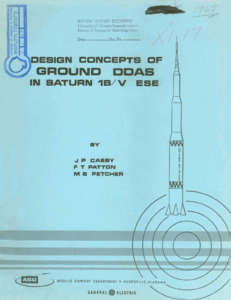
"Design Concepts of Ground DDAS in Saturn 1B/V ESE."
In the Saturn IB/V programs the sheer quantity of data required for computer processing and ESE display makes it necessary to provide an efficient data acquisition system. For much of the data originating in the launcher this requirement is satisfied by the Ground Digital Data Acquisition System (DDAS). This paper provides a technical description of the Ground DDAS with emphasis placed on the unique design concepts of this telemetry system. -
"Functional Management in NASA."
This is a Comment Edition of Historical Note No. 53 prepared by a summer employee of the NASA Historical Staff (APPH). The author has agreed to integrate comments and corrections submitted by critical readers, a normal process of validation for all historical reports and studies. -
"Propulsion : the key to space travel."
Cover has: P. D. Castenholz and H. K. Griggs, Advanced Systems, Advanced Projects Department. D. W. Hege, Manager, Advanced Projects. Paper regarding the importance of propulsion technology and the future missions that would require advancements in that field. -
"Materials in space exploration."
This paper presents a general review of major structural alloys that have been used in liquid rockets and space vehicles, the current state-of-the-art as applied to the Apollo launch vehicle systems, and discusses some materials currently under development for future requirements in vehicles for space exploration. Some aspects of the importance of corrosion resistant materials and suitable protective measures are discussed, as applied to both flight hardware and associated ground support equipment. -
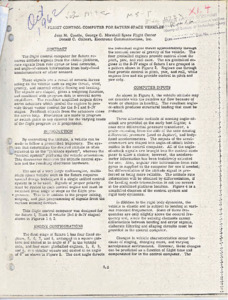
"Flight Control Computer for Saturn Space Vehicles."
The flight control computer for Saturn receives attitude signals from the stable platform, rate signals from rate gyros or lead networks, and angle-of-attack information from body-fixed accelerometers or other sensors. -
"The Common Bulkhead for the Saturn S-II Vehicle: Unique Manufacturing Effort Adds to Space-Age Hardware Technology".
Presentation regarding the construction of Apollo and Saturn rockets. -
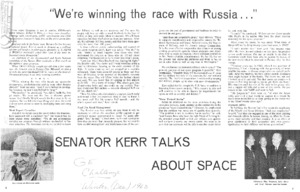
"We're winning the race with Russia."
Partial article discussing the United States' victories in the space-race over Russia. -
"Saturn and the NASA space program."
Given at the Birmingham Chapter National Defense Transportation Association. Focuses chiefly on moon-missions. -
"Effects of High-Pressure Hydrogen on Steels."
Hydrogen embrittlement of steels is hardly a new subject, but the effects of high-pressure hydrogen have been treated in detail only more recently and to a much more limited extent. Thus, most investigations of hydrogen embrittlement have been concerned with hydrogen in metals, while for the high-pressure hydrogen problem, we are more concerned with metals in(in contact with) hydrogen. I believe there is a difference and, certainly,different mechanisms of embrittlement are at least possible.; Presented at the Central Florid Section, American Welding Society, Orlando, Florida, 14 November 1967 and North Alabama Chapter, American Society for Metals, Huntsville, Alabama, 16 November 1967. -
"Saturn Apollo guidance error estimation."
A brief sketch of the development of the equations for a weighted least squares estimator is given, the equations for both collective and recursive estimators being included. Four possible problem sources that may be encountered in the application of the estimator are identified. Various "success" parameters are defined in an attempt to predict the success with which, the method has been applied. The application of the estimation technique to the problem of computing various error parameters associated with the ST-124M guidance platform is described with the numerical results obtained using a manufactured data case are presented. These results are used to form conclusions about the effectiveness of the "success" parameters and preferred approaches to the problem of system evaluation using techniques of estimation theory. -

Boeing Magazine, vol. XXXIV, no. 4, April 1964.
The magazine contains the articles "Aidr Cargo Jets Ahead", "Saturn Stands Up", "Tunnel of Flame", "Where the Air Is Really Hot", "Spaghetti to the Rescue", "B-52 Bombers Undergo Tests", "sports-Minded Magician", "Skipper Regan", and "Road to the Stars". Also included is a briefing of events in the Boeing Company. -