
Browse Items (970 total)
Sort by:
-
"Memorandum: John F. Kennedy Memorial Library in Massachusetts."
Memorandum from Wernher von Braun regarding a request made for NASA's cooperation to obtain resources from the Kennedy Memorial Library. -
Comments on SA-5 mission.
A notation in the upper lefthand corner states "For the record: These are Dr. von Braun's comments to present to President Kennedy during his visit at Cape Canaveral, Fla., Nov. 16, 1963." A handwritten note is in the upper right corner. It appears that some of the pages to this document are missing. -
"Goddard patents: notes from von Braun to Slattery."
Archive copy is a poor photocopy.; Handwritten in ink is: Ref: Goddard Patents (See D. Akens for final draft of letter). -
"Letter to Mr. David L. Christensen."
Letter to David L. Christensen from Ralph I. Villers responding to a request from Christiansen. Enclosed is the material requested. -
"Stability analysis of Apollo - Saturn V propulsion and Structure feedback loop."
The propulsion and the structure of a space vehicle form a feedback loop through inertial coupling referred to as the pogo phenomenon and experienced with the Thor , Titan, and Apollo-Saturn V space vehicles. -
"Ground Equipment to Support the Saturn Vehicle."
With the advent of the first large space vehicle, the SATURN, the ground support equipment and launch facility designer is faced with the necessity of conceiving and building an unprecedented launch system concurrent with the vehicle development. The paper intends to present a comprehensive picture of the problems involved and how they are solved. It follows the SATURN through the various modes of operation such as transportation over land and water, checkout, handling and erection, propellant loading, and describes the facilities at the launch site. -
"Development Status for Arc Guidance, Weld Observation Systems, and a Review of Process Control Parameters."
Letter to David L. Christiensen from W. A. Wall, enclosing requested documents. -
"Project Manager's Report."
Report detailing the costs of materials and contracts. -
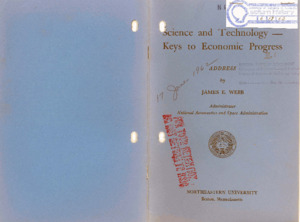
"Science and technology - keys to economic progress."
A book written with the key focus being how technology and science and its progress can aid in the growth of the economy. -
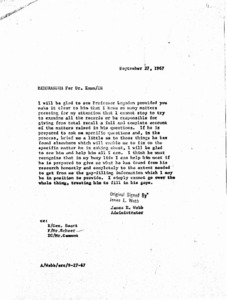
"Memorandum for Dr. Emme/EH from James E. Webb, Administrator."
Memorandum regarding a potential meeting between James E. Webb and Professor Lagadon. -
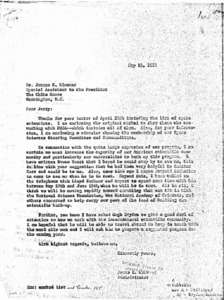
"Letter to Dr. Jerome B. Wiesner."
Letter to Jerome B. Wiesner from Jones B. Webb regarding requested documents as well as how they, as scientists, interact with the scientific community. -
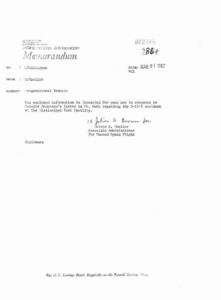
Congressional inquiry regarding the S-II-T accident at the Mississippi Test Facility : letter to the honorable Clinton P. Anderson, Committee on Aeronautical and Space Science, United States Senate from James E. Webb, Administrator.
Archive copy is a photocopy.; Includes memorandum and information from George E. Mueller, Associate Administrator for Manned Space Flight. Letter contains handwritten editing and notes. -
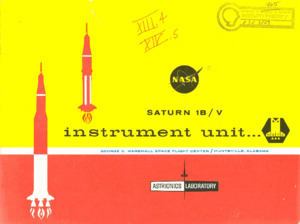
"Saturn IB/V instrument unit."
This brochure provides some basic, general information about the lnstrument Unit, a very important part of the Saturn IB and Saturn V launch vehicles. These launch vehicles are being developed primarily for the Apollo program for manned lunar exploration but will also be used for future space missions. -
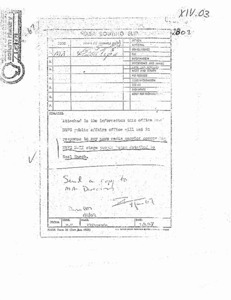
"Response to any news media queries concerning MSFC S-II stage."
Letter to answer any incoming questions from the media regarding the MSFC-II stage and any briefed on Seal Beach. -
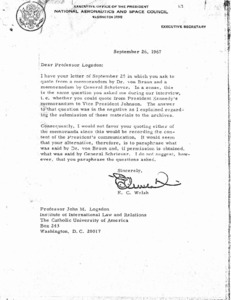
"Letter to Professor John M. Logsdon."
Correspondance between Professor Logsdon and Welsh regarding Logsdon quoting Wernher von Braun's memorandum. -
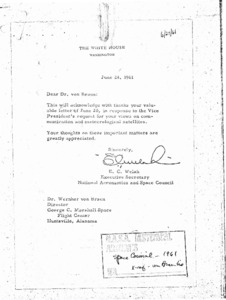
"Letter to Dr. Wernher von Braun."
Letter to Wernher von Braun from E.C. Welsch thanking Braun for his letter on June 20th regarding his thoughts on communication and meteorological satilites. -
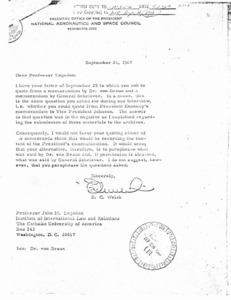
"Letter to Professor John M. Logsdon."
Letter to Professor Logsdon from E. C. Welcsh denying Logsdon's request to quote Wernher von Braun and President Kennedy from their memorandums. -
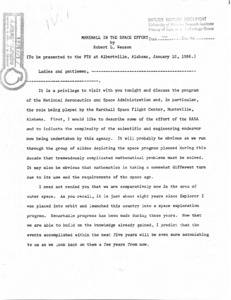
"Marshall in the Space Effort."
Presentation reviewing the complex engineering undertaken at NASA and the mathmatical problems that need to be solved regarding the space program. -
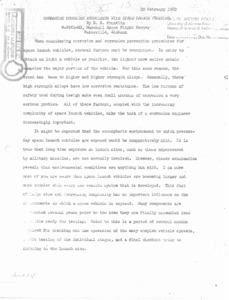
"Corrosion problems associated with the Saturn space vehicles."
Corrosion problems associated with space vehicles, in general, are discussed as contrasted to those problems experienced with structures in an earth atmosphere. Primary emphasis is placed on structural alloys in this discussion, although some corrosion failures experienced in various mechanical components are described. General corrosion prevention measures are indicated, and solutions to specific corrosion failures described. Major failures experienced have been attributed to stress corrosion cracking, rather than general or galvanic type corrosion. Most such failures have occurred with only five different materials: three aluminum alloys - 7075-T6, 7079-T6, and 2024-T6; and two precipitation hardening stainless steels - 17-7PH and AM 355. Corrective actions were different in each case, but involved either a complete change to another material, a change to a different temper of the same alloy, or a modification of the heat treatment and/or general processing techniques. General conclusions are that the types of failures described could be avoided by: a more suitable selection of alloys in the initial design, a realistic review of the environments that could be encountered in the service lifetime of the component, lowering stresses, improving process controls, and effecting better familiarization of design personnel with the with the overall stress corrosion problem in an effort to reduce human error.; Preprint 18e.; Materials for re-entry and spacecraft systems - spacecraft materials.; Materials Conference, Philadelphia, Pennsylvania, March 31 - April 4, 1968. -
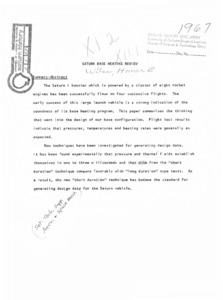
"Saturn base heating review."
The Saturn I booster which is powered by a cluster of eight rocket engines has been successfully flown on four successive flights. The early success of this large launch vehicle is a strong indication of the soundness of its base heating program. This paper summarizes the thinking that went into the design of our base configuration. Flight test results indicate that pressures, temperatures and heating rates were generally as expected. New techniques have been investigated for generating design data. It has been found experimentally that pressure and thermal fields establish themselves in one to three milliseconds and that data from the "short duration" technique compare favorably with "long duration" type tests. As a result, the new "short duration" technique has become the standard for generating design data for the Saturn vehicle.