
Browse Items (970 total)
Sort by:
-
"Development of the NASA/Grumman Lunar Module."
Paper regarding the actions and achievement of the Grumman Aerospace Corporation. -
"Development of Separable Connectors for the Saturn S-IV Stage."
The purpose of this paper is to present information, in the area of separable connectors as they pertain to the Saturn S-IV Program. -
"Development of LOX-Hydrogen Engines for the Saturn Apollo Launch Vehicles."
During the development of the RL-10 and J-2 engines, many problems were encountered. Solutions to the significant problems are contained. A description of these LOX-Hydrogen engines, outlining the unique features of each will be given. Performance parameters for both engine systems are tabulated. Specific applications to various stages are shown. -
"Development of LOX/RP-1 Engines for Saturn/Apollo Launch Vehicles."
The development of liquid rocket engines follow similar patterns regardless of engine size. During the development of the H-1 and F-1 engines, many problems were encountered. Methods of solving the combustion instability problem are discussed. A description is given of the major components of each engine, outlining their unique features. The requirements for an insulation cocoon are discussed. Problems associated with materials substitution are provided; also highlighted is the fact that problems occur after engine deliveries and require continued development support. Safety features incorporated on the engines are mentioned. Solution to problems encountered in flight are discussed. Upratings of both engines systems are presented graphically.; On the NASA Technical Reports Server (NTRS) unclassified. Can also be found on AIAA. -
Development of LOX/RP-1 engines for Saturn/Apollo launch vehicles.
The development of liquid rocket engines follow similar patterns regardless of engine size. During the development of the H-1 and F-1 engines, may problems were encountered. Mehtods of solving the combustion instability problem are discussed.; AIAA 4th Propulsion Joint Specialist Conference, Cleveland, Ohio, June 10-14, 1968.; Also available on NASA Technical Reports Server (NTRS) as unclassified. Can be ordered. Also on AIAA. -
"Development of the Saturn S-IV and S-IVB Liquid Hydrogen Tank Internal Insulation."
In April of 1960 the Douglas Aircraft Company was awarded a contract to develop the second and uppermost stage for the Saturn I space booster. In order to realize the high specific impulse available, this stage, called the S-IV, was to utilize liquid hydrogen and liquid oxygen as the propellants. After burn-out of the first stage, the S-IV Stage was to ignite its engines at an altitude of approximately 200,000 feet, burn for approximately 8 minutes, and inject a 20,000 lb spacecraft into a low earth orbit. This program represented Douglas's first major endeavor with liquid hydrogen. It was necessary to develop an insulation for the S-IV Stage that was capable of withstanding the thermal shock associated with loading, could provide adequate insulative properties to limit the flow of heat into the hydrogen, and was of minimum weight. This latter fact cannot be over emphasized because every extra pound of insulation is one less pound of available payload weight. -
"The Development of Servovalves with Improved Reliability for Space Vehicles."
Considerations for improvement in the reliability of the Saturn engine gimbal servosystems are briefly covered. The Saturn I servovalves operate with increased electrical input power. The Saturn V vehicle stages will use mechanical feedback actuators with increased electrical input power, larger orifices and nozzle sizes, larger torque motor wire size, and greater spool driving forces. -
"Development Status for Arc Guidance, Weld Observation Systems, and a Review of Process Control Parameters."
Letter to David L. Christiensen from W. A. Wall, enclosing requested documents. -
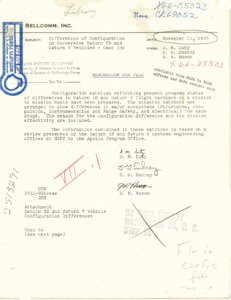
Differences of configuration in successive Saturn IB and Saturn V vehicles- case 330.
Includes memorandum for file. Configuration matrices reflecting present program status of differences in Saturn IB and Saturn V flight hardware on a mission to mission basis have been prepared. The attached matrices are arranged to show differences in major subsystems (Structures, Propulsion, Instrumentation and Range Safety, and Electrical) for each stage. The reason for the configuration difference and the mission effectivity are included.; DMD, 2031-SGE-eas, GRH; Includes "Recommendation for announcement and distribution of Bellcomm Report". -
"Digest of FY-62 Funded Advanced Studies : July 1966."
This publication is one of a planned series to summarize the MSFC advanced study program for each fiscal year beginning with FY-61. A separate report will cover the study program for each fiscal year. The purpose of these documents is to provide historical reference information which should be helpful in planning future study programs. The FY-62 funded studies are covered in this document. These investigations are covered under two major categories: Launch Vehicle Studies; and Lunar, Orbital, and Planetary Studies. The information presented on each study includes a brief description of the objectives and results and pertinent contract data. In order to keep this report small and easy to use, no attempt was made to include conclusions based on the study results ; however,the final reports documenting the investigations are referenced. If these reports are needed for permanent retention and are not available from the MSFC Library (MS-IPL), submit requests for the documents to the Scientific and Technical Information Facility, Attention: NASA Representative, P.0. Box 33, College Park, Maryland 20740. -
"Digest of FY-63 funded advanced studies : July 1966."
This publication is, one of a planned series to summarize the advanced study program for each fiscal year beginning with FY-61. A separate report will cover the study program for each fiscal year. The purpose of these documents is to provide historical reference information which should be helpful in planning future study programs. The FY-63 funded studies are covered in this document. These investigations are covered under three categories: Launch Vehicle and Supporting Studies; Orbital and Lunar Studies; and Planetary Studies. The information presented on each study includes a brief description of the objective and results and pertinent contract data. In order to keep this report small and easy to use, no attempt was made to include conclusions based on the study results; however, the final reports documenting the investigations are referenced. If these reports are needed for permanent retention and are not available from the Technical Supervisor or the MSFC Library (MS-IPL), submit requests for the documents to the Scientific and Technical Information Facility, Attention: NASA Representative, P. O. Box 33, College Park, Maryland 20740. -
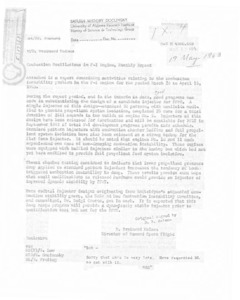
Combustion Oscillations in F-1 Engine.
The set of documents includes an introductory letter written by D. Brainerd Holmes and Tischler's report with the subject "F-1 Combustion Instability Report for Associate Administrator; Period March-April, 1963". -
"The Common Bulkhead for the Saturn S-II Vehicle: Unique Manufacturing Effort Adds to Space-Age Hardware Technology".
Presentation regarding the construction of Apollo and Saturn rockets. -
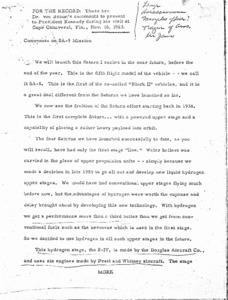
Comments on SA-5 mission.
A notation in the upper lefthand corner states "For the record: These are Dr. von Braun's comments to present to President Kennedy during his visit at Cape Canaveral, Fla., Nov. 16, 1963." A handwritten note is in the upper right corner. It appears that some of the pages to this document are missing. -
"Comments on Problems Relating to the Lunar-Landing Vehicle."
"This technical note concerns some of the problems encountered with the landing of a payload on the moon. The main problem areas such as guidance, velocity control and impact considerations are discussed. Although no final conclusions or designs are intended, it is hoped that the material presented will serve as a guide for future detailed work." -
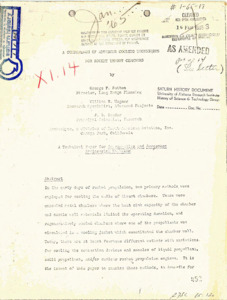
"A Comparison of Advanced Cooling Techniques for Rocket Thrust Chambers".
The document is a technical paper for Astronautics and Aerospace Engineering Magazine.The copy has handwritten notes that appear to be for revisions. The abstract states "In the early days of rocket propulsion, two primary methods were employed for cooling the walls of thrust chambers. These were uncooled metal chambers where the heat sink capacity of the chamber and nozzle wall materials limited the operating duration, and regeneratively cooled chambers where one of the propellants was circulated in a cooling jacket which constituted the chamber wall. Today, there are at least fourteen different methods with variations for cooling the combustion devices and nozzles of liquid propellant, solid propellant, and/or nuclear rocket propulsion engines. It is the intent of this paper to examine these methods, to describe for each the useful range of operating conditions, as well as present and likely future applications, to define their limitations and associated problems. Emphasis is primarily placed on liquid rocket engines." -
"Computer Controlled Power Application for the Saturn Launch Vehicle".
This paper describes a real-time digital computer program that controls the application of electrical power to the S-IVB stage of the Saturn vehicle at Cape Kennedy, Florida. Douglas Aircraft Company, the S-IVB stage manufacturer, provided NASA with the program requirements relative to the energizing sequence, voltage and current measurement tolerances, and vehicle system operational tests. International Business Machines Corporation provided NASA with the computer program to satisfy the task requirements. The program conjoined the components of the Electrical Support Equipment (two RCA 110A computers and control and instrumentation devices) into a closed loop system. The supporting operating system program by IBM is described. -
"Component Failure Effect on Systems: An Analytical Model".
Prepared by R. L. Parkhill, Section Chief, Saturn S-IVB Reliability Analysis and J. Pauperas JR., Asst. Section Chief, Saturn S-IV Reliability Analysis. Presented to the 4th Annual Seminar on Reliability for Space Vehicles, Los Angeles, California, December 6, 1963. This paper presents techniques originated by Douglas Engineering working under NASA contract NAS7-1. Prepared as a record of the study conducted for the Administrative Engineer on the Department Overhead Account No. 9703.; SUMMARY: In today's complex systems, such as Saturn, many traditional reliability analysis concepts are not acceptable. Because of time and budget restrictions, and the requirement to provide a "man rated" space vehicle, the Douglas Saturn Engineering Reliability Section has developed a new analytical approach; it is called "criticality ranking". It is a "totem pole" of components whose single failure may lead to system loss. "Criticality ranking" is one of the results of an analytical model which encompasses failure effect and reliability prediction. This paper describes this analytical model, discusses some of the techniques and ground rules, and presents examples. A discussion of the application of the results is also included. -
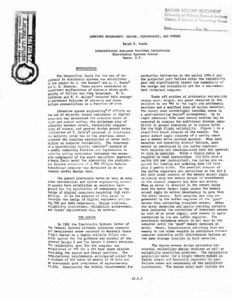
"Computer Redundancy: Design, Performance, and Future".
Discusses the importance of redundancy as a safety measure in electronic systems. -
"Communication-System Blackout During Reentry of Large Vehicles".
This paper was published in the Proceedings of the IEEE, volume 55, number 5, May 1967.; ABSTRACT: Much of the theoretical research on reentry blackout is in a format difficult for the communications design engineer to use in his system analysis. This paper derives simplified equations for the average sheath power loss that may be added (in dB) to the usual space loss to obtain an approximate total propagation loss. The plasma and sheath properties are discussed in detail but largely without supporting mathematics, in order to give the design engineer a better understanding of the overall problem. For the same reason and to provide insight into the final results, the average radiated power is found, using both intuitive and rigorous techniques. Several graphs of plasma properties are included in the development as an aid to numerical computation, and results are compared with the work of other authors.