
Browse Items (970 total)
Sort by:
-
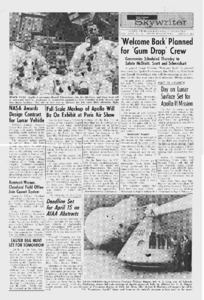
"Welcome back planned for 'Gum drop' crew."
News article detailing the planned 'Welcome back' events surrounding the resturn of the Apollo 9 crew. -
"Welding cryogenic materials for aerospace applications."
Cryogenic propellant rocket engine hardware and the related test facilities will be described. Methods used for selection of alloys for liquid oxygen and liquid hydrogen service will be discussed. Unique equipment and welding procedures are reviewed with emphasis on welding problems and their solutions to assure reliable hardware and facilities. Examples of specific welding procedures and methods of quality assurance will be given for joining application ranging in size from .001" to 11" thick sections. -
"Welding for aerospace application : a panel discussion."
Original is a photocopy; W. A. Wilson, Chairman; Russell Meredith, North American Aviation; Robert Hackman, Linde Company; Frank Wallace, Pratt-Whitney Aircraft; P.G. Parks, NASA, MSFC; G. O. Hoglund, Aluminum Company of America. -
"Where are we going in space management."
Presented to the First Space Congress, Cocoa Beach, Florida, April 21, 1964 by Joseph H. Reed, Chief, Management Analysis Office, Executive Staff, Marshall Space Flight Center at the request of the Associate Administrator for Manned Space Flight, NASA -
"Why internal insulation for the Saturn S-IV liquid hydrogen tank?."
Prepared for presentation at the Cryogenic Engineering Conference, Los Angeles, California, August 14-16, 1962.; There is no page 8. -
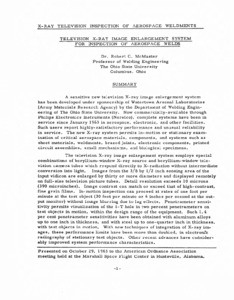
"X-ray television inspection of aerospace weldments : Television x-ray image enlargement system for inspection."
A sensitive new television X-ray image enlargement system has been developed under sponsorship of Watertown Arsenal Laboratories (Army Materials Research Agency) by the Department of Welding Engineering of The Ohio State University. Now commercially-available through Philips Electronics Instruments (Norelco), complete systems have been in service since January 1963 in aerospace, electronic, and other facilities. Such users report highly- satisfactory performance and unusual reliability in service. The new X-ray system permits in-motion or stationary examination of critical aerospace materials, components, and systems such as sheet materials, weldments, brazed joints, electronic components, printed circuit assemblies, small mechanisms, and biological specimens. -
Convective Energy Transport in Stellar Atmospheres: A Convective Cell Model.
One of the Orange Aid Preprint Series in Nuclear Astrophysics, September 1968.; Supported in part by the National Science Foundation [GP-7976], the Office of Naval Research [Nonr-220(47)]. ; ABSTRACT: The motion in a convectively unstable region is expanded into an ensemble of convective cells. Each of these cells interacts with the surrounding medium according to the semiempirical model proposed by Turner (1963 ). Possible detailed models of the flow patterns within each cell are presented. The radius and velocity of these cells are given as functions of distance moved. The convective flux and rms velocity are given as averages over the ensemble of cells. As in the standard mixing length theory the principle uncertainty remains the average initial radius of the cells. -
Convective Energy Transport in Stellar Atmospheres: A Convective Cell Model.
One of the Orange Aid Preprint Series in Nuclear Astrophysics, September 1968.; Supported in part by the National Science Foundation [GP-7976], the Office of Naval Research [Nonr-220(47)]. ; ABSTRACT: The motion in a convectively unstable region is expanded into an ensemble of convective cells. Each of these cells interacts with the surrounding medium according to the semiempirical model proposed by Turner (1963 ). Possible detailed models of the flow patterns within each cell are presented. The radius and velocity of these cells are given as functions of distance moved. The convective flux and rms velocity are given as averages over the ensemble of cells. As in the standard mixing length theory the principle uncertainty remains the average initial radius of the cells. -
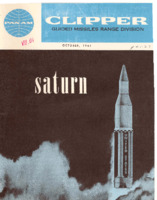
Guided Missiles Range Division Clipper, vol. 2, no. 3, October 1961.
The Clipper is a Guided Missiles Range Division, Pan American World Airlines, Inc., internal publication. This issue includes the articles "News at a Glance," "The Big One," "New Ships on the Horizon," "Civic Responsibility," "Picture Highlights," "Service Awards," "September Service Pins," and "Recognizing Credit Union." "The Big One" includes details about Pan Am's role in developing the Saturn booster. -
-
1966 Chronology of Marshall Space Flight Center.
This draft copy of the chronology includes a memorandum from Marshall Historian L. L. Jones of the Historical Office. -
A "Think Clean" training program.
This paper outlines steps involved in preparing and presenting an instruction course on clean rooms. The training area, personnel, equipment, and program outline will be described. A summary of the results obtained over the first year of operation will be presented. -
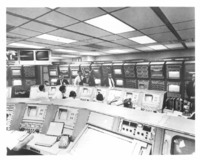
-
-
-
Advanced Astrionics project review.
Given at the IRAD Technical Seminar, Gaithersburg, Maryland, January 30, 1968. F. L. Pugh, Principal investigator; E. C. Caldwell, Advanced IU Systems, IBM Huntsville. -
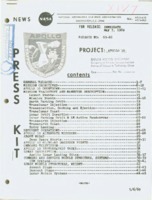
Apollo 10 press kit.
The press kit includes documentation on the Command and Service Module, Lunar Module, Saturn V launch vehicle, astronauts, and mission descriptions. Release No. 69-68. -
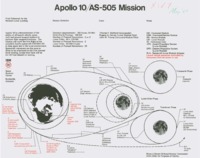
Apollo 10/AS-505 mission chart.
The chart includes diagrams, mission statistics, crew, and notes. There is an additional copy in the David Christensen Collection. -
Apollo 5 press kit.
For release Thursday P.M., January 11, 1968. -
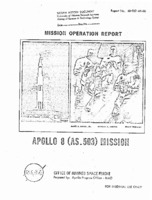
Apollo 8 Mission Operation Report.
This report is meant to provide NASA Senior Management with information on flight plans, mission objectives, and the basis for assessment of mission accomplishment. Note that page 61 is missing from the report.