
Browse Items (970 total)
Sort by:
-
"Fabricating the Saturn S-IC Booster."
AIAA Second Annual Meeting, San Francisco, California. Discusses the fabrication process of the Saturn S-IC booster. -
"The J-2 Liquid Hydrogen Rocket Engine."
The 5-2 high-energy liquid propellant rocket engine (~i~. l), a large engine producing 200,000 pounds of thrust at altitude conditions, burns liquid hydrogen and liquid oxygen to produce the necessary high specific impulse for practical space use. Rocketdyne, a Division of North American Aviation, Inc., is developing the engine for the George C. Marshall Space Flight Center, Xfi. The first use of the engine will be in the upper stages of the Saturn vehicles. Five engines will be used for the second, S-I1 stage of the Saturn V, and one will power the S-IVB third stage of the Saturn V and S-ISTI second stage of 'the Saturn IB; Original is a photocopy on onion skin. -
"Letter to Dr. Wernher von Braun."
Archive copy is a poor photocopy. Unable to read. -
"Interview with Dr. Wernher von Braun."
Transcription of an interview with Wernher von Braun and Mr. Sohier. -
"Memorandum: Indices to MSFC circulars and MSFC Administration regulations and procedures from Chief Management Services Office."
Memorandum regarding indices ready for reference and filing. -
The Post-Apollo Space Program: Directions for the Future.
The document is a Space Task Group report to the president. Pages 8, 18, 26, 27 of the document are missing. -
"Saturn IB SA-217 reference launch vehicle."
This document contains a definition of a reference Saturn IB launch vehicle designated SA-217. The Saturn IB SA-217 is a projected reference vehicle, based on Saturn IB SA-212, incorporating the latest proposed product improvements. The two-stage payload capability of this vehicle to a 100-nautical-mile circular orbit is 44,965 pounds. The Saturn IB SA-217 launch vehicle is to be used as the baseline vehicle for advanced studies requiring the use of the standard or modified Saturn IB launch vehicle. This vehicle definition does not necessarily represent approved changes to any specific vehicle. This document supersedes the Saturn IB SA-213 reference Launch Vehicle, described in memorandum R-P&VE-DIR-65-92. -
-
"Saturn I flight test evaluation."
As this paper is being written, the Saturn I flight test program includes five flights launched between October, 1961 and January, 1964. All five fiights were complete successes, both in achieving all major test missions and in obtaining an unprecedented volume of system performance data for flight analysis. -
-
"Engineering Capabilities Presentation."
This Engineering Capabilities Presentation lists the competence and capability that has been demonstrated by the Space Support Division of Sperry Rand Corporation while fulfilling contractual commitments in the aerospace industry. This is a preliminary presentation; the preparation of a complete capabilities history of the division is currently in the developmental stage. The Capabilities Experience Summary is comprised of ten categories. e.g. Category 1 - Aeronautics, etc. The capabilities reported herein were performed by the Space Support Division under Contract NAS8-20055 to the National Aeronautics and Space Administration, George C. Marshall Flight Center, Astrionics Laboratory, Huntsville, Alabama. -
"Earth Orbital Workshop Capabilities Brochure."
A brochure designed to depict a competence and capability in the area of large earth-orbital workshops. -
"Sperry Rand monthly progress report for July, 1969."
The following pages contain reports for each of the individual contract appendices covering technical progress and accomplishments, related problems, and staffing progress. The report of manhours expended against each appendix by schedule order is being submitted as a part of the financial management report. -
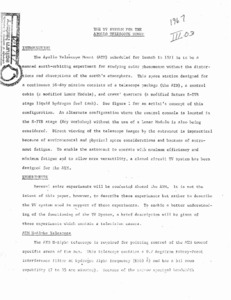
"The TV system for the Apollo telescope mount."
Focuses on the construction and future use of the Apollo space telescope. The components described in this paper except for those listed otherwise were designed by the Space Support Division of Sperry Rand Corporation to specifications established by NASA's Marshall Space Flight Center in Huntsville, Alabama. Appreciation is extended to MSFC for permission to publish this paper and for data and help provided for its preparation. -
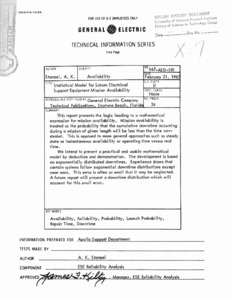
"Statistical model for Saturn electrical support equipment mission availability."
This report presents the logic leading to a mathematical expression for mission availability. Mission availability is treated as the probability that the cumulative downtime occurring during a mission of given length will be less than the time constraint. This is opposed to more general approaches such as steady state or instantaneous availability or operating time versus real time. We intend to present a practical and usable mathematical model by deduction and demonstration. The development is based on exponentially distributed downtimes. Experience shows that certain systems follow exponential downtime distributions except near zero. This error is often so small that it may be neglected. A future report will present a downtime distribution which will account for this small error. -
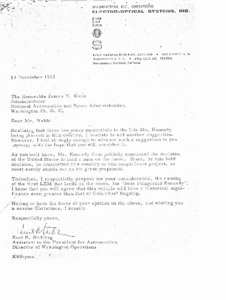
Letter to the Honorable James E. Webb, Administrator, National Aeronautics and Space Administration from Kurt R. Stehling.
A letter to Jame E. Webb proposing that the first LEM that lands on the moon to be named after President Kennedy." -
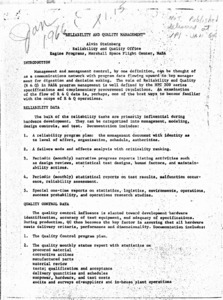
"Reliability and quality management."
The role of Reliability and Quality in NASA program management is well defined by the NPC 200 series and complimentary procurement regulations. -
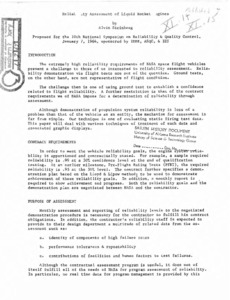
"Reliability assessment of liquid rocket engines."
Proposed for the 10th National Symposium on Reliability & Quality Control. This paper will deal with various techniques of treatment of such data and associated graphic displays. -
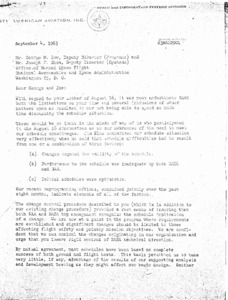
"Letter to Mr. George M. Low. and Joseph F. Shea."
Letter to George M. Lowe and Joseph F. Shea from H.A. Storms president continuing a conversation that was left unfinished. -
Postflight Analysis of Saturn Telemetry Systems.
The abstract states "A telemetry system is a device to transfer information from an inaccessible to an accessible location. A constant input to a telemetry system yields outputs that are distributed according to some density function. A linear change in this constant input may yield a nonlinear change in output. The theory of statistics and experimental design may be applied to the data received from a flight to evaluate the inflight accuracy, linearity, and precision of various telemetry systems. This paper explains the analytical concepts used in postflight analysis of Instrument Unit telemetry systems. It also presents the method for interpreting the results of these analytical techniques."