
Browse Items (970 total)
Sort by:
-
"History of MSFC Reliability Philosophy."
Paper given to North East Chapter , Mississippi Society of Professional Engineers. Essay discussing the history of the MSFC Reliability Philosophy. -
"Historical Sketch of MSFC."
A rocket from the George C. Marshall Space Flight Center will carry the first American to the moon, and the deadline is 1970. Because of the Center's expanding role in space, there are increasing requests for information about our activities. This brief historical sketch should help to answer questions about our past, our present, and our hopes for the future. Marshall Space Flight Center (MSFC) is the largest installation of the National Aeronautics and Space Administration (NASA). The Marshall Center is NASA's agency responsible for large space rockets and related research. MSFC employs about 7500 civil service employees with an annual payroll of more than {dollar}82 million. In addition approximately 4300 contractor employees work for MSFC on the Arsenal, earning an estimated {dollar}43 million. The Center occupies about 1800 acres near Huntsville, Alabama; in this large area are 270 buildings with floor space totalling about 4,000,000 square feet for a real estate and property value of about {dollar}325 million. MSFC's 1966 fiscal year budget was {dollar}1.8 billion. Obviously MSFC has much human and monetary worth behind United States round trips to the moon and beyond. In addition to its size, MSFC is unique because it has a large rocket development team with more than three decades of experience. Prior to the rocket work that dates back to Peenemuende [sic] the world heard little and cared less concerning rockets and space. As a group Marshall has always thought big. It has worked together as a group, and equally well with fellow scientists throughout the Free World, to get the most into space soonest. This is why there is increasing interest in larger and larger rockets and rocket programs from our Center, a fact generating more and more questions about our Center, and in turn generating a "workload" request for this sketch by the Historical Office. We hope that you enjoy our historical sketch, which could as well be entitled "Closer and Closer Views of the Moon and Beyond." David S. Akens, MSFC Historian. -
"Historical Notes on Oral History in NASA."
Prepared for the Second National Colloquium on Oral History, Columbia University. Contains notes on the oral history of NASA. -
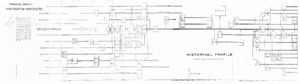
"Historical Profile: North American Aviation, Inc."
Paper written as a study of functional management in NASA. -
-
"Engines for Manned Flight."
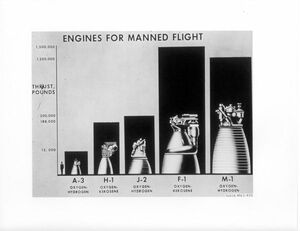
8 x 10 inch black and white photograph.; Images included are: A-3 oxygen-hydrogen, H-1 oxygen-kerosene, J-2 oxygen-hydrogen, F-1 oxygen-Kerosene, M-1 oxygen-hydrogen. The thrust pounds is also listed.Shows them in reference to a human as a scale. -
"Engineering Capabilities Presentation."
This Engineering Capabilities Presentation lists the competence and capability that has been demonstrated by the Space Support Division of Sperry Rand Corporation while fulfilling contractual commitments in the aerospace industry. This is a preliminary presentation; the preparation of a complete capabilities history of the division is currently in the developmental stage. The Capabilities Experience Summary is comprised of ten categories. e.g. Category 1 - Aeronautics, etc. The capabilities reported herein were performed by the Space Support Division under Contract NAS8-20055 to the National Aeronautics and Space Administration, George C. Marshall Flight Center, Astrionics Laboratory, Huntsville, Alabama. -
"Engineering : Saturn S-II program"
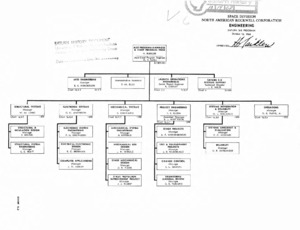
Organizational chart diagram of the North American Rockwell Corporation Engineering division: 10-14-1968 -
"Engineering Safety Into Missile-Space Systems."
Safety Engineering, as applied to complex missile and space systems, has developed a new methodology referred to as "System Safety Engineering." The requirement for a comprehensive approach to safety which is included as a contractually covered adjunct to the design, development, and operational phases of a systems life cycle has become apparent from costly missile mishap experience. The general concepts and accomplishments of this new engineering discipline are described along with possible beneficial relationships with Reliability and other recognized organizational elements engaged in safety related activities. -
"Evolution of Aircraft."
Illustration depicting the history of airplanes across a graph. -
"Evolutionary Steps in S-IVB Development."
The injection stage of a multistage launch vehicle must be partially a velocity stage and partially a spacecraft; it must not only boost the payload, it must also perform cooperative mission operations with the payload after orbital insertion. These hybrid requirements result in intrinsic stage versatility which permits consideration of new and challenging missions for the stage which were unanticipated during initial design.; Prepared by T. J. Gordon, Director, Advance Space Stations and Planetary Systems, Space Systems Center, Douglas Aircraft Company, Huntington Beach, California. -
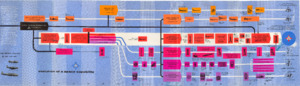
"Evolution of a Space Capability."
Two different organizational charts. -
"Extensions of Saturn."
This paper discusses the possible applications of Saturn vehicles to future space exploration. Potential missions utilizing Apollo derived hardware are examined. Research, development, and operations in earth orbit as well as lunar exploration, unmanned and manned interplanetary exploration are reviewed. These hypothetical missions are discussed in the context of the present and potential capability of three configurations of the Saturn vehicle; an uprated Saturn I, a three-stage Saturn V and a four-stage Saturn V. NOTE: Work presented herein was conducted by the Douglas Missiles and Space Systems Division under company-sponsored research and development funds. Therefore, the concepts and objectives described within this paper reflect the opinions of the authors and do not necessarily constitute endorsement by NASA, the Air Force, or any other U.S. Government organization. The nominal performance numbers presented are typical of the current configurations and possible future vehicle configurations. -
"Fabrication of Plenum Tanks by Explosive Forming and Electron Beam Welding."
This report presents the results of a program initiated to study the use of explosive forming and electron beam fusion welding techniques in the fabrication of pressurized cryogenic materials containers. Using these techniques, vessels were successfully formed from 304 stainless steel and X7106 aluminum alloy in the T63 condition.; Manufacturing Research and Technology Division.; Manufacturing Engineering Laboratory.; Research and Development Operations. -
"Fabricating the Saturn S-IC Booster."
AIAA Second Annual Meeting, San Francisco, California. Discusses the fabrication process of the Saturn S-IC booster. -
"Facility Design for Handling Liquid Hydrogen for Space Vehicle Applications."
Presented to German Society for Rocket Technology & Astronautics.Essay discussing the capabilities of liquid hydrogen as fuel. -
"Facilities Engineering for the National Aeronautics and Space Administration."
Article makes references to a film. Centers around the idea that testing space vehicles extensively before launch is cost control. -
"Fact Sheet : IBM Computer Will Direct Saturn Orbital Test Flight."
Press release regarding a IBM digital computer directing a Saturn 1B orbital mission. -
"Failure Investigations of Large Liquid Propelled Rocket Engine Components."
Case histories of seven typical failures in large liquid propelled rocket engines components have been prepared. Quite simple to complex investigations are presented covering a variety of failure modes in a variety of materials. Included are successful solutions to the failure problems investigated.; Archive copy is a poor photocopy. -
"Films List : NASA Motion Picture Film Service Area Five: Alabama - Kentucky - Louisiana - Mississippi - Tennessee."
A list of films oriented towards the National Space Program and other related topics.