
Browse Items (970 total)
Sort by:
-
Memorandum for Dr. Mueller from Robert C. Seamans.
This memorandum details changes or changes to be considered in Apollo-Saturn nomenclature. It also contains the matter of the Apollo and AAP missions designs and changes Seamans wishes to see. -
"Manufacturing welding control by E. R. Seay, Group Engineer, Lockheed-Georgia Company."
Paper given at the American Ordnance Association Welding Section Panel. Focuses on the process of welding and development programs. -
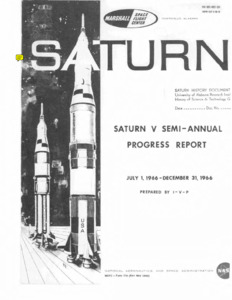
"Saturn V semi-annual progress report July-December, 1966."
MA-001-00202H.; MPR-SAT V 66-3.; ABSTRACT: This Saturn V Semi-Annual Progress report describes progress and major achievements from July 1, 1966, through December 31, 1966, in the Saturn V Program. -
-
"Countdown to Liftoff".
This is an article from the Boeing Magazine. The Archive copy is a very poor photocopy and is difficult to read.; About the time the S-IC-1 booster is lifting the first Apollo/Saturn V from the launch pad on its maiden unmanned flight next year, a Boeing systems test crew will begin static testing the S-IC-4 at Devils Swamp, Mississippi (MTF). Starting with S-IC-4, all Saturn V first stage boosters will be captive fired at MTF. At present, S-IC firings are conducted by MSFC's test laboratory at Huntsville. The first flight stage, the S-IC-1, was placed in the static test stand on 24 January 1966 and completed its test program 25 Feb. It was removed from the stand March 14 and is undergoing post-firing checkout. it is due to be shipped this summer to KSC where it will be mated to the two upper stages of Saturn V, the IU and Dummy Apollo payload. The S-IC-2 went into the static stand on March 22 and is being tested during April The S-IC-3 also will be tested at Huntsville in 1966. The job of putting the world's largest and most powerful rocket together will be accomplished in the world's largest building, the 52-story vehicle assembly building. -
Memorandum to update the "Apollo/Saturn Logistics Support Requirements Plan."
This memorandum contains the pages to be changed in the logistics program for the Apollo/Saturn Project. The logistics plan includes the design, procuring, manufacturing, and production processes. This plan formalizes the program, improves logistic support, and implements management and action plans. -
"Facilities Engineering for the National Aeronautics and Space Administration."
Article makes references to a film. Centers around the idea that testing space vehicles extensively before launch is cost control. -
"Management problems faced in making future manned space exploration decisions."
This paper presents in synoptic form, an analysis of the management problems being faced in making fuhlre manned spaceflight decisions. It is an attempt to view the manned space program in total perspective - its relationship to other scientific research, other national programs, the role of Congress, the President's role, industry's role, and then show their relative influence and impact on decisior, making for the Post-Apollo period. -
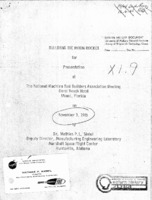
Draft of "Building the Moon Rocket."
"Building the Moon Rocket" was presented at the National Machine Tool Builders Association Meeting, Doral Beach Hotel, Miami, Florida on November 3, 1965 by Dr. Mathias P.L. Siebel, the Deputy Director, Manufacturing Engineering Laboratory. There are handwritten notes throughout. -
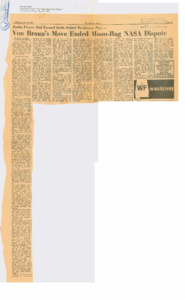
-
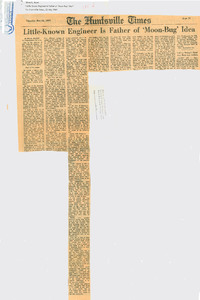
"Little known engineer is father of 'Moon-Bug' idea."
News article that details the creation and function of a lunar module or "moon bug" created by Wernher von Braun. -
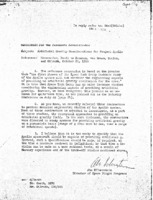
"Memorandum for the Associate Administrator: Artificial Gravity Considerations for Project Apollo."
This memorandum contains artificial gravity considerations for Project Apollo and was directed to Seamans, Wernher von Braun, Donlon, and Gilruth. Silverstein writes that he believes it is too early to tell if the Apollo spacecraft is capable of providing artificial gravity. -
"Technical survey of ABMA activities."
Handwritten notes on the document.; Archive copy is a poor photocopy. -
"Memorandum to Dr. Eugene M. Emme, Code EH, NASA Headquarters, Washington, D. C. from Bart J. Slattery, Jr., Chief of Public Affairs."
Memorandum from NASA Chief of Public Affairs to Eugine M. Emme. States that a video from Wernher von Braun are included regarding his views on the NASA program. -
"IU Presentation and Dedication."
This is a note book that contains newspaper articles and photographs about the new IBM building in Huntsville, Alabama. It also has information about the Instrument Unit for the first Saturn IB flight. There is also information about the Saturn IB Instrument Unit being barged to Kennedy Space Center.; There are 2 pages that list the articles with the title, newspaper name, writer and date.; There are six color photographs that show the dedication of the IBM building and the Instrument Unit. One photograph has Dr. Wernher von Braun standing behind the ring. Two of the photographs show the Instrument Unit on a trailer being pulled by a truck.; Preferred Citation: [Identification of item] Saturn V Collection, Dept. of Archives/Special Collections, M. Louis Salmon Library, University of Alabama in Huntsville, Huntsville, AL. -
"Space Station operations analysis using Gemini-Titan II-Agena."
Copy No. 026. Ger-10866. -
"History of Rocket Development Division."
A document recounting the history of the Rocketdyne Development Division -
Unofficial Directory: Government, Industry, and University Contacts in Management Research and Engineering.
The Preface states "This is a directory of industry, University, and Federal contacts who are involved in the areas of Management Science, Behavioral Science, Operations Research , Cybernetics, and Organizational Structure and Behavior. The listing represents a variety of disciplines -- Sociology, Psychology, Social Psychology, Psychiatry, Anthropology, Statistics, History, Public Administration, Political Science, Economics, Systems Analysis, Ecology,and General Systems Theory." -
"Technical problems in on-board checkout systems."
For the purposes of this paper, an onboard checkout system is defined as a system which is built into prime flight equipment, flies with it, and permits a checkout capability to exist during all the major phases of the test and mission life of that prime equipment. Varying degrees of capability may exist in such a system, depending on what is designed into it. This, in turn, is generally dependant on life and mission requirements of the prime equipment, degree of mission checkout required, reliability restrictions,redundancy levels, data management scheme, and equally important, state of the art . Not all checkout can be accomplished with onboard equipment. Mechanical system problems such as leak detection, for example, require techniques that cannot be remotely controlled and evaluated today. On the other hand, such things as in-flight telemetry have been used for quite a long time and will continue to be used for onboard checkout. -
"The Case for Compatibility."
"The Case for Compatibility" is a paper by Robert L. Smith, Jr., who worked in Quality and Reliability Assurance Laboratory at George C. Marshall Space Flight Center. The summary states, "Ever since the use of missiles and space launch vehicles began, questions have existed in every program regarding the similarity between upstream (e.g., manufacturing, static firing ) and launch site checkout equipment. Programs have existed which utilized nearly identical equipment for both uses; other programs have existed in which any resemblance of the equipment was probably coincidental. Many factors have entered the final decisions, not the least of which were economic and schedule considerations, and, in some instances, the organizational structure of the developer."