
Browse Items (970 total)
Sort by:
-
"Contractor Program Procedure".
Outlines various procedures for Saturn V contractors. -
Contractor Program Procedures: Contract NAS8-5608; DRL 067, Line Item 7; DRL 007, Line Item 7.
The document is a Boeing manual. It contains operating procedures and directives specifically for the Launch Sytems Branch. -
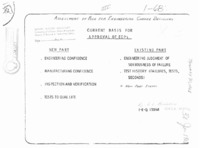
"Assessment of Risk for Engineering Change Decisions."
This document includes the current basis for approval of ECPs, fatigue life after stress reduction, and other probability and comparative risk assessments. On the first page there is an inscription, "By E.L. Bombara NASA-MSFC." -
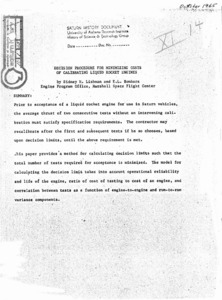
"Decision Procedure for Minimizing Costs of Calibrating Liquid Rocket Engines."
Prior to acceptance of a liquid rocket engine for use in Saturn vehicles, the average thrust of two consecutive tests without an intervening calibration must satisfy specification requirements. The contractor may recalibrate after the first and subsequent tests if he so chooses, based upon decision limits, until the above requirement is met. -
"Use of tank mounted booster pumps for providing NPSH to turbopumps operating in a radiation environment."
This paper outlines the results of a test program which was planned to demonstrate the feasibility of using a tank mounted, all-inducer, high speed liquid hydrogen booster pump to provide NPSH for the turbo pump in a reactor-powered vehicle. The cavitation problem associated with pumpoing liquid hydrogen, when used as a propellant, is further aggravated by localized heating caused by radiation from the reactor. -
"Development of LOX/RP-1 Engines for Saturn/Apollo Launch Vehicles."
The development of liquid rocket engines follow similar patterns regardless of engine size. During the development of the H-1 and F-1 engines, many problems were encountered. Methods of solving the combustion instability problem are discussed. A description is given of the major components of each engine, outlining their unique features. The requirements for an insulation cocoon are discussed. Problems associated with materials substitution are provided; also highlighted is the fact that problems occur after engine deliveries and require continued development support. Safety features incorporated on the engines are mentioned. Solution to problems encountered in flight are discussed. Upratings of both engines systems are presented graphically.; On the NASA Technical Reports Server (NTRS) unclassified. Can also be found on AIAA. -
Development of LOX/RP-1 engines for Saturn/Apollo launch vehicles.
The development of liquid rocket engines follow similar patterns regardless of engine size. During the development of the H-1 and F-1 engines, may problems were encountered. Mehtods of solving the combustion instability problem are discussed.; AIAA 4th Propulsion Joint Specialist Conference, Cleveland, Ohio, June 10-14, 1968.; Also available on NASA Technical Reports Server (NTRS) as unclassified. Can be ordered. Also on AIAA. -
"The Missile gap : a study of the formulation of military and public policy."
A thesis presented to the faculty of the Fletcher School of Law and Diplomacy. In partial fulfillment of the requirements for the Degree of Doctor of Philosophy.; This document is only the abstract of the thesis.; Document includes biographical note and table of contents.; aArchive copy is a photocopy. -
"Saturn V interface management."
The purpose of the Saturn V Interface Management System is to establish and maintain interface design compatibility between interfacing items under the design responsibility of different agencies. It provides the management tools for effective change control over the design of designated systems and equipment that have critical interface design requirements. -
"Saturn launch vehicle presentation."
Speech to be presented by C. L. Bradshaw, Deputy Director, Computation Division at Supervisor's Club, Knoxville Utilities Board. Speech praising the progress of space-based technologies and advancements. -
"Liquid Rockets."
This review indicates recent developments which have occurred in the liquid rocket engine field, special development areas associated with the liquid engines in current usage, and several trends which may be expected in the design of future advanced rocket engines. -
"Milestones in cryogenic liquid propellant rocket engines."
This paper reviews the milestones achieved with cryogenic liquid propellant rocket engines, discusses current technology improvement programs, and projects future engine designs. During the last two decades, these cryogenic rocket engines have played a major role in rocketry and achieved numerous important milestones. These engines power the Vanguard, Redstone, Thor, Atlas, and Titan I vehicles , the Saturn I and Uprated Saturn I vehicles, and will soon be employed in the Saturn V for the Apollo missions. The requirements dictated by these vehicles have necessitated growth from the 27,000-pound-thrust Vanguard engine to the 7,600,000-pound-thrust booster cluster for the Saturn V. Gains in specific impulse have also been significant. The successful application of liquid hydrogen in the Centaur and Saturn upper-stage rocket engines was a major achievement. -
"Extensions of Saturn."
This paper discusses the possible applications of Saturn vehicles to future space exploration. Potential missions utilizing Apollo derived hardware are examined. Research, development, and operations in earth orbit as well as lunar exploration, unmanned and manned interplanetary exploration are reviewed. These hypothetical missions are discussed in the context of the present and potential capability of three configurations of the Saturn vehicle; an uprated Saturn I, a three-stage Saturn V and a four-stage Saturn V. NOTE: Work presented herein was conducted by the Douglas Missiles and Space Systems Division under company-sponsored research and development funds. Therefore, the concepts and objectives described within this paper reflect the opinions of the authors and do not necessarily constitute endorsement by NASA, the Air Force, or any other U.S. Government organization. The nominal performance numbers presented are typical of the current configurations and possible future vehicle configurations. -

-
-
"Application of the Saturn V Launch Vehicle to Unmanned Scientific Exploration of the Solar System."
According to the foreword, "This paper presents the results of a twelve-week mission and systems analysis of a combined Jupiter orbiter/solar probe mission utilizing the Saturn V launch vehicle." -
"A review of the research origins of the LANCE weapon system -- Project hindsight -- Task 1 supplement."
This report includes a discussion of 57 research and exploratory development events that have been identified as contributing significantly to LANCE. Forty-six of these are research events. Eight of the research events deal with LANCE aerodynamics, four with propulsion, 24 with solid-state components used in the guidance and control system,and 10 with the research origins of the materials and manufacturing processes used in LANCE. In addition, 11 exploratory development events are identified. The principal concern of this study has been the identification of further research origins of LANCE and the 46 documented events are its major product. A further concern and obligation of this study has been to provide HINDSIGHT with some additional data on the research phenomenon including some further observations on the nature and route of research utilization.; FOREWORD: The purpose of this report is to present a survey of fundamental research contributing to the successful development of the LANCE weapon system. Included in this report are discussions of research inputs to a number of LANCE systems and technology areas. The circumstances of these research contributions to LANCE are discussed. The implications of these examples of research utilization are analyzed and some general observations and conclusions on the research payoff phenomena are given. This report was requested by the Army Missile Command as a supplemental contribution to Project HINDSIGHT.; Contract No. DA-01-021-AMC-14693(Z).; Battle Memorial Institute ,Columbus Laboratories.; RSIC-627.; Includes letter from W. Metscher, Lt. Col. to Mr. David L. Christensen dated March 14, 1969. -
"The potential bio-medical applications of Saturn nondestructive test methods."
A brief history and purpose of nondestructive methods followed by a discussion of those methods. -
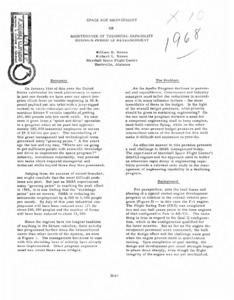
"Space age management or maintenance of technical capability during a period of retrenchment."
On January 3Ist of this year the United States celebrated its tenth anniversary in Space. In just one decade we have seen our space program climb from an humble beginning (a 30.8-pound payload put into orbit with a jury-rigged rocket) to extra-vehicular-activity and the tremendous Saturn V vehicle capable, of putting 250,000 pounds into low earth orbit. We have seen it grow from a "quick and dirty" operation to a program which at its peak had approximately 380,000 industrial employees in excess of {dollar}5.O billion per year. The marshalling of this great management and technological team generated many "growing pains". A few years ago the hue and cry was, "Where are we going to get sufficient people with scientific knowledge and drive to implement the space program?" Industry, sometimes reluctantly, was pressed into tasks which required managerial and technical skills beyond those they then possessed. -
"Trends in procurement" by Garland Buckner.
Speech delivered by Garland G. Buckner to the National Contract Management Association, Huntsville Chapter. Discusses the outdated procurement process, how its changing and how to track the trends of how its changing.