
Browse Items (970 total)
Sort by:
-
"A Practical Approach to the Optimization of the Saturn V Space Vehicle Control System Under Aerodynamic Loads."
This paper includes the equations for the bending moment of a launch vehicle with the effects of bending and sloshing dynamics. It also includes a comparison between the bending moment response envelope of the measure winds and the bending moment response of the MSFC synthetic wind profile. -
"Dynamic Loads of a Launch Vehicle Due to Inflight Winds."
Analysis of the stability and dynamic load environment of a launch vehicle resulting from atmospheric disturbances is a very complex problem. To determine the dynamic load environment of the vehicle requires an adequate description of the wind field, vehicle dynamics and control system. The essential of such a study, namely methods of analysis, wind field specification and representative vehicle response parameters for evaluation, are of equal importance. This paper is concerned with the mathematical foundations of the vehicle model and method of analysis. -
"Technical History of Saturn."
Draft of working paper. Typed with handwritten notes (title and author) and pages. Copy in MSFC files noted on first page. -
"Application of Saturn Systems to Orbit Launch Operations."
Presented at the AIAA/AAS Stepping Stones to Mars Meeting, this paper compares the "payload velocity spectrum for existing and future missions" with Saturn V capabilities. -
"Systems applications in orbital launch operations."
The objective is to examine the technical requirements and feasibility of conducting orbital launch operations with systems now in the development phase. In order to maintain realistic constraints on the analysis, the Saturn S-IVB stage has been used as an example of present stage technology. The requirements, procedures and complexity of operations for orbital assembly and launch are discussed. The primary design requirement for orbital assembly and launch operations is increased orbital stay time (from hours to days or weeks). -
Saturn AS-501 evaluation bulletin No. 1, November 14, 1967.
The findings herein are the results of the combined evaluation efforts of the various Laboratories of Research and Development Operations at MFSC, The Boeing Company, North American Rockwell/Space Division, Douglas Aircraft Company, International Business Machines, and Rocketdyne. -
"Report to the administrator, NASA on the Saturn development plan."
In anticipation of this transfer, the NASA and Department of Defense have established, an interim working agreement that provides for immediate assumption by NASA of responsibilities fortechnical management of the Saturn vehicle development. -
"Apollo Logistic Support Systems."
According to an abstract found on the page following the title page, this paper includes "one possible conceptual definition of an early Apollo Logistics Support Systems (ALSS) is presented and various payloads for the system are briefly discussed. " It also discusses the Lunar Mobile Laboratory (MOLAB) and other considerations for a lunar scientific mission. -
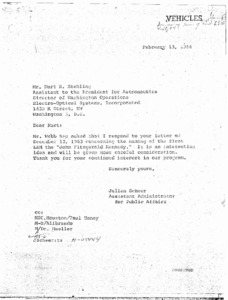
"Letter to Mr. Kurt R. Stehling."
Letter to Kurt R. Stehling from Julian Scheer answering on behalf of "Mr. Webb," stating that Kurt's "idea" was interesting and is to be given careful consideration. -
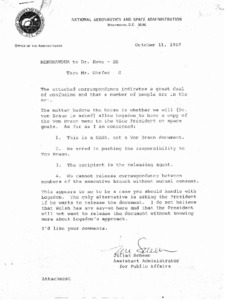
"Memorandum to Dr. Emme - EH through Mr. Shafter - G from Julian Scheer, Assistant Administrator for Public Affairs, National Aeronautics and Space Administration."
This attached correspondence indicates a great deal of confusion and that a number of people are in the act. The matter before the house is whether we will (Dr. von Braun is asked) to allow Logsdon to have a copy of the Von Braun memo to the Vice President on space goals. -
Survey of Automatic Checkout Systems for Saturn V Stages.
The Abstract states "The four checkout systems developed and utilized by the National Aeronautics and Space Administration (NASA) for acceptance checkout of the Saturn V launch vehicle stages and instrument unit are described. The vehicle's characteristics, test policies, equipment design criteria, and operational factors are reviewed. Following a general description of each checkout system, this paper presents a brief definitive description of each major subsystem test station. These test systems are used for post-manufacturing and post-static firing acceptance checkout. The section related to the S-II stage includes several representative flow diagrams and descriptions of automatic tests. To present in detail the large volume of information describing these four checkout systems would require the writing of four papers." -
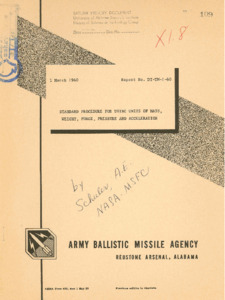
"Standard procedure for using units of mass, weight, force, pressure and acceleration."
Report No. DT-TM-1-60. ; FORWARD: The field of missiles and rockets deals with quantities of matter at various locations with different accelerations of gravity. The weight of these masses changes with gravity and the measurements of liftoff weight, fuel weight, etc., result in different values, depending on whether mass or weight units are used. Pressure and thrust are independent of the acceleration of gravity, but the instruments for measuring these values are calibrated with standard masses, producing different weight forces and calibration curves at different locations. Most sections of ABMA and other agencies or companies use pounds or kilograms as units of mass, weight or force, and the influences of different accelerations of gravity are often disregarded or treated incorrectly. These discrepancies become increasingly unacceptable with larger missiles and greater distances between operation sites. Therefore, the following Standard Procedure has been prepared to insure consistent and uniform terms and units of mass, weight, force, pressure and acceleration. All sections and individuals concerned are urged to use these units andprocedures. This is signed by Dr. Wernher von Braun, Director Development Operations Division. -
"The role of weighing in the development and firing of missile and spaceships."
Speech regarding the importance of developing and upgrading space ships and space technology. -
"Digital Transducers."
This paper outlines the major advantages of digital transducers and describes the principles and features (1) direct digital transducers, (2) indirect digital transducers, (3) quasi-digital transducers, and (4) A to D transducers. -
"Lunar Applications of a Spent S-IVB/IU stage (LASS)."
Support of lunar exploration missions is a major consideration in future space program planning. The spent Saturn v/S-IVB/IU can support both lunar - orbit and lunar -landing operations. This paper investigates lunar applications of the spent stage, and incorporates data generated during Company-funded studies. Investigated here is the feasibility of using a launch vehicle employing standard S-IC and S-I1 boost stages to deliver a modified S-IVB/IU and large discretionary payloads to a lunar orbit (LASSO) and/or the lunar surface (LASS). Operations in Earth orbit and direct-ascent trajectories are examined, and consideration is given to the use of the spent stage as a shelter in a manner similar to the presently planned Earth orbital workshop operations. Both the LASSO and LASS concepts are recommended for consideration in future lunar exploration plans. These concepts are capable of placing a gross wet weight of 101,400 lb in lunar orbit or landing 63,580 lb on the lunar surface respectively. The effective payload capability can be enhanced by proper integration of translunar mission subsystems with the subsystems required for lunar orbit or surface operations. The vehicles can be available within 3 years, with current-technology hardware sufficient for performing the missions described.; Douglas Paper No. 4256. -
"Highlights of General Electric's Participation in the U.S. Missile and Space Program."
Press release covering the system of functional management in NASA. -
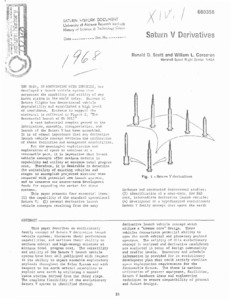
"Saturn V derivatives."
This paper desciibes an evolutionary family concept of !h turn V derivative launch vehicle systems, discusses their performance capabilities, and outlines their ability to perform orbital and hlgh-energy missions at minimum total program cost. -
"Facility Design for Handling Liquid Hydrogen for Space Vehicle Applications."
Presented to German Society for Rocket Technology & Astronautics.Essay discussing the capabilities of liquid hydrogen as fuel. -
"A Comparison of Advanced Cooling Techniques for Rocket Thrust Chambers".
The document is a technical paper for Astronautics and Aerospace Engineering Magazine.The copy has handwritten notes that appear to be for revisions. The abstract states "In the early days of rocket propulsion, two primary methods were employed for cooling the walls of thrust chambers. These were uncooled metal chambers where the heat sink capacity of the chamber and nozzle wall materials limited the operating duration, and regeneratively cooled chambers where one of the propellants was circulated in a cooling jacket which constituted the chamber wall. Today, there are at least fourteen different methods with variations for cooling the combustion devices and nozzles of liquid propellant, solid propellant, and/or nuclear rocket propulsion engines. It is the intent of this paper to examine these methods, to describe for each the useful range of operating conditions, as well as present and likely future applications, to define their limitations and associated problems. Emphasis is primarily placed on liquid rocket engines." -
"Planning for strategic deterrence in the 1970s."
Article discussing money-resources and the budget.