
Browse Items (970 total)
Sort by:
-
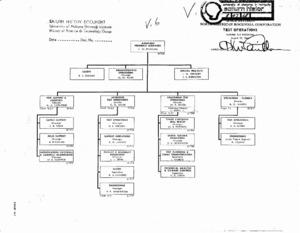
"Test operations:" Organization Chart.
Organization Chart of the North American Rockwell Test Operations. -
"Test procedure validation by computer simulation."
Digital computer simulation of the Saturn I Instrument Unit electrical networks was accomplished using the Discrete Network Simulation programs. The schematics were analyzed and a logic model prepared which consisted of a series of Boolean equations. The test procedures, which are written in the Acceptance, Test, or Launch Language (ATOLL), consist of a sequential set of computer instructions for the RCA llOA checkout computer to control the operation of the electrical networks. The procedures also contain the predicted results for each operation. The driving functions for the simulation of the model are generated from the ATOLL test tape by the Input Generator Program. The time sequenced operation of the networks is indicatedby the output from the simulation program in addition to the number of times each component in the system changes state. The results of the simulation are compared to the test procedure predictions on the ATOLL tape by the Comparator Program and any differences are listed. The Comparator Program also lists any component which did not change state at least once. -
"The Astrodynamicist's Role vis-a-vis the Systems Engineer."
By J. Reynolds Duncan, Jr., Aerospace Engineer, NASA Marshall Space Flight Center, Huntsville, Alabama. AIAA 7th Aerospace Sciences Meeting, New York City, New York, January 20 - 22, 1969. -
"The Case for Compatibility."
"The Case for Compatibility" is a paper by Robert L. Smith, Jr., who worked in Quality and Reliability Assurance Laboratory at George C. Marshall Space Flight Center. The summary states, "Ever since the use of missiles and space launch vehicles began, questions have existed in every program regarding the similarity between upstream (e.g., manufacturing, static firing ) and launch site checkout equipment. Programs have existed which utilized nearly identical equipment for both uses; other programs have existed in which any resemblance of the equipment was probably coincidental. Many factors have entered the final decisions, not the least of which were economic and schedule considerations, and, in some instances, the organizational structure of the developer." -
"The Challenge of Change vs the Control of the Process."
The introduction states, "This paper is designed to present the Rocketdyne engine program as it applies to the Saturn launch vehicles and will apply to the Apollo program of manned flight to the moon (Fig. 1). The vehicle that will launch this flight is the Saturn V, the largest and most powerful of the Saturn family. This vehicle, 362 feet tall and 33 feet in diameter, will be capable of sending a 45-ton payload to the moon or placing a 120-ton payload in earth orbit. Five F-1 engines power the first stage of the Saturn V; five J-2 engines, the second stage; and one J-2 engine, the third stage. The thrust of the first-stage engines alone will be equivalent to 160 million horsepower. Both of these engines, the F-1 and the J-2, were designed at, and are currently being produced by Rocketdyne." -
"The Common Bulkhead for the Saturn S-II Vehicle: Unique Manufacturing Effort Adds to Space-Age Hardware Technology".
Presentation regarding the construction of Apollo and Saturn rockets. -
"The development of a bonded common bulkhead for Saturn."
A Part of the development of the Saturn S-IV/S-IVB stage the Douglas Aircraft Company has pioneered in the development of the cryogenic common bulkhead. The term common bulkhead is derived from the design function of the bulkhead, which is to separate the two cryogenics, liquid hydrogen and liquid oxygen, in a single tank, thereby shortening the stage and eliminating the necessity for two separate bulkheads and the associated interstage structure. The common bulkhead is structurally adequate to withstand both the thermal and the pressure loads from both the hydrogen and the oxygen tanks, and it has sufficient insulation properties to prevent the liquid hydrogen from freezing the liquid oxygen. Another benefit from the common bulkhead is that it permits a reduction in the total length of the vehicle, thereby reducing the bending moments. -
"The development of a checkout language : ATOLL."
ATOLL was developed to fulfill the requirements for a common computer language that could be used by the test engineers for launch and factory checkout. "ATOLL" is the abbreviated name for Acceptance, Test, Or Launch Language. -
"The Development of Servovalves with Improved Reliability for Space Vehicles."
Considerations for improvement in the reliability of the Saturn engine gimbal servosystems are briefly covered. The Saturn I servovalves operate with increased electrical input power. The Saturn V vehicle stages will use mechanical feedback actuators with increased electrical input power, larger orifices and nozzle sizes, larger torque motor wire size, and greater spool driving forces. -
"The development of the Saturn system safety program."
This paper describes the major highlights or milestones passed in the development of a System Safety Program at MSFC since early 1967. it discusses accomplishments, problems resolved, and decisions made for Apollo Saturn vehicles AS-501 and AS-502, and projects that are to be accomplished on future Saturn vehicles. -
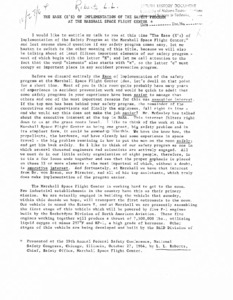
"The ease (E's) of implementation of the Safety Program at the Marshall Space Flight Center."
Presented at the 19th Annual Federal Safety Conference, National Safety Congress, Chicago, Illinois. A rundown of the new safety protocols, chiefly favoring the letter 'E.' -
"The history of Army missile development."
Published as "Army Missile Development," Army Information Digest, XI. Establishes the development and history of weaponized rocket ordenance. -

"The IBM Clean Room Comes of Age."
A history of the IBM's Space Systems Center clean room and a description of its uses. -
"The impact of manufacturing on design as related to accessibility."
The purpose of this paper is to emphasize the need for accessibility in the assembly and maintenance of spacecraft. This is especially pertinent because accessibility to subsystems for replacement, repair, and maintenance has proven to be one of the more costly phases of preflight preparation. The most successful programs in this day and age have been when the design and manufacturing engineers work side by side around a mockup where solutions to the problems can be visually seen and solved, keeping in mind the assembly as related to accessibility. Therefore, it will be shown that in order to overcome the difficulties, designers should adapt a hard, fast ground rule that each unit must be accessible and individually removable without disturbing the other units.; Aeronautic and Space Engineering and Manufacturing Meeting, Los Angeles, Calif. Oct. 7 - 11, 1968. -
"The Influence of Apollo/Saturn V Launch Operations on Lunar Site Selection: Case 330."
This paper presents some relationships between Apollo/Saturn V launch operations and multiple lunar landing sites, including the means by which site selection could facilitate launch operations. -
"The instrumentation of space vehicle in connection with the successful Saturn flight tests."
Presented on September 21, 1962, at the Eleventh Tagung Der Deutchen Raketen - Gesellschaft, Koblenz, West Germany. Instrumentation sf the Saturn space vehicle represents a considerable effort during the development phase, for proper design evaluatian of this new configuration, its propulsion system, and its structure and control characteristics, an unprecedented number of measurements are required to be carried onboard and to be recovered, These measurements are expected to work properly and to furnish the design engineer with information that is not available by ground testing, -
"The Iterative Guidance Law for Saturn."
Summary: "Based on Lawden's equation, semi-explicit,'iterative' Saturn guidance equations are derived, many were successfully flight tested on Saturn I and analyzed for the main Apollo mission and other applications applications." -
"The J-2 Liquid Hydrogen Rocket Engine."
The 5-2 high-energy liquid propellant rocket engine (~i~. l), a large engine producing 200,000 pounds of thrust at altitude conditions, burns liquid hydrogen and liquid oxygen to produce the necessary high specific impulse for practical space use. Rocketdyne, a Division of North American Aviation, Inc., is developing the engine for the George C. Marshall Space Flight Center, Xfi. The first use of the engine will be in the upper stages of the Saturn vehicles. Five engines will be used for the second, S-I1 stage of the Saturn V, and one will power the S-IVB third stage of the Saturn V and S-ISTI second stage of 'the Saturn IB; Original is a photocopy on onion skin. -
"The Missile gap : a study of the formulation of military and public policy."
A thesis presented to the faculty of the Fletcher School of Law and Diplomacy. In partial fulfillment of the requirements for the Degree of Doctor of Philosophy.; This document is only the abstract of the thesis.; Document includes biographical note and table of contents.; aArchive copy is a photocopy. -
"The NASA/Grumman Apollo lunar module"
Handwritten in pencil on the document. Describes the layout and function of various sections of the Apollo lunar module.