
Browse Items (970 total)
Sort by:
-
"Report on the Saturn-Apollo program."
Presented to ACHEMA Congress and European Meeting of Chemical Engineering 1967, Frankfurt, Germany, June 21, 1967 by Dr. Eberhard Rees.; Includes slide numbers. -
"Memorandum : technical information summary concerning Saturn I vehicle SA-6."
This memorandum outlines, through a series of sketches with accompanying text, the general features of the sixth SATURN I launch vehicle. The sketches are devoted primarily to the launch vehicle but also presents limited information on the spacecraft, the launch facility and launch preparations. The information presented in this summary was compiled through the efforts of R&DO personnel from P&VE, AERO and ASTR. -
"First Hundred Seconds."
Keynote address at National Aeronautics and Space Administration to the American Rocket Society Conference on Launch Vehicle Structures and Materials. Speech focuses on problems facing the structure of Saturn rockets and other space vehicles. -
Source credibility and personal influence in three contexts : a study of dyadic communication in a complex aerospace organization.
Abstract to "A thesis submitted to the faculty of Purdue University fo Gary Marshall Richetto in partial fulfillment of the requirements for the degree of Doctor of Philosophy, January 1969".; Handwritten note on front page: Return to Internal Communication, Room 223, 4202. -
Meteorites and ballistics.
Technical Report surrounding meteorites and their ballistics. -
"The ease (E's) of implementation of the Safety Program at the Marshall Space Flight Center."
Presented at the 19th Annual Federal Safety Conference, National Safety Congress, Chicago, Illinois. A rundown of the new safety protocols, chiefly favoring the letter 'E.' -
"The development of a bonded common bulkhead for Saturn."
A Part of the development of the Saturn S-IV/S-IVB stage the Douglas Aircraft Company has pioneered in the development of the cryogenic common bulkhead. The term common bulkhead is derived from the design function of the bulkhead, which is to separate the two cryogenics, liquid hydrogen and liquid oxygen, in a single tank, thereby shortening the stage and eliminating the necessity for two separate bulkheads and the associated interstage structure. The common bulkhead is structurally adequate to withstand both the thermal and the pressure loads from both the hydrogen and the oxygen tanks, and it has sufficient insulation properties to prevent the liquid hydrogen from freezing the liquid oxygen. Another benefit from the common bulkhead is that it permits a reduction in the total length of the vehicle, thereby reducing the bending moments. -
"Development and Utilization of Computer and Test Programs for Checkout of Space Vehicles."
A computer system was designed to allow test engineers to progressively employ automation in the checkout of the Uprated Saturn I and Saturn V space vehicle programs and still allow manual control of the checkout process. A two-computer system was selected by National Aeronautics and Space Administration, and the International Business Machines Corporation was chosen to provide the programming engineering necessary to implement these objectives. Space vehicle checkout, prior to launch, may be characterized by controlling, monitoring, and testing the vehicle and its subsystems through the use of ground support equipment (GSE).; IBM Huntsville Library.; Presented at AIAA Conference, XVIIth International Astronautical Congress, Madrid, Spain, October 10-15, 1966 by Edward A. Robin, Manager, Vehicle Test Programming Department. -
"Telemetry system for Saturn S-I stage development."
The telemetry system used on the Saturn S-I stage for the transmission of vehicle test data is described. Multiplex and modulationtechniques such as PAM/FM/FM, SS/FM and PGM are used in the system. The diverse data requirements for developing the eight-engineliquid-fueled stage necessitated the use of a combination of severalmodulation techniques to efficiently handle the data. A cursory comparisonis made of the merits of each technique. Physical and electricalrequirements and characteristics of the system are outlined. -
"Some computer applications in Saturn stage checkout."
This paper discusses a number of interesting applications of digital computers in the checkout of individual Saturn stages and in the prelaunch checkout of the complete Saturn vehicle. It discusses the concepts of automation in Saturn checkout, the unique two-computer mode of operation at the launch site and the operations of the high speed data link connecting the two computers. Also discussed are the functions of the computer while propellants are loaded automatically on one of the stages; the functions of the display computer in the newest and largest Saturn display system, and operations and utilization of the Digital Events Evaluator, the main recording device utilized during stage checkout. -
"S-IVB Saturn high energy upper stage and its development."
The development of carrier rockets For manned space missions has been one of the major activities in the aerospace field during the past decade. The early space efforts were made possible by the existence of large ballistics missiles. It soon became obvious that the delivery of weapons and the launch of large spacecraft could not be combined into one operational system in an efficient way; therefore, a family of spacecraft boosters had to be created. -
"The role of the S-IVB in the Apollo and past Apollo programs."
Douglas Paper No. 4396.; Prepared by Ludwig Roth, Director, Saturn/Apollo Program Extension, Douglas Aircraft Company.; Presented to 16th Annual Conference of the Hermann Oberth Society. Discusses the role of the Apollo rocket after the Apollo program has concluded. -
"Problems in cryogenic pump design for space application."
Report detailing the problems surrounding cryogenic pump design for space travel and missions. -
"The program manager's problem"
Included in "First Annual Logistics Management Symposium," Huntsville, Alabama; Archive copy is a poor photocopy. Describes the stages of rocket-development/launch and the logistical problems with each. -
"Telegraphic message : inspection requirements for S-II-1 and S-II-2 at KSC."
Photocopy of an inspection list requirements for S-II-1 and S-II-2. -
"Recoverable S-IB."
The paper deals with the selection of a simple recovery system for the Saturn IB first stage. As an introduction to the discussion on recovery system objectives, a plot of the expected trajectory is presented. This is followed by a statement which lists the necessary steps which must be followed to develop a recovery program. -
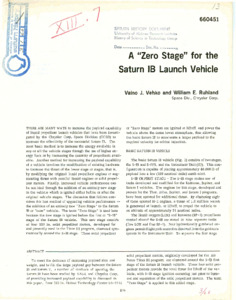
"A 'Zero Stage' for the Saturn IB Launch Vehicle."
To meet the demands of increasing payload size and weight, and to fill the large payload gap between the Saturn IB and Saturn V, a number of methods of uprating the Saturn IB have been studied by NASA and Chrysler Corp. of providing increased payload capability is discussed in this paper. Four 120 in. United Technology Center UA-1205 solid propellant motors, originally developed for the Air Force Titan III program, are clustered around the S-IB first stage of the Saturn IB launch vehicle. These four solid propellant motors provide the total thrust for liftoff of the vehicle, with S-IB stage ignition occurring just prior to burn-out and separation of the solid propellant motors. The term "Zero Stage" is applied to this added stage. -
"Appendix to Chapter II of a Survey of Various Vehicle Systems for the Manned Lunar Landing Mission."
This appendix includes various diagrams of orbital launch vehicles, graphs of propellant and tankweight, returnpayload, and lift-off requirements, velocity requirements for a manned lunar mission, multiple drawings for the Saturn C-3 vehicles, lunar mission payloads, information of vehicle size, and a summary of the Saturn C-3 lunar mission. -
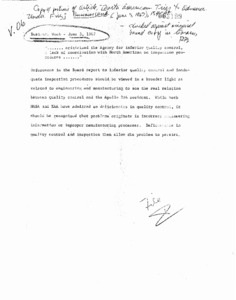
"Memorandum, routing slip, and letter by Harold G. Russell, Colonel, USAF, concerning the Business Week article 'North American tries to advance under fire.'"
This document also contains part of the Business Week article "North American tries to advance under fire", (June 3, 1967) pages 154 to 162. The complete article can be found at the UAH Library in microfilm format.; The document has handwritten notes and is a poor photocopy. -
"The use of wind shears in the design of aerospace vehicles."
Prepared for presentation at the 23rd Meeting of the Structures and Materials Panel, AGARD, October 4-11,1966, ONERA, Paris, France.; ABSTRACT: The relative influence of various wind profile properties and disturbances on launch vehicle flight dynamic response is studied. Particular emphasis is placed on the influence of wind shears and turbulence on dynamic response during the boost phase of the flight. Four hundred and seven individual detailed (Jimsphere) wind profiles are the primary wind inputs for this analysis. Time response of the vehicle to each profile is computed and a statistical evaluation of the results made. Results are obtained for the Saturn V space vehicle and conclusions drawn as to the relative influence of wind shears and turbulence vs the degree of refinement of the dynamic model of the space vehicle.