
Browse Items (970 total)
Sort by:
-
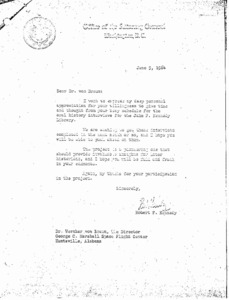
"Letter to Dr. Wernher von Braun."
This letter asks for an oral history interview from von Braun concerning his conversations and visits with President John F. Kennedy.; Archive copy is a very poor copy. -
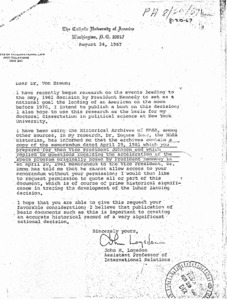
"Letter to Dr. Wernher von Braun."
Letter to Wernher von Braun from John M. Logsdon asking that Braun approves a request to quote his memorandum in his book. -
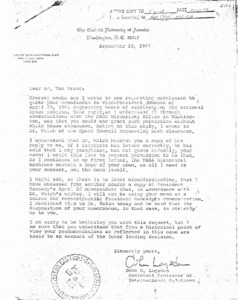
"Letter to Dr. Wernher von Braun."
Letter to Wernher von Braun from John M. Logsdon reiterating his request to use Braun's memorandum in his book as well as apologizing for any miscommunication. -
"Letter to Dr. Wernher von Braun."
Archive copy is a poor photocopy. Unable to read. -
"Letter to Mr. David Christensen."
Letter to David L. Christensen from Ralph I. Villers responding to a request from Christiansen. Enclosed is the material requested. -
"Letter to Mr. David L. Christensen."
Letter David L. Christensen from W. Angele responding to a pervious request. -
"Letter to Mr. David L. Christensen."
Letter to David L. Christensen from Ralph I. Villers responding to a request from Christiansen. Enclosed is the material requested. -
"Letter to Mr. Frank L. Murphy."
Letter to Frank L. Murphy from David L. Christensen informing an awarding of a contract as well sa requesting documents. -
"Letter to Mr. D. R. Spotz."
Letter to D. R. Spotz from David L. Christensen informing an awarding of a contract as well sa requesting documents. -
"Letter to Mr. Walter D. Sohier."
This letter was attached to the edited transcript of the interview for the John F. Kennedy Library.; Archive copy is a photocopy. -
"Letter to Professor John M. Logsdon."
Letter to Professor Logsdon from E. C. Welcsh denying Logsdon's request to quote Wernher von Braun and President Kennedy from their memorandums. -
"IU/S-IVB Forward Skirt Orbital and Translunar Thermal Analyses."
This report determines the maximum and minimum solar and terrestrial thermal energy incident and absorbed by Saturn IB/V vehicles in earth orbit and translunar travel. The influence' of this external energy on the Instrument Unit Thermal Conditioning System performance, and consequently its adequacy to maintain the electronic packages at acceptable temperature limits is ascertained. Conclusions are: a) Methanol/water coolant temperature will deviate from 111 specifications only during translunar cold flights. However, adequate thermal conditioning of the electronic equipment would still be maintained. b) Instrument Unit missions exceeding 6 1/2 hours, or electronic packages heat dissipation magnitudes lower than 3 kw or higher than 8.5 kw, should be reviewed to ascertain thermal compatibility. -
"The J-2 Liquid Hydrogen Rocket Engine."
The 5-2 high-energy liquid propellant rocket engine (~i~. l), a large engine producing 200,000 pounds of thrust at altitude conditions, burns liquid hydrogen and liquid oxygen to produce the necessary high specific impulse for practical space use. Rocketdyne, a Division of North American Aviation, Inc., is developing the engine for the George C. Marshall Space Flight Center, Xfi. The first use of the engine will be in the upper stages of the Saturn vehicles. Five engines will be used for the second, S-I1 stage of the Saturn V, and one will power the S-IVB third stage of the Saturn V and S-ISTI second stage of 'the Saturn IB; Original is a photocopy on onion skin. -
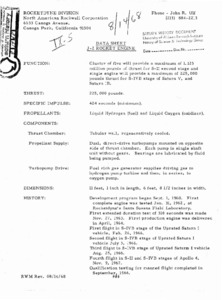
"Data Sheet J-2 Rocket Engine."
A datasheet describing the function of the J-2 rocket engine. -
"Memorandum: John F. Kennedy Memorial Library in Massachusetts."
Memorandum from Wernher von Braun regarding a request made for NASA's cooperation to obtain resources from the Kennedy Memorial Library. -
"John F. Kennedy Space Center: A Selective Bibliography."
This is primarily the bibliography of an organization located in an area which was once inhabited by more beasts and birds than people. The evolution of the Kennedy Space Center cea be traced from the Army Ballistic Missile Agency and Marshall Space Flight Center, Huntsville, Alabama. That period is fully covered by Historical Origins of NASA's Launch Operations Center to July 1, 1962. -
"John F. Kennedy Space Center: A Selective Bibliography."
This is primarily the bibliography of an organization located in an area which was once inhabited by more baasts and birds than people. The evolution of the Kennedy Space Center :LS :A .ceable from the Army Ballistic Missile Agency and Marshall Space Flight Center, Huntsville, Alabama. That period is fully covered by Historical Origins of NRSB's Launch epesons Center to July 1, 1962. However, because of the core working relationship between the Kennedy Space Center and the Air Force Eastern Test Range articies showing evolution of the Air Force Missile Test Center are included. -
"Juno V Space Vehicle Development Program (Phase I): Booster Feasibility Demonstration."
The initial phase of the JUNO V space vehicle development program, as presented herein, provides for a static demonstration and a total of four flight feasibility tests. The latter two flights will give the U.S. its first payload capability in excess of 10,000 lb in mid 1961. The objective of the overall program is to provide a reliable, economical, and flexible carrier vehicle with relatively large payload capability for orbital and space missions at the earliest possible date. -
"Juno V Transportation Feasibility Study (U)."
The purpose of this report is to present an investigation to determine the feasible, practical and economical method of transporting the JUNO V thrust unit. This includes the first phase of transporting between Fabrication Laboratory, Systems Analysis and Reliability Laboratory and to the test stand, as well as the later phases, onto the Redstone Arsenal loading docks and from there down the Tennessee, Ohio and Mississippi Rivers to the Atlantic Missile Range, Florida.; Transportation and Packaging Section, Systems Support Equipment Laboratory. -
"Juno V Space Vehicle Development Program."
This report io the second in a scrics of reports on the JUNO V Space I Vehicle Development Program and indicates the present status of the overall I program. The objective of the overall program is to provide a reliable, economical, and flexible carrier vehicle with relatively large payload capability for orbital and space missions at the earliest possible date.