
Browse Items (970 total)
Sort by:
-
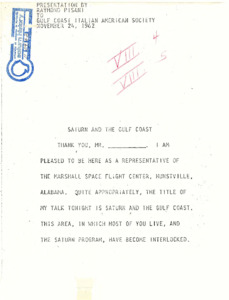
"Saturn and the Gulf Coast."
Presentation about the Saturn program and its purpose in the gulf coast. -
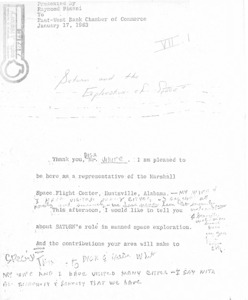
"Saturn and the exploration of space."
Presentation Raymond Pisani to the East-West Bank Chamber of Commerce regarding the Saturn project's roll in space exploration and what contrabutions the East-West Bank can make in that area. -
"Saturn instrumentation systems."
Paper to be presented at the Third International Flight Test Instrumentation Symposium College of Aeronautics. A brief description of the Saturn vehicles is given, delineating the makeup of and differences between the Saturn I, Saturn IB, and Saturn V. -
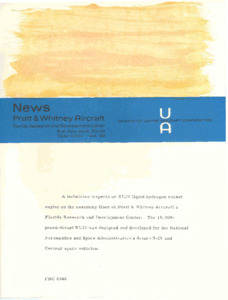
"Technician inspects an RL10 liquid hydrogen engine."
A technician inspects an RLlO liquid hydrogen rocket engine OD the assembly floor. of Pratt & Whitney Aircraft's Florida Research and Development Center. The 115,000-pound-thrust RLlO was designed and developed for the National Aeronautics and Space Administration's Saturn S-IV azld Centaur space vehicles. -
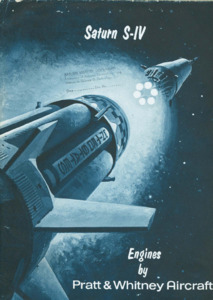
"Saturn S-IV engines."
Folder of information. -
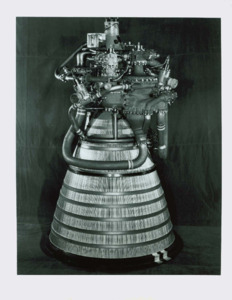
"Pratt & Whitney Aircraft RL10 liquid hydrogen rocket engine."
Photograph of a liquid hydrogen rocket engine. -
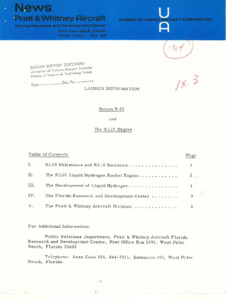
"Launch Information: Saturn S-IV and the RL10 Engine."
The RL10, which powers the National Aeronautics and Space Administration' s Saturn S-IV, is the newest propulsion system to be put to work in advancing our nation's space effortr On November 27, 1963, a pair of RLlO's successfully powered a five-ton Centaur space vehicle in earth orbit in the first flight demonstration of the outer space powerplant which uses high-nenergy liquid hydrogen as fuel. A six-engine cluster of RLlO' s, generating a total of 90, 000 pounds of thrust, powers the Saturn S-IV stage. The 15, 000 pound-thrust engine was designed and developed for NASA's Mar shall Space Flight Center at Pratt & Whitney Aircraft's Florida Research and Development Center, 20 miles northwest of West Palm Beach. -
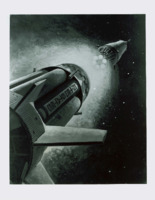
Artist's Conception of the RL10-powered Saturn S-IV Stage.
This artist's rendering of the RL10-powered Saturn S-IV stage is depicted as heading toward deep space after separation from the booster. The drawing is accompanied with a brief description of the Saturn S-IV. -
"Transportation of Douglas Saturn S-IVB stages."
Presented to the American Society of Civil Engineers by R. W. Prentice, manager, Saturn Logistics Support, Douglas Aircraft Company Inc., Missile & Space Systems Division, Space Systems Center, Huntington Beach, California. This paper describes the significant events and equipment associated with transporting the Douglas Aircraft Company, Inc., built Saturn S-IVB stage from stage fabrication at Huntington Beach, California, to the Sacramento Test Center and to the Kennedy Space Center. Descriptions and illustrations of the transportation vehicles and major ground support and instrumentation equipment are presented for a more comprehensive understanding of the transportation problem. -
"Post-Apollo space program report: directions for the future."
Summary of President's Advisory Committee report to the President's Space Task Group. -
"Propulsion and Vehicle Engineering Laboratory monthly progress report, December."
Monthly progress report of the month of December, 1968. -
Press Release : S-IC simulator--Immediate release.
Huntsville, Ala. -- NASA Marshall Space Flight Center engineers and scientists will soon begin using a giant Saturn V booster simulator in making various tests of equipment and facilities here and at Michoud Operations, Mississippi Test Operations and Cape Kennedy. -
"Master list of projects."
Note attached to document to Mr. Christensen from William D. Putnam. List of projects ordered by criteria. -
"Engineering : Saturn S-II program"
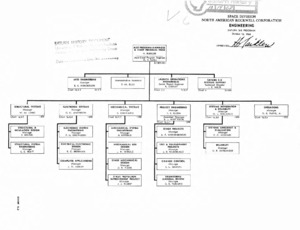
Organizational chart diagram of the North American Rockwell Corporation Engineering division: 10-14-1968 -
"Saturn S-IVB quarterly technical progress report."
Douglas Aircraft Company Report DAC-56533, Saturn S-IVB Quarterly Technical Progress Report, covers design and development progress on the Saturn IB and Saturn V configurations of the S-IVB stage during January, February, and March 1967. This report is prepared for the National Aeronautics and Space Administration under Contract NAS7-01.; Prepared for National Aeronautics and Space Administration under NASA contract NAS7-101.; Approved by A. P. O'Neal, Director, Saturn Development Engineering. -
"Space vehicle test stands."
One of the pacing items in this Nation's accelerated space program is the construction of facilities for the manufacture, development, testing, check-out, transportation and launching of space vehicles. Behind each successful launching are countless hours of effort in development, quality and reliability checks and tests of engines, components, boosters, and stacked stages; including pressure tests, cold-flow tests and hot firing (or static) tests; all to assure the safest possible trip for the men or instrumentation in the space craft. -
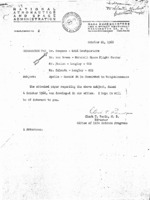
Memorandum to Dr. Seamans, Dr. von Braun, Mr. Donlon, and Mr. Gilruth.
The memorandum contains a paper titled, "Apollo - Should It Be Committed to Weightlessness." This paper contains information about artificial gravity and the effects of prolonged periods of weightlessness on human beings and chimpanzees. -
"MSFC specifications, standards and procedures microfiche reference file index."
This reference file has been prepared in order to identify data contained on microfiche in the MS-D Repository. This index is divided into three sections. Section I - MSFC Specifications, Section II - MSFC Standards, and Section III - MSFC Procedures. This listing will be kept up-to-date and will be published monthly.; Prepared by: RCA Service Company.; April 15, 1968.; Rpt. #005 (handwritten on the cover). -
"Where are we going in space management."
Presented to the First Space Congress, Cocoa Beach, Florida, April 21, 1964 by Joseph H. Reed, Chief, Management Analysis Office, Executive Staff, Marshall Space Flight Center at the request of the Associate Administrator for Manned Space Flight, NASA -
"Approach in Achieving High Reliability for Saturn Class Vehicles."
This paper focuses on an approach for achieving high reliability within the Navigation, Guidance, and Control systems of the Saturn class launch vehicles.