
Browse Items (970 total)
Sort by:
-
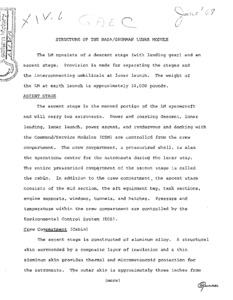
"Structure of the NASA/Grumman lunar module."
Describes the structure and function of each part of the NASA Lunar Module -
"Survey of Saturn stage test and checkout computer program development."
This survey of the Saturn Stage Test and Checkout Computer Program Development contains a summary description of the systems developed for factory and static test of the stages of the SATURN IB and SATURN V Vehicles. The responsibilities of the MSFC and stage contractor organizations that are involved in test and checkout computer program development are briefly described. The test and checkout hardware and software (computer program) systems are given for each stage and for each site where tests are conducted. The systems and procedures that are used for program production verification, documentation, and change control required for the implementation of planned computer programs are included. Notes are included in the report to indicate what material is missing or incomplete. No attempt has been made to draw any conclusions regarding the automatic test and checkout systems being developed for each stage and the manner in which the efforts are organized, scheduled, and implemented. This document has been based on material provided by stage contractors and by components of MSFC through May 1, 1966. COMPUTER SYSTEMS SECTION. VEHICLE SYSTEMS INTEGRATION BRANCH. VEHICLE SYSTEMS CHECKOUT DIVISION.; SR-QUAL-66-3. -

"System description for Saturn vehicle (SA-1 through SA-4)."
Missing pages iv, 3, 6 to 8. Photocopy of files containing sections of the project. -
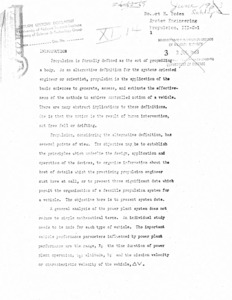
"System engineering propulsion, III-C-1."
Page numbering is inconsistent; there are no pages numbered 14 - 17. Some pages have handwritten numbers, others have no numbers at all.; The print quality of many pages is poor. Discusses the definition and function of propulsion as well as how to most effectively employ it . -
"System safety handbook."
The testing of a hardware system consists of' subjecting it to carefully controlled operating conditions for the purpose of demonstrating that this system performs its function properly. -
"Systems applications in orbital launch operations."
The objective is to examine the technical requirements and feasibility of conducting orbital launch operations with systems now in the development phase. In order to maintain realistic constraints on the analysis, the Saturn S-IVB stage has been used as an example of present stage technology. The requirements, procedures and complexity of operations for orbital assembly and launch are discussed. The primary design requirement for orbital assembly and launch operations is increased orbital stay time (from hours to days or weeks). -
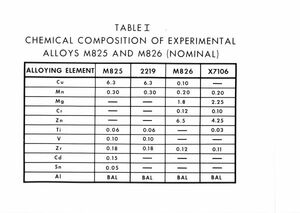
"Table I : chemical composition of experimental alloys."
8 x 10 inch black and white photograph of a table reperesenting the chemical composition of alloys M825 and M826. -
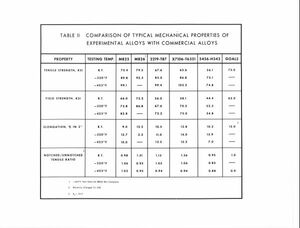
"Table II : comparison of typical mechanical properties of experimental alloys with commercial alloys."
8 x 10 inch black and white photograph of a table comparing the tensile strength of each alloy in relation to a desired goal. -
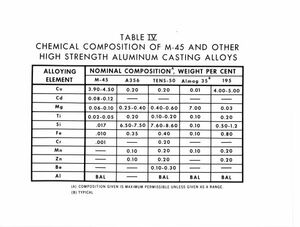
"Table IV : chemical composition of M-45 and other high strength aluminum casting alloys."
8 x 10 inch black and white photograph of a graph displaying different alloys and comparing their 'nominal composition weight per cent' to one another. -
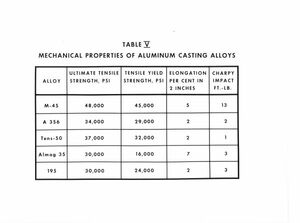
"Table V : mechanical properties of aluminum casting alloys."
8 x 10 inch black and white photograph of a table detailing the tensile strength, tensile yeild, elongation per cent and charpy impact of alloys. -
"Technical facilities & equipment digest."
This document portrays the capability of technical facilities and equipment at the George C, Marshall Space Flight Center (MSFC) , one of three basic field centers under the NASA Office of Manned Space Flight. -
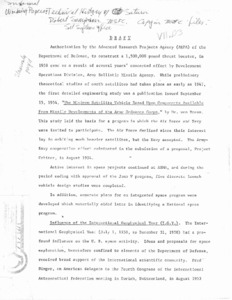
"Technical History of Saturn."
Draft of working paper. Typed with handwritten notes (title and author) and pages. Copy in MSFC files noted on first page. -
"Technical Information Summary Apollo 8 (AS-503) Apollo Saturn V Space Vehicle."
This document is prepared jointly by the Marshall Space Flight Center laboratories R-AERO-P, R-ASTR -S, and R-P&VE-VN . The document presents a brief and concise description of the AS-503 Apollo Saturn Space Vehicle. Where necessary, for clarification, additional related information has been included. It is not the intent of this document to completely define the Space Vehicle or its systems and subsystems in detail. The information presented herein, by text and sketches, describes launch preparation activities, launch facilities, and the space vehicle. This information permits the reader to follow the space vehicle sequence of events beginning a few hours prior to liftoff to its journey into space. -
"Technical information summary Apollo-10 (AS-505) Apollo Saturn V space vehicle."
The document presents a brief and concise description of the AS-505 Apollo Saturn Space Vehicle. Where necessary, for clarification, additional related information has been included. -
"Technical Information Summary Apollo-9 (AS-504) Apollo Saturn V Space Vehicle."
The document presents a brief and concise description of the Apollo 9 Saturn Space Vehicle. -
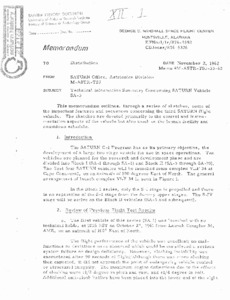
"Technical information summary concerning Saturn vehicle SA-3."
This memorandum outlines, through a series of sketches, some of the important features and sequences concerning the third SATURN flight vehicle. The sketches are devoted primarily to the control and instrumentation aspects of the vehicle but also touch on the launch facility and countdown schedule. -
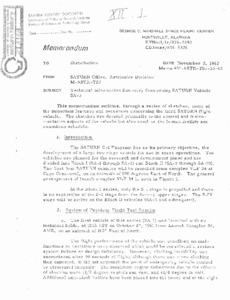
"Technical information summary concerning Saturn vehicle SA-3."
This memorandum outlines, through a series of sketches, some of the important features and sequences concerning the third SATURN flight vehicle. The sketches are devoted primarily to the control and instrumentation aspects of the vehicle but also touch on the launch facility and countdown schedule. -
"Technical problems in on-board checkout systems."
For the purposes of this paper, an onboard checkout system is defined as a system which is built into prime flight equipment, flies with it, and permits a checkout capability to exist during all the major phases of the test and mission life of that prime equipment. Varying degrees of capability may exist in such a system, depending on what is designed into it. This, in turn, is generally dependant on life and mission requirements of the prime equipment, degree of mission checkout required, reliability restrictions,redundancy levels, data management scheme, and equally important, state of the art . Not all checkout can be accomplished with onboard equipment. Mechanical system problems such as leak detection, for example, require techniques that cannot be remotely controlled and evaluated today. On the other hand, such things as in-flight telemetry have been used for quite a long time and will continue to be used for onboard checkout. -
"Technical survey of ABMA activities."
Handwritten notes on the document.; Archive copy is a poor photocopy. -
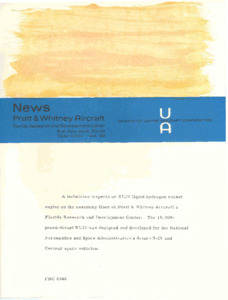
"Technician inspects an RL10 liquid hydrogen engine."
A technician inspects an RLlO liquid hydrogen rocket engine OD the assembly floor. of Pratt & Whitney Aircraft's Florida Research and Development Center. The 115,000-pound-thrust RLlO was designed and developed for the National Aeronautics and Space Administration's Saturn S-IV azld Centaur space vehicles.