
Browse Items (970 total)
Sort by:
-
"Saturn V vehicle electronics."
This presentation is a review of the electrical and electronics systems of the Saturn V launch vehicle. Since airborne and ground electronics cannot be separated as a system, this presentation will touch upon both the airborne and ground checkout equipment. Certain airborne electronic items are singled out in order to elaborate upon the application of computers for checkout and launch. This review covered in a broad sense such airborne electronics as the control computer, the measuring telemetry and RF systems, the switch selector, the digital command receiver and the remote automatic calibration system. The ground support equipment electronics covered include such equipment as the data link, computer system and display systems. The importance of software in the Saturn V program is stressed by the application of a standard program language through the use of acceptance test or launch language (ATOLL). -
"Saturn V vehicle electronics."
This presentation is a review of the electrical and electronics systems of the Saturn V launch vehicle. Since airborne and ground electronics cannot be separated as a system, this presentation will touch upon both the airborne and ground checkout equipment. Certain airborne electronic items are singled out in order to elaborate upon the application of computers for checkout and launch. This review covered in a broad sense such airborne electronics as the control computer, the measuring telemetry and RF systems, the switch selector, the digital command receiver and the remote automatic calibration system. The ground support equipment electronics covered include such equipment as the data link, computer system and display systems. The importance of software in the Saturn V program is stressed by the application of a standard program language through the use of acceptance test or launch language (ATOLL). -
"Saturn Vehicle Cryogenic Programs."
Paper from the 1965 Cryogenic Engineering Conference at Rice University, Houston, Texas, paper K-4. The abstract states, "This paper covers the cryogenic propellant and gaseous application to the George C. Marshall Space Flight Center Saturn Programs. Emphasis is placed on the overall application and the resultant logistic considerations. The planning of facilities, storage, and transportation required to ensure an adequate supply of cryogenic fluids when needed is traced from the engine and stage requirements. The entire cycle of technical requirements, estimating the quantities required from production and management of the program is developed, spacecraft application and other trends that affect cryogenic production are reviewed." -
"Saturn vehicles for Apollo photograph."
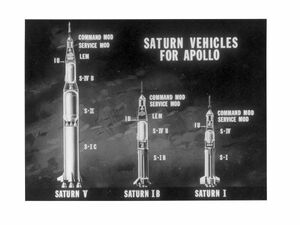
8 x 10 inch black and white photograph. Contains images of the Saturn V, Saturn IB and Saturn I in reference to one another -
"Saturn: draft."
Report on the history of the Saturn program. -
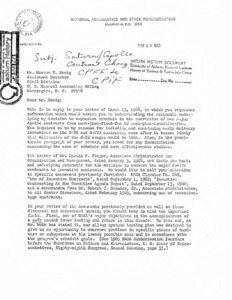
"Saturn/Apollo contract change : letter from George E. Mueller to Morton E. Henig."
Correspondence letter detailing Mueller's concerns regarding potential issues in the design of the Saturn stages. -
"Science and technology - keys to economic progress."
A book written with the key focus being how technology and science and its progress can aid in the growth of the economy. -
"Science and technology advisory committee for manned space flight."
This publication contains the Marshal Space Flight Center contribution at the Science and Technology Advisory Committee (STAG) at the Manned Spacecraft Center. -
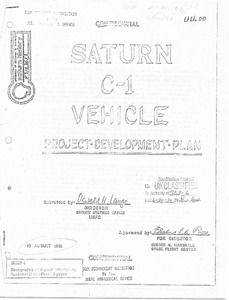
"Section III of Saturn C-1 vehicle project development plan."
Plan for the development and construction of the Saturn C-1 vehicle. -
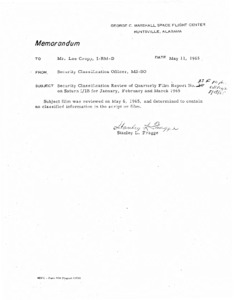
"Security classification review of quarterly film report no. 23."
Memo to Mr. Lee Cropp indicating that 'the film' had been reviewed and was deemed to contain no classified information. -
"Security classification review of Saturn I/IB quarterly film report, no. 25."
Memo to Mr. Lee Cropp informing that the subject film report was reviewed for security classification. -
"Security classification review of Saturn I/IB quarterly film report, no. 25."
Memo to Mr. Lee Cropp, I-RM-D. -
"Selected methods for uprating Saturn vehicles."
This paper will discuss selected methods for increasing the Saturn launch vehicle payload capabilities. These methods involve system changes or additions that give large step performance'increases aver those which can be obtained by product improvements. The selected philosophy of approach and the established designed systems wil1,be described, as well as anticipatedsystem concepts that may be used to increase the Saturn vehicles' capabilities. -
"Sensitivity of rocket engine stability to propellant feed system dynamics."
Because of the increased reliability required of rocket systems in their more recently assigned missions, previously acceptable design features must be reappraised ad refined. In the region of rocket engine system stability, the probles is centered in two areas, the combustor and the propellant feed system The principal interest of this paper lies in the coupling that occurs between the feed system and combustion dynamics, often termed a "buzzing" instability then the dymics are characterized by periodic pressure oscillations in the range of 200 to 1000 cps appearing in the combustion chamber and' the feed system. -
"Signal distribution in automatic checkout systems."
This paper deals with several selected aspects of the signal distribution in automatic checkout systems. These are: 1) The use of relay matrices as control elements; 2) The inclusion of self-checking capabilities; 3) Problems of systems integration. These aspects are not unique to automatic checkout systems. However, due to the nature of automatic checkout systems as presently being designed around digital circuitry, they find either fuller or different applications than in other types of systems. Also, while they are on the surface somewhat disconnected in nature, they tend to interrelate during the implementation of an automatic checkout system. -
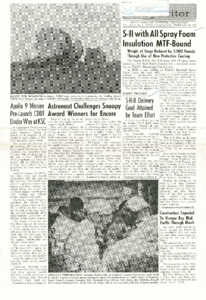
"SII, with all spray foam insulation MTF-bound."
News article detialing the innovation of the SII's design, specifically how it is made lighter. -
"Six-engine cluster of the Saturn S-IV rocket."
A press-release detailing the successfuly firing and the specfic launching information of the Saturn I-V rocket-launch. -
"Some computer applications in Saturn stage checkout."
This paper discusses a number of interesting applications of digital computers in the checkout of individual Saturn stages and in the prelaunch checkout of the complete Saturn vehicle. It discusses the concepts of automation in Saturn checkout, the unique two-computer mode of operation at the launch site and the operations of the high speed data link connecting the two computers. Also discussed are the functions of the computer while propellants are loaded automatically on one of the stages; the functions of the display computer in the newest and largest Saturn display system, and operations and utilization of the Digital Events Evaluator, the main recording device utilized during stage checkout. -
"Some select physiological, anthropometric, and human engineering data useful in vehicle design and logistic problems of space flight operations."
Report No. DSP-TM-2-60 31 p.; Pages which were blank (not scanned): 2, 26, 28 -
"Space age management or maintenance of technical capability during a period of retrenchment."
On January 3Ist of this year the United States celebrated its tenth anniversary in Space. In just one decade we have seen our space program climb from an humble beginning (a 30.8-pound payload put into orbit with a jury-rigged rocket) to extra-vehicular-activity and the tremendous Saturn V vehicle capable, of putting 250,000 pounds into low earth orbit. We have seen it grow from a "quick and dirty" operation to a program which at its peak had approximately 380,000 industrial employees in excess of {dollar}5.O billion per year. The marshalling of this great management and technological team generated many "growing pains". A few years ago the hue and cry was, "Where are we going to get sufficient people with scientific knowledge and drive to implement the space program?" Industry, sometimes reluctantly, was pressed into tasks which required managerial and technical skills beyond those they then possessed.