Browse Items (970 total)
Sort by:
-
"Quality assurance provisions for government agencies."
NASA Quality publication that contains requirements designed to facilitate the execution of programs effectively. -
"Apollo Saturn LIEF Operations Plan."
This paper identifies the support functions performed by MSFC through the Launch Information Exchange Facility (LIEF) during the Apollo Saturn Mission Operations and other facilities required to carry out these functions. It also identifies mission specific documents required for operation. Note that page 20 is missing. -
Bibliography of AEDC J-2 engine test reports.
Includes a letter to David L. Christensen, Research Institute, University of Alabama, Huntsville, Alabama from James Neely, dated March 18, 1969, with the subject line, "Technical paper entitled 'Start Transient Investigation of the Rocketdyne J-2 engine at Simulated Altitude Conditions.' " The bibliography of all AEDC J-2 engine test reports between July 1966 and Octoebr 1968 is attached. -
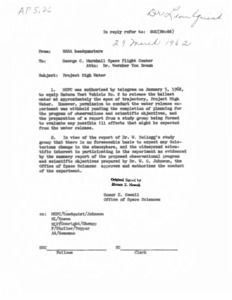
"Project High Water."
Letter to Wernher von Braun from NASA headquarters regarding Project Highwater and how it was withheld. -
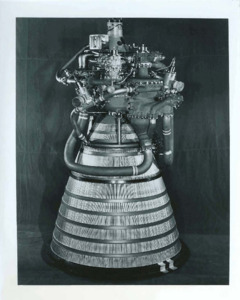
"Pratt & Whitney Aircraft RL10 liquid hydrogen rocket engine"
Photograph of a Pratt & Whitney rocket engine. -
"Saturn S-IV cryogenic weigh system. Part I : propellant utilization."
In order to achieve maximum vehicle efficiency, it is essential that the vehicle propellants be loaded to desired values and that these propellants approach simultaneous depletion at the end of powered flight. To accomplish precise loading and assure minimum residuals, a highly accurate and repeatable, vehicle located, propellant management (PM) or propellant utilization (PU) system must be used. As the ability to load propellants to predetermined values depends directly on the ability of the system to accurately sense the propellant masses, it is essential that the system be calibrated with respect to propellant mass under conditions resembling those to be experienced during final loading and powered flight. The use of a cryogenic weight system will reduce the unknown factors in capacitance sensor element shaping, tank geometry, and propellant properties to a degree which will permit the determination of propellant masses to with .025%. -
"Manned planetary flyby missions (based on Saturn/Apollo Systems) : executive summary report."
This report summarizes a study (by North American Aviation, Space Division) of Manned Interplanetary Flyby Missions to Venus and Mars during the period from 1975 to 1982. [The study was a broad but penetrating technical investigation of using a manned flight system for planetary exploration.] The results, along with previously known aspects of manned Mars and Venus flyby missions, vehicles, and systems, were integrated into total mission-system capable of performing a realistic and meaningful planetary exploration program. Manned Planetary Missions are feasible. Attractive multiplanet flyby missions can be performed by Saturn/Apollo systems. However, injected payload and mission requirements developed within the guidelines and assumptions of this study cannot be met with modified S-II or S-IV stages when used with the standard Saturn V Earth-launch vehicle. When using an Earth orbit assembly mode and an uprated Saturn Earth launch vehicle for application to manned planetary flyby missions, the launch vehicle should have a payload capability (2-stage to low Earth orbit) of 400,000 pounds or more for use with M(S)-IVB planetary injection stages. Manned planetary flyby missions provide a means of combining the favorable aspects of both manned and unmanned missions into a unique and highly effective planetary exploration mission-system capable of providing major significant inputs to the scientific and engineering questions concerning the interplanetary medium, our Sun, and our neighboring planets Venus and Mars. -
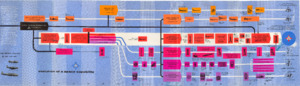
"Evolution of a Space Capability."
Two different organizational charts. -
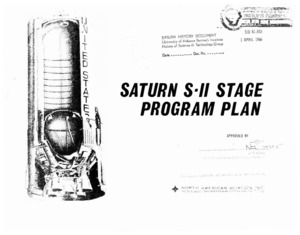
"Saturn S-II stage program plan."
This documents outlines the S & ID plan to fulfill the requirements of Contracts NAS7-80 and NAS7-200 for the design, development and manufacture of the Saturn S-II stage.; APPROVED by R E. Greer, Vice President and S-II Program Manager.; This reissue supersedes all previous issues of this report.; FOREWORD: The S-II stage is 81.5 feet in length and 33 feet in diameter, with a usable propellant capacity of 970,000 pounds, The S-II propellants are fully cryogenic-liquid oxygen at -279 F and liquid hydrogen at -423 F. Its five-engine cluster provides one million pounds of thrust. The stage is a cylindrical structure of relatively light weight with a shell designed to resist all loads without the use of stiffening members. Its skin is of welded aluminum panels, as are the elliptical bulkheads of the fuel and oxidizer tanks. Unique to its design is the common bulkhead that separates the -423 F liquid hydrogen from the -247 F liquid oxygen. The common bulkhead - a sandwich of two 33-foot diameter aluminum domes separated by an insulating filler of honeycomb - eliminates the weight penalty that would be imposed by the second bulkhead in more conventional design. This document describes the S & ID program plan for development of the S-II stage and associated a support equipment. -
"Manufacturing plan for Saturn S-II, Stages 16-25."
Manufacturing plan for for SII stages 16 through 25. -
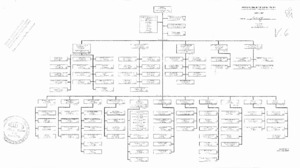
"Organizational charts for Rocketdyne, a Division of North American Aviation, Inc."
Chart No. 1 Rocketdyne master approved by S. K. Hoffman, President (Vice President, North American Aviation, Inc.,).; Chart No. 6.1 Engineering Field Laboratories approved by R. J. Lodge, Director.; Chart No. 6.1.1 Santa Susana Field Laboratory, approved by D. M. Carpenter, Manager.; Chart No. 6.1.2 Field Laboratories Nevada Field Laboratory approved by G. J. Wunderlin, Manager.; Chart No. 6.1.3 Edwards Field Laboratory approved by F. F. Twight, Manager.; Chart No. 6.6 Engineering Administration approved by P. J. Kanne, manager.; Chart No. 12 Solid Rocket Division approved by T. E. Myers. -
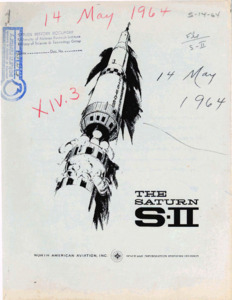
"The Saturn S-II."
The S-II is the second stage of NASA's Apollo moon-landing rocket - the giant Saturn V. The most powerful hydrogen-fueled booster under production, the S-II is destined for Apollo manned lunar missions and will help power three Americans to the moon. The S-II is being developed and manufactured at Seal Beach, Calif., by North American's Space and Information Systems Division, Downey, Calif., under the technical direction of NASA's Marshall Space Flight Center, Huntsville, Ala. -
"Saturn S-II general manual."
This manual contains information covering the second stage of the Saturn V launch vehicle. -
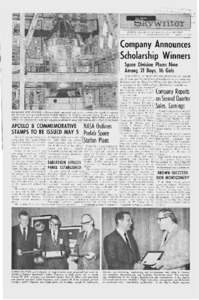
"Company announces scholarship winners: Space Division places 9 of 21 boys and 16 girls."
A news article detailing the winners of scholarships from a competition held by Space Division. This contest was held for the children of Space Division employees. -
"Manufacturing plan for Saturn S-II, Stages 16-25."
Manufacturing plan for the Saturn S-II." -
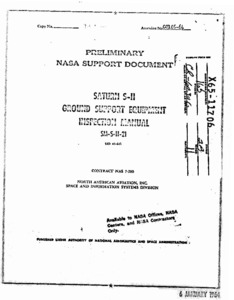
"Saturn S-II ground support equipment inspection manual."
This publication has been prepared to provide preliminary inspection requirements and limitations on all ground support equipment to support the Saturn II stage of the Saturn V launch vehicle. -
"Apollo - LEM Docking Drogue Assembly Static Structural Test."
This document contains the tests and test results from structural tests performed on the Apollo LEM docking drogue assembly between January 11, 1967 and February 15, 1967. The document contains various graphs, diagrams, and images pertaining to the tests. -
"Apollo-LEM Docking Combined Probe and Drogue Assemblies Static Structural Test."
This document contains the test technical report and results for the LEM docking probe and drogue assemblies to demonstrate that the assemblies would sustain enough load to capture latch. The document contains various graphs, diagrams, and images from testing. The final page contains a note that page no. A-139 is missing from the report. -
"Evolution of Aircraft."
Illustration depicting the history of airplanes across a graph. -