
Browse Items (970 total)
Sort by:
-
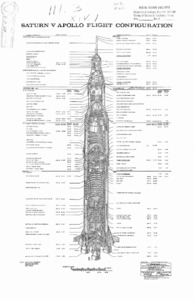
"Saturn V Apollo flight configuration."
Diagram displaying the internal rooms, pieces and functions of the Saturn V as well as the space-suits of the astronauts. -
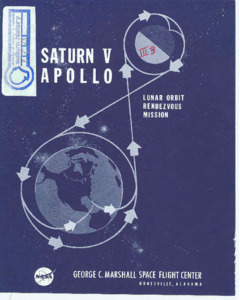
"Saturn V Apollo lunar orbit rendezvous mission."
Diagram explaining the process of a lunar mission from liftoff to recovery. -
"Saturn V derivatives."
This paper desciibes an evolutionary family concept of !h turn V derivative launch vehicle systems, discusses their performance capabilities, and outlines their ability to perform orbital and hlgh-energy missions at minimum total program cost. -
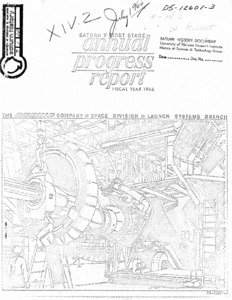
"Saturn V first stage annual progress report : fiscal year 1966."
This report is the consolidation of D5-11994, "Quarterly Technical Progress Report," for the fourth fiscal quarter and the fiscal year 1966 Annual Progress Report and places special emphasis on activities on the fourth fiscal quarter. -
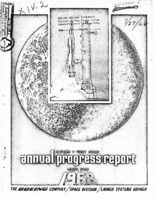
"Saturn V First Stage Annual Progress Report: Fiscal Year 1968."
The report covers June 30, 1967 through June 27, 1968: Contract NAS8-5608, Schedules 1 and 1A, July 27, 1968. Prepared by J. P. Delaloye, Management Reporting and Analysis; Supervised by D. G. Valentine, Management Reporting and Analysis; Approved by R. F. Terry, Program Reports; D. H. Creim, Michoud, Program Planning and Reporting Manager; E. K. Cooper, S-IC Program Executive. -
"Saturn V ground winds program."
The concept on Saturn V was to "budget" an amount for the dynamic portion of the wind load as a factor on the steady state drag. Wind tunnel tests paralleled the development and fabrication phases. The results indicated that the system was unable to withstand the design winds; thus, a decision was made to implement a viscous damper "fix" on the facility vehicle at the Kennedy Space Center. Damping tests in the Vertical Assembly Building (VAB) will have been completed and response tests on the pad will be in progress at the time of this symposium. This paper will present the history and status of this program to date. -
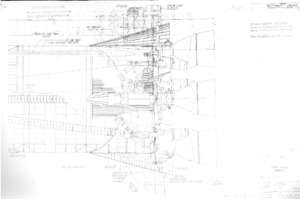
"Saturn V inboard profile : Launch escape system flight separation."
Diagram displaying the launch escape system flight separation in progress. -
"Saturn V interface management."
The purpose of the Saturn V Interface Management System is to establish and maintain interface design compatibility between interfacing items under the design responsibility of different agencies. It provides the management tools for effective change control over the design of designated systems and equipment that have critical interface design requirements. -
"Saturn V launch vehicle ground support equipment fact booklet."
This booklet has been prepared to provide a quick reference to Saturn V stage peculiar ground support equipment. It consists of visual presentations and a brief description of each major component. It is intended to quickly familiarize concerned elements with the over-all MSFC launch vehicle ground support equipment and is not intended for design usage. The booklet has been prepared in five sections. Section I contains the introductory material and a description of the Saturn V mobile launcher (ML). Section II contains information on the umbilical equipment. Section III contains information on the servicing equipment, both fixed and mobile. Section IV contains information on the access equipment. Section V contains information on the handling and auxiliary equipment. -
"Saturn V quarterly progress report : January - March."
Quarterly progress report for the months of January - March, 1966. -
"Saturn V rocket booster test stand at MSFC."
Press release.; Release No. 65-198. -
"Saturn V S-IC stage engine gimbal actuation system."
The actuation system for the Saturn V S-IC stage is described and compared to the Saturn I system. The use of mechanical feedback actuators that result in a significant increase in system reliability and the damping of load resonance is discussed. The unprecedented component sizes and system requirements are cited. -
"Saturn V S-IC stage engine gimbal actuation system."
The actuation system for the Saturn V S-IC stage is described and compared to the Saturn I system. The use of mechanical feedback actuators that result in a significant increase in system reliability and the damping of load resonance is discussed. The unprecedented component sizes and system requirements are cited. -
"Saturn V semi-annual progress report July - December, 1967."
This Saturn V Semi-Annual Progress Report describes progress and major achievements from July 1, 1967 in the Saturn V Program. -
"Saturn V semi-annual progress report July-December, 1966."
MA-001-00202H.; MPR-SAT V 66-3.; ABSTRACT: This Saturn V Semi-Annual Progress report describes progress and major achievements from July 1, 1966, through December 31, 1966, in the Saturn V Program. -
"Saturn V service arms : preliminary engineering report."
This report presents the manufacturing requirements for fabricating Saturn V service arms and contains design and operating details of the service arms and associated equipment. Part 1 defines the areas of responsibility necessary for the manufacture of Saturn V service arms and associated equipment. Capability requirements, manufacturing processes, special techniques, schedules, and other areas are detailed in Part 1. The manufacturer selected to fabricate the arms and related equipment must meet the requirements (stated in Part 1. Part 2 contains design and operation details of the service arms, Command Module Access Arm, and related equipment used on or in support of the Launcher-Umbilical Tower for the Saturn V Vehicle at Complex 39. The design and construction of all basic arms is similar. Eight service arms are being designed. The arms are being designed to support all umbilical lines necessary to service the various stages of all Saturn V Vehicles. The arms are also being designed to allow personnel access to the vehicle. Some of the arms must be retracted before vehicle lift-off and others will retract following lift-off. This requirement necessitated the design of umbilical disconnect and arm retract devices which would ensure clearance between the arms and vehicle during lift-off. The Command Module Access Arm is a separate design concept. The arm is used only for astronaut access to the Command Module. Part 2 presents the preliminary design directed toward meeting the requirements stated above. -
"Saturn V space program and aluminum welding technology."
This paper discusses the flaws and limitations with welding technology, specifically with the techniques involved. -
"Saturn V specification cross reference index."
The purpose of the Saturn V Specification Cross Reference Index is to Supplement CM-004-001-2H, the Saturn V Specification Index. It is intended to provide a convenient means of finding the specifications by specification number which is cross referenced to Specification Matrix Number and contract end item number. More complete information on specifications including preparation, approval, and contractual status as well as all effective Specification Change Notices (SCN's) can be obtained from CM-004-001-2H, the Saturn V Specification Index which contains the master listing of the same specifications arranged in logical management and functional groupings and listed in Specification Matrix number order. More complete information on hardware can be obtained from various Saturn V Configuration Accounting Indices which list items by in contract end item (CEI) number order.; This document supplements the Saturn V specification index CM -004-001-2H of the same issued date. -
"Saturn V specification index."
The purpose of the'saturn V Specification Index is to provide the official detailed record of all specifications and specification changes required for configuration management of the Saturn V Program and to report specification submittal and approval status. -
"Saturn V stage progress."
Report detailing the progress of the Saturn V's construction, focusing on the individual parts.