
Browse Items (970 total)
Sort by:
-
"Human Factor: ATM/Skylab."
The "Skylab" in the title was a later addition. This is a summary of the human factor aspects of the Apollo Applications space habitat. -
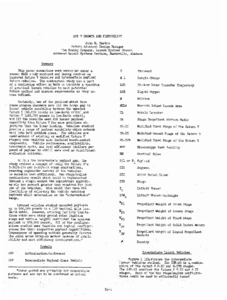
"Sat V growth and flexibility."
This paper summarizes work conducted under a recent NASA study contract and Boeing studies on improved Saturn V vehicles and intermediate payload Saturn vehicles. The contractual study was a part of a continuing effort by NASA to identify a spectrum of practical launch vehicles to meet potential future payload and mission requirements as they become defined.; UAHuntsville's Saturn V finding aid has the title as: Saturn V Growth and Flexibility, by J.E. Martin.; Preferred Citation: [Identification of item] Saturn V Collection, Dept. of Archives/Special Collections, M. Louis Salmon Library, University of Alabama in Huntsville, Huntsville, AL. -
"Saturn S-IV cryogenic weigh system. Part II : weigh operations."
Two basic methods for mass determination are: (1) direct measurement, (2) volume and density determination. Both methods or variations have been used to determine space vehicle propellant mass with varying degrees of success. Stringent propellant loading accuracy requirements of k0.5 percent for the Saturn S-IV Stage have led to the development of a Cryogenic Calibration Weigh System. The method employs accurate electronic force transducers and measuring systems as the standard and experimental weighings have verified achievement of better than the required accuracy. -
"Procurement programs of Marshall Space Flight Center as related to DOD procurement and Space Administration support by DOD activities."
"Speech presented by Col. John R. McCombs regarding administrative conduct and how they should handle contracts. -
"Propulsion development problems associated with large liquid rockets."
NASA technical memorandum, Propulsion and Mechanism Branch. Propulsion and Vehicle Engineering Division, Research and Development Operations. -
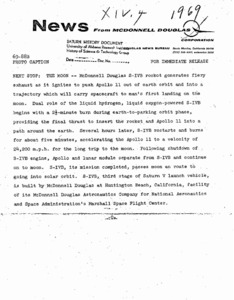
"Next stop : the moon."
Release describing the launch of the Apollo 11. -
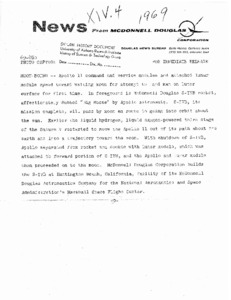
"Moon-bound"
Press release describing a photograph of a lunar module. -
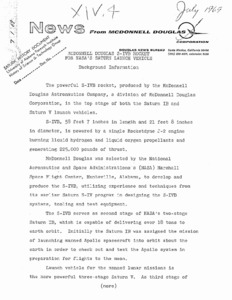
"McDonnell Douglas S-IVB rocket for NASA's Saturn launch vehicle."
Press release detailing how a rocket is the top stage of both the Saturn IB and Saturn V launch vehicles. -
"Liquid Rocket Propellant Compatibility Testing."
Material-propellant compatibility as related to liquid rocket propulsion system design criteria is discussed and applicable test methods to derive usable design data are presented. Test methods, with emphasis on metallic materials, are discussed and the shortcomings of a number of these test methods are pointed out. These tests include static immersion tests, stress-corrosion tests, flow tests, impact tests, and tests to determine the effect of cracks and notches in metals on compatibility. A general outline for the evaluation of metallic and nonmetallic materials with respect to propellant compatibility is presented. -
"X-ray television inspection of aerospace weldments : Television x-ray image enlargement system for inspection."
A sensitive new television X-ray image enlargement system has been developed under sponsorship of Watertown Arsenal Laboratories (Army Materials Research Agency) by the Department of Welding Engineering of The Ohio State University. Now commercially-available through Philips Electronics Instruments (Norelco), complete systems have been in service since January 1963 in aerospace, electronic, and other facilities. Such users report highly- satisfactory performance and unusual reliability in service. The new X-ray system permits in-motion or stationary examination of critical aerospace materials, components, and systems such as sheet materials, weldments, brazed joints, electronic components, printed circuit assemblies, small mechanisms, and biological specimens. -
"The role of simulation in the development of an automatic checkout system"
For publication in Luftfahrttechnik Raumfahrttechnik. Discusses the uses and advantages to using simulations. -
"Signal distribution in automatic checkout systems."
This paper deals with several selected aspects of the signal distribution in automatic checkout systems. These are: 1) The use of relay matrices as control elements; 2) The inclusion of self-checking capabilities; 3) Problems of systems integration. These aspects are not unique to automatic checkout systems. However, due to the nature of automatic checkout systems as presently being designed around digital circuitry, they find either fuller or different applications than in other types of systems. Also, while they are on the surface somewhat disconnected in nature, they tend to interrelate during the implementation of an automatic checkout system. -
"Man, Machine, and Automatic Test Operations."
Essay detailing the relationship between men and machines." -
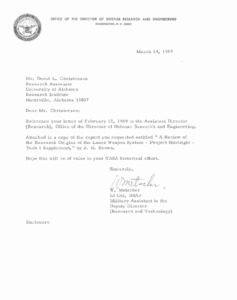
"Letter from Mr. David L. Christensen."
Letter stating that "A review of the research origins of the Lance weapon system - Project Hindsight -Task 1 supplement" is inside as requested. -
Michoud Assembly Facility Historical Report, January 1, 1967-December 31, 1967.
Pages 1 and 2 appear to have been cut out of the document. Page 14 is only half a page. Page 40 is repeated but each page has different information. -
Theoretical liquid propellant performance calculations
Archive copy is a photocopy.; The purpose of these writings is to compile in one volume the basic elements of thermodynamics and gas dynamics which are useful in the evaluation of thrust chamber performance. It is presumed that the reader will have had an elementary course in thermodynamics and gas dynamics. The discussion of topics useful in evaluating thrust chamber performance is, of necessity, limited to these physical effects amenable to other areas that are as yet in the research stage of development. The author would like to take this opportunity to express his gratitude to Mr. G. S. Gill for many stimulating discussions on this subject. Thanks are due to Mr. D. J. Kuyper for permission to utilize his discussion on elastic-plastic strain and its application to nozzle throat area change. Finally, the author wishes to express his gratitude to his wife, Alice, who typed the bulk of the manuscript. -
"Communication-System Blackout During Reentry of Large Vehicles".
This paper was published in the Proceedings of the IEEE, volume 55, number 5, May 1967.; ABSTRACT: Much of the theoretical research on reentry blackout is in a format difficult for the communications design engineer to use in his system analysis. This paper derives simplified equations for the average sheath power loss that may be added (in dB) to the usual space loss to obtain an approximate total propagation loss. The plasma and sheath properties are discussed in detail but largely without supporting mathematics, in order to give the design engineer a better understanding of the overall problem. For the same reason and to provide insight into the final results, the average radiated power is found, using both intuitive and rigorous techniques. Several graphs of plasma properties are included in the development as an aid to numerical computation, and results are compared with the work of other authors. -
"Contracts for Saturn Upper Stages S-IV and S-V".
Details contracts for upper stages of Saturn IV and Saturn V and includes illustrative appendixes. Archive copy is a photocopy. -
"Digital Simulation of an Aerospace Vehicle."
The rapid development of computer technology and the creation of new engineering oriented languages has established that general purpose digital computers are now extremely suitable to perform simulation of large scale physical systems. With Aerospace Vehicle Simulation (AVS), an effort has been undertaken at MSFC to simulate continuous and discrete dynamics of an aerospace vehicle and its ground support equipment on a large digital computer. This simulation produces a copy of the physical vehicle configuration and its functions in the form of a large scale mathematical model in the computer. AVS will be an essential part of an integrated information system which can be used by several laboratories and offices at MSFC for the design, checkout, test, and management of aerospace vehicles. -
"Saturn ascending phase guidance and control techniques."
Lunar Missions Meeting, July 17-19, 1962. Focuses on the guidence concept under development at the Marshall Space Flight Center