
Browse Items (970 total)
Sort by:
-
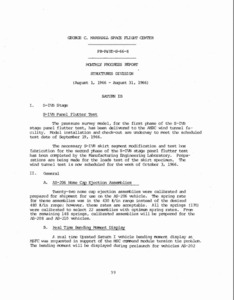
"Propulsion and Vehicle Engineering Laboratory monthly progress report (August 1, 1966 through August 31, 1966)."
A collection of progress reports covering a large number of projects within the month of August, 1966 -
"Propulsion and Vehicle Engineering Laboratory monthly progress report (July 1, 1966 through July 31,1966)."
A collection of progress reports covering a large number of projects within the month of July, 1966 -
"Propulsion and Vehicle Engineering Laboratory monthly progress report (March 1, 1966 through March 31,1966)."
A collection of progress reports covering a large number of projects within the month of March, 1966 -
"Propulsion and Vehicle Engineering Laboratory monthly progress report (November 1, 1966 through November 30, 1966)."
A collection of progress reports covering a large number of projects within the month of November, 1966 -
-
"Propulsion and Vehicle Engineering Laboratory monthly progress report, December."
Monthly progress report of the month of December, 1968. -
"Propulsion and Vehicle Engineering Laboratory monthly progress report, November."
Monthly progress report for the month of November, 1968 -
"Propulsion and Vehicle Engineering Laboratory monthly progress report, September."
Monthly progress report for the month of September, 1968 -
"Propulsion and Vehicle Engineering Laboratory monthly progress report" April.
Monthly progress report for the Propulsion Division, April 1st through April 31st -
"Propulsion and Vehicle Engineering Laboratory monthly progress report" May.
Monthly progress report for the Propulsion Division, May 1st through May 31st -
"Propulsion development problems associated with large liquid rockets."
NASA technical memorandum, Propulsion and Mechanism Branch. Propulsion and Vehicle Engineering Division, Research and Development Operations. -
"Propulsion lecture."
Lecture discussing the types of propellant used in space rockets. -
"Pumping boiling liquid hydrogen without cavitation."
Article containing diagrams about the pumping and boiling process of water. -
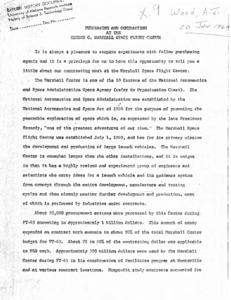
"Purchasing and contracting at the George C. Marshall Space Flight Center."
This is a speech given to fellow purchasing agent regarding purchasing and contracting. -
"Quality assurance provisions for government agencies."
NASA Quality publication that contains requirements designed to facilitate the execution of programs effectively. -
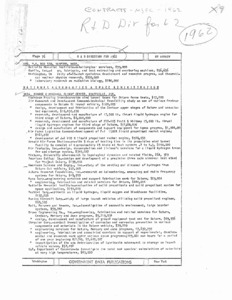
"R & D directory for 1962 (NASA-MSFC Contracts-1962)."
Excerpt of contracts MSFC 1962, pages 76-79. -
"Recent NASA experience with hydrogen engines."
This paper presents a review of the experience which has accumulated in the development of the Liquid Hydrogen J-2 and RL10 rocket engines. These engines are being developed by the Rocketdyne Division of North American Aviation and Pratt & Whitney Aircraft, a Division of United Aircraft Corporation respectively.; On NASA Technical Reports Server (NTRS) as Unclassified; No Copyright; Unlimited; Publicly available. Also found on AIAA site. -
"Recent NASA experience with hydrogen engines."
This paper presents a review of the experience which has accumulated in the development of the Liquid Hydrogen J-2 and RL10 rocket engines. These engines are being developed by the Rocketdyne Division of North American Aviation and Pratt & Whitney Aircraft, a Division of United Aircraft Corporation respectively.; On NASA Technical Reports Server (NTRS) as Unclassified; No Copyright; Unlimited; Publicly available. Also found on AIAA site. -
"Recoverable S-IB."
The paper deals with the selection of a simple recovery system for the Saturn IB first stage. As an introduction to the discussion on recovery system objectives, a plot of the expected trajectory is presented. This is followed by a statement which lists the necessary steps which must be followed to develop a recovery program. -
"Redundancy employing majority voting for a Saturn servoactuator."
R-ASTR-NF.; ABSTRACT: The servoactuator was developed to improve the reliability of the Saturn S-IVB thrust vector control system by insuring continued system operation if single point failures occur. The selection of the majority voting technique is discussed. Its simplicity is cited along with the advantages of minimum weight, size, power consumption, and compatibility with existing control electronics. Operational features, design mechanization, and the analysis of test results are covered.