
Browse Items (970 total)
Sort by:
-
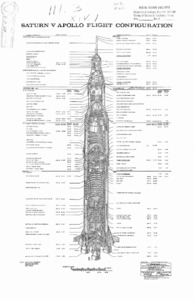
"Saturn V Apollo flight configuration."
Diagram displaying the internal rooms, pieces and functions of the Saturn V as well as the space-suits of the astronauts. -
"Furnace Brazing of Liquid Rocket Thrust Chambers."
Brazing as a technique for joining metal parts has been utilized for centuries. Industry, however, has only begun to use it on a wide scale in the last twenty years. The rapid growth of brazing has been a result of consumer and military demands Tor products of lighter weight, less expense, and higher performance. Today, brazing is one of the most widely used fabrication techniques in the production of liquid rockets, gas turbines, refrigerator and other types of heat exchangers, automobile parts, vacuum tubes, and many nuclear products. -
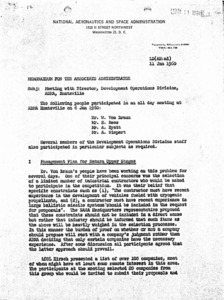
"Meeting with the Director, Development Operations Division, ABMA, Huntsville : Memorandum for the Associate Administrator."
The following people participated in an all day meeting at ABMA Huntsville on 6 January 1960: Dr. W. Von Braun, Mr. E. Rees, Mr. A. Hyatt, Mr. A. Siepert. Writer of the memorandum is Abraham Hyatt, Deputy Director, Launch Vehicle Programs. -
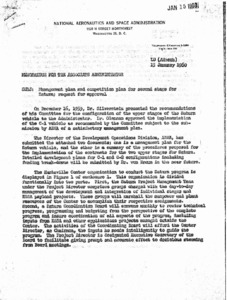
Management plan and competition for second stage for Saturn.
Archive copy is a photocopy. -
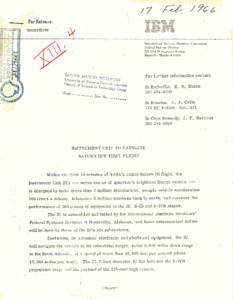
"Instrument Unit to Navigate Saturn IB's First Flight.".
Within the first 10 minutes of NASA's initial Saturn IB flight, the Instrument Unit (IU), nervecenter of America's mightiest launch vehicle, is designed to make more than 7 million calculations, sample vehicle calculations 100 times a minute, telemeter 3 million numbers back to Earth, and measure the performance of 300 pieces of equipment in the IU, S-IB, and S-IVB stages. -
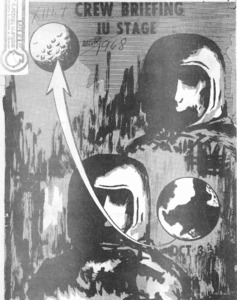
"Crew Briefing : Instrument Unit Stage Presentation".
Document outlining different slides of a presentation containing numerous organizational charts, diagrams and bullet-list points. -
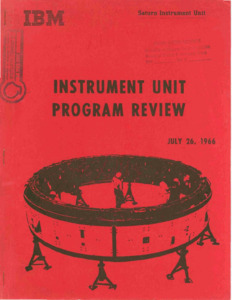
"Instrument Unit Program Review : Saturn Instrument Unit."
Handwritten names and phone numbers on the first page. Apollo / Saturn Team. -
"A Hybrid Simulation for Dynamic Verification of Saturn Guidance and Control Subsystems."
This paper presents a discussion of a hybrid simulation used to dynamically verify the Saturn Guidance and Control subsystems. First, the Saturn vehicle is briefly described to provide background information. The Instrument Unit (IU) is considered in more detail to give a proper setting for the Guidance and Flight Control (G and FC) discussion that follows. After a brief description of the actual G and FC System operation, simulation models of the G and FC components are considered in detail. This is followed by a discussion of the model assignment to a particular computer (digital or analog) and justification for making that assignment. Finally, results of the AS-204/LM1 hybrid simulation studies are briefly considered with mention of the actual flight data. -
"Automatic Saturn V Page Test System."
The abstract notes, "This paper describes the Automatic Saturn V Page Test System. The system is used to evaluate microminiature Unit Logic Device (ULD) circuits. A page is an assembly consisting of a magnesium- lithium frame, an input-output connector, test points, and multilateral printed circuit boards that interconnect the IUDs into logic circuits. The test system automatically performs tests for shorted voltages and shorted diodes, static logic function, and pulse function." -
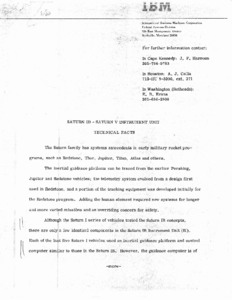
"Saturn IB - Saturn V instrument unit technical facts."
Press release detailing the technical aspects of the Saturn IB. -
"Saturn IB/V Instrument Unit system description and component data: technical manual."
This manual contains a brief description of each Instrument Unit (IU) system and their respective components for S-IU-201 through 212 and S-IU-501 through 515. -
IBM Apollo/Saturn Press information.
These are the facts about IBM's role as a NASA prime contractor in the Apollo/Saturn program. They are organized for quick reference. Computer terms are defined in a glossary. Glossy prints of photographs and illustrations are available from IBM information offices listed on the following page. Please order by photo number. Andrew J. Cella Manager of Information, IBM Federal Systems Division. -
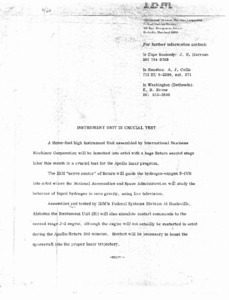
"Instrument Unit in Crucial Test."
A three-foot high Instrument tional Business Machines Corporation will be launched into orbit with a huge Saturn second stage
later this month in a crucial test for the Apollo lunar program. -
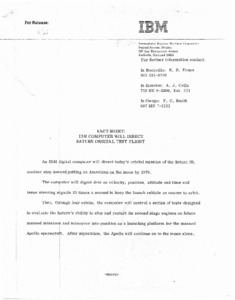
"Fact Sheet : IBM Computer Will Direct Saturn Orbital Test Flight."
Press release regarding a IBM digital computer directing a Saturn 1B orbital mission. -
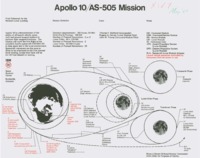
Apollo 10/AS-505 mission chart.
The chart includes diagrams, mission statistics, crew, and notes. There is an additional copy in the David Christensen Collection. -
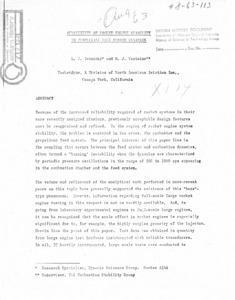
"Sensitivity of rocket engine stability to propellant feed system dynamics."
Because of the increased reliability required of rocket systems in their more recently assigned missions, previously acceptable design features must be reappraised ad refined. In the region of rocket engine system stability, the probles is centered in two areas, the combustor and the propellant feed system The principal interest of this paper lies in the coupling that occurs between the feed system and combustion dynamics, often termed a "buzzing" instability then the dymics are characterized by periodic pressure oscillations in the range of 200 to 1000 cps appearing in the combustion chamber and' the feed system. -
"The reliability of the all-up concept."
Prepared for George C. Marshall Space Flight Center, Huntsville, Alabama under contract NAS8-11087. Publication No. 294-02-12-440. Special Technical Report No. 13.; INTRODUCTION: The Saturn/Apollo Systems Office at the George C. Marshall Space Flight Center (MSFC) requested ARINC Research Corporation to make a brief study of the reliability aspects of the All-Up concept. Under the requirements of Task 294-02 of Contract NAS8-11087, the study included a comparison between the reliability of the first Saturn V vehicle if All-Up, and its reliability with dummy upper stages. -
"Test procedure validation by computer simulation."
Digital computer simulation of the Saturn I Instrument Unit electrical networks was accomplished using the Discrete Network Simulation programs. The schematics were analyzed and a logic model prepared which consisted of a series of Boolean equations. The test procedures, which are written in the Acceptance, Test, or Launch Language (ATOLL), consist of a sequential set of computer instructions for the RCA llOA checkout computer to control the operation of the electrical networks. The procedures also contain the predicted results for each operation. The driving functions for the simulation of the model are generated from the ATOLL test tape by the Input Generator Program. The time sequenced operation of the networks is indicatedby the output from the simulation program in addition to the number of times each component in the system changes state. The results of the simulation are compared to the test procedure predictions on the ATOLL tape by the Comparator Program and any differences are listed. The Comparator Program also lists any component which did not change state at least once. -
"Organization of a countdown"
The Organization of a Countdown was developed over 8 years of missiles and space systems testing at the Douglas Aircraft Company, Sacramento test Center. The experience on which this study was based includes the Thor development and acceptance testing, Titan I second stage engine development testing, Development of liquid hydrogen handling techniques, Saturn S-IV and S-IVB development and acceptance testing. The intent of this paper is to examine the static test countdown organization and discuss the need for a systematic method to organize a countdown. -
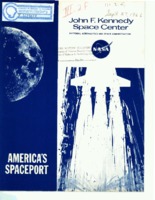
"America's Spaceport."
Guide to John F. Kennedy Space Center, including an introduction from Center director Kurt Debus.