
Browse Items (970 total)
Sort by:
-
A "Think Clean" training program.
This paper outlines steps involved in preparing and presenting an instruction course on clean rooms. The training area, personnel, equipment, and program outline will be described. A summary of the results obtained over the first year of operation will be presented. -
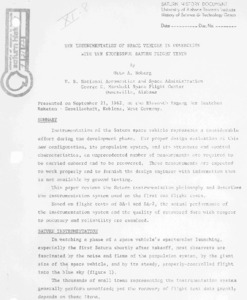
"The instrumentation of space vehicle in connection with the successful Saturn flight tests."
Presented on September 21, 1962, at the Eleventh Tagung Der Deutchen Raketen - Gesellschaft, Koblenz, West Germany. Instrumentation sf the Saturn space vehicle represents a considerable effort during the development phase, for proper design evaluatian of this new configuration, its propulsion system, and its structure and control characteristics, an unprecedented number of measurements are required to be carried onboard and to be recovered, These measurements are expected to work properly and to furnish the design engineer with information that is not available by ground testing, -
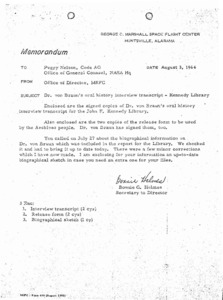
Dr. von Braun's oral history interview transcript - Kennedy Library: memorandum.
This memorandum references the signed copies of Dr. von Braun's oral history interview for the John F. Kennedy Library. -
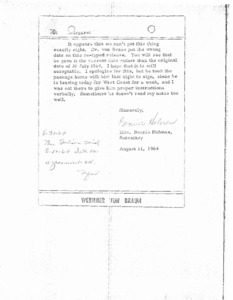
"Memorandum to Margaret from Mrs. Bonnie Holmes, Secretary."
Memorandum apologizing for the wrong date placed on a previous memorandum. -
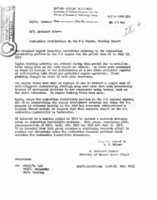
Combustion oscillations in the F-1 engine, monthly report.
The set of documents includes an introductory letter written by D. Brainerd Holmes and Tischler's report with the subject "F-1 Combustion Instability Report for Associate Administrator; Period June-July 1963." -
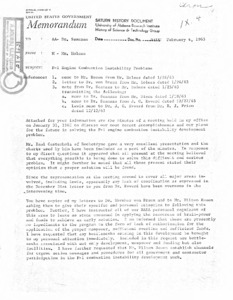
"Memorandum to Dr. Seamans from Mr. Holmes. Subject: F-1 engine combustion instability problems."
Memorandum discussing a presentation regarding problems that needed solving, a "Dr. Evvard's" lack of cooperation and letters to Wernher von Braun. -
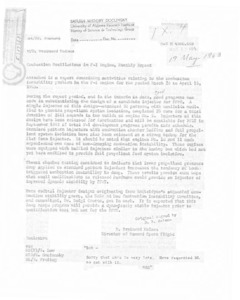
Combustion Oscillations in F-1 Engine.
The set of documents includes an introductory letter written by D. Brainerd Holmes and Tischler's report with the subject "F-1 Combustion Instability Report for Associate Administrator; Period March-April, 1963". -
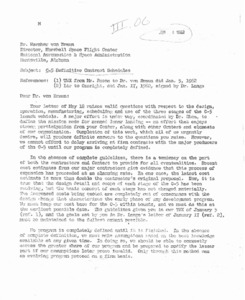
Letter to Dr. Wernher von Braun.
Letter to Wernher von Braun from D. Brainerd Holmes. Contains C-5 definitive contract schedules. -
"Saturn V space program and aluminum welding technology."
This paper discusses the flaws and limitations with welding technology, specifically with the techniques involved. -
"Letter to Mr. David L. Christensen, Research Associate."
Letter to Mr. David L. Christensen from Helmut J. Horn regarding the reports he requested. -
"The Iterative Guidance Law for Saturn."
Summary: "Based on Lawden's equation, semi-explicit,'iterative' Saturn guidance equations are derived, many were successfully flight tested on Saturn I and analyzed for the main Apollo mission and other applications applications." -
"An Iterative Guidance Scheme and Its Application to Lunar Landing."
A guidance scheme for vehicle flight from lunar orbit to a prescribed point on a spherical, non-rotating moon is presented. The equations of motion have been simplified only to perm it a closed solution for the thrust magnitude and thrust direction. The trajectory computations them selves are made under more realistic and accurate assumptions and are not included. -
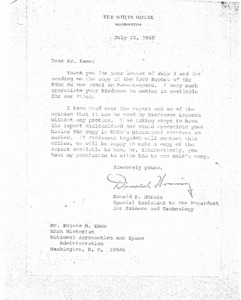
"Letter to Mr. Eugene M. Emme."
Letter to Mr. Eugene M. Emme from Donald F. Horneg regarding her request for her report to be read by Professor Logsdon. -
"Letter to Professor John Logsdon."
Letter to Professor Logsdon from Donald F. Hornig granting Logsdon's request PSAC Men-In-Space panel report. -
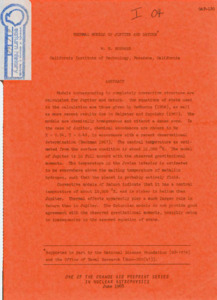
"Thermal models of Jupiter and Saturn"
One of the orange Aid Preprint Series in Nuclear Astrophysics by W. B. Hubbard, California Institute of Technology, Pasadena, California.; Argues that the Saturnian models are flawed as their predictions do not line up with detected gravitational events. -
"A Prime Contractor's Reliability Program for Components/Parts for the Douglas S-IVB Stage Project."
This paper, presented at the fifth annual Reliability and Maintainability Conference in New York City, contains a "prime contractor's reliability program for components/parts for the Douglas S-IVB stage project." These parts include special flight critical items and their complementary reliability engineering program plan is outlined in this paper. -
"Saturn television system for SA-6."
The Saturn television system is an instrumentation device intended to provide visual information on vehicle performance in real time. The system covers the entire problem from the original image presented to the television camera to the presentation of the finished photographs for analyses. -
"Flight Software Development Laboratory."
A man-in-the-loop computer facility has been created using a digital computer, display terminal,and space vehicle flight computer to enable programmers to check out flight programs in a simulated space flight environment. The simulation requires a real time multi-programmed environment, which is supplied by a control system capable of scheduling programs on 32 levels of priority interrupt as well as answering demands for service at the display terminal. A special interface device permits visibility and control of the flight program as it executes in the flight computer. On-line inputs from the programmer at the display terminal and outputs from data collection and reduction routines to the display screen are executed in real time. The Flight Software Development Laboratory has proved to be very useful in reducing program preparation time and increasing flight program confidence. -
"Saturn V ground winds program."
The concept on Saturn V was to "budget" an amount for the dynamic portion of the wind load as a factor on the steady state drag. Wind tunnel tests paralleled the development and fabrication phases. The results indicated that the system was unable to withstand the design winds; thus, a decision was made to implement a viscous damper "fix" on the facility vehicle at the Kennedy Space Center. Damping tests in the Vertical Assembly Building (VAB) will have been completed and response tests on the pad will be in progress at the time of this symposium. This paper will present the history and status of this program to date. -
"Dynamic Problems in Launch Vehicles and Spacecraft."
Addresses improving spacecraft safety by resolving various known dynamic problems.