
Browse Items (970 total)
Sort by:
-
"Nuclear engine design considerations."
The intent of this paper is to examine the static test countdown organization and discuss the need for a systematic method to organize a countdown. -
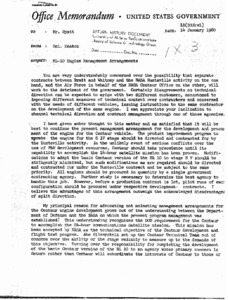
"Office memorandum : United States Government : RL-10 engine management arrangements."
Memorandum regarding potential arguements and disagreements over the technical direction between two "customers." -
"Operational Experiences on the Saturn V S-IVB stage."
This paper presents a light, but reverent, discussion of some of the Douglas operational experiences on the Saturn V/S-IVB stage. Certain relevant aspects of earlier work on the Thor intermediate range ballistic missile, the Saturn I S-IV stage, and the Uprated Saturn I S-IVB stage are also discussed.; Aeronautic and Space Engineering and Manufacturing Meeting, Los Angeles, Calif., Oct. 7 - 11, 1968. -
"Opportunities for European Payloads on the Saturn Vehicle."
Prepared for presentation to the Eurospace Conference. In this paper, we will not deal with the first two questions, which must be of interest to every potential experimenter, but only with the last question of vehicle availability. -
"Orbiting research laboratory/logistics spacecraft checkout requirements study."
This report presents the results of the study of Orbiting Research Laboratory and Logistic Spacecraft Checkout Requirements as they relate to prelaunch operations at MILA. The study was performed jointly by the Florida Division and the Systems Research and Analysis Division of TRW Space Technology Laboratories for NASA under the terms of contract NAS10-1076. -

"Organization chart of the Department of Defense - Directory."
An organizational chart directory. -
"Organization of a countdown"
The Organization of a Countdown was developed over 8 years of missiles and space systems testing at the Douglas Aircraft Company, Sacramento test Center. The experience on which this study was based includes the Thor development and acceptance testing, Titan I second stage engine development testing, Development of liquid hydrogen handling techniques, Saturn S-IV and S-IVB development and acceptance testing. The intent of this paper is to examine the static test countdown organization and discuss the need for a systematic method to organize a countdown. -
"Organization, programs, and activities, of the technical sections Nortronics - Huntsville."
This brochure is intended to depict the present status of the technical activities of Nortronics-Huntsville as of the date indicated. It is based on all currently available information. It is subject to periodic revision as additional pertinent information becomes available. -
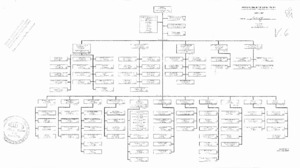
"Organizational charts for Rocketdyne, a Division of North American Aviation, Inc."
Chart No. 1 Rocketdyne master approved by S. K. Hoffman, President (Vice President, North American Aviation, Inc.,).; Chart No. 6.1 Engineering Field Laboratories approved by R. J. Lodge, Director.; Chart No. 6.1.1 Santa Susana Field Laboratory, approved by D. M. Carpenter, Manager.; Chart No. 6.1.2 Field Laboratories Nevada Field Laboratory approved by G. J. Wunderlin, Manager.; Chart No. 6.1.3 Edwards Field Laboratory approved by F. F. Twight, Manager.; Chart No. 6.6 Engineering Administration approved by P. J. Kanne, manager.; Chart No. 12 Solid Rocket Division approved by T. E. Myers. -
"Organizational Structure and Mission of Aerospace Environment Division"
This document offers a brief description of the Aerospace Environment Division including the basic mission; branches; an organizational directory; and responsibilities of the Environment Research Office, the Atmospheric Dynamics Branch, the Terrestrial Environment Branch, and the Space Environment Branch. William W. Vaughan's name is inscribed on the front page. -
"Outline of the capability of technical facilities and equipment at the George C. Marshall Space Flight Center."
Outline of the equipment present at George C. Marshall Space Flight Center. -
"Pan Am Clipper : Guided Missiles Range Division : December, 1964."
A collection of articles, one of which musing about the landing on/colonization of Mars in the future. -
"Part analysis program."
Includes carbon copy of letter sent to David L. Christensen from Ernst Lange regarding the Part Analysis program. -
"Payload integration for space experimentation."
Space experimentation requires an increasingly complex planning and systems engineering effort to meet the demand for highest precision and reliability of all measurements and observations. A companion paper discusses the interfaces between the scientific/technical areas of space experimentation and the instruments, subsystems and support systems within the spacecraft. This paper deals with the organization and the procedures which are needed to perform the difficult payload integration process for space experimentation. In the course of this process it is necessary to define the experiments completely, to describe all instruments in terms of engineering specifications, to investigate the commonality of equipment, to group the experiments into mission compatible payloads, to specify acceptable loads on all subsystems and astronauts (when present) and to plan for all contingencies during the flight. -
"Pershing (u): a report bibliography."
List of unclassified reports. -
"Personnel administration."
Presented at the Society for Personnel Administration. Discusses the problems with the current administration. -

"Pesco progress."
Article covering the development of cryogenic pumps. -
"Philosophy and practices of reliability as applied in the design of the Saturn Instrumentation System."
The basic engineering approach used in the Saturn instrumentation system has evolved to provide a highly reliable design for short periods of operation. The airborne measuring and telemetry systems including preflight tests, inspection, documentation, and feedback between the users and designers are discussed. The apparent differences between the practice and theory of reliability are rationalized. Some consideration is given to new problems in designing systems that must operate in hostile environments for long periods. The potential contribution of redundancy as a design concept is discussed.; This paper is concerned with the airborne measuring and telemetry systems; it does not attempt to treat the entire Saturn instrumentation system which consists of tracking devices including optical, radar, and Doppler, plus television, film cameras, and a myriad of instruments connected with factory checkout, ground test, and launch. -
"Planning for strategic deterrence in the 1970s."
Article discussing money-resources and the budget. -
"Plastics in space flight programs."
Article aimed at improving the NASA's ability to complete its projects."