
Browse Items (970 total)
Sort by:
-
"Nondestructive testing of space vehicle liquid propellant rocket engines."
Presented at the Western Metals Congress, Los Angeles, California, 15 March 1967.; Archive copy is a photocopy.; ABSTRACT: This report describes the various nondestructive test methods employed to evaluate materials and processes used in the manufacture of large liquid propellant rocket engines at the Rocketdyne Division of North American Aviation, Inc. The contents of the paper were purposely oriented for an audience of aerospace, design and materials engineers. A brief description of liquid propellant rocket engine reliability is presented. The relationship of standards and specifications to nondestructive testing is discussed and various test methods are described along with a discussion of their applications and limitations. The sequence of events leading up to the use of nondestructive testing in production inspection is presented. Finally, the organization of labor directly related to nondestructive testing is given. -
"Manned Launch Vehicle Development."
Includes handwritten notes. Includes references to slides. Essay remarking on how space vehicles will interact on the moon's surface. -
-
"Juno V Transportation Feasibility Study (U)."
The purpose of this report is to present an investigation to determine the feasible, practical and economical method of transporting the JUNO V thrust unit. This includes the first phase of transporting between Fabrication Laboratory, Systems Analysis and Reliability Laboratory and to the test stand, as well as the later phases, onto the Redstone Arsenal loading docks and from there down the Tennessee, Ohio and Mississippi Rivers to the Atlantic Missile Range, Florida.; Transportation and Packaging Section, Systems Support Equipment Laboratory. -
"Fabrication of Plenum Tanks by Explosive Forming and Electron Beam Welding."
This report presents the results of a program initiated to study the use of explosive forming and electron beam fusion welding techniques in the fabrication of pressurized cryogenic materials containers. Using these techniques, vessels were successfully formed from 304 stainless steel and X7106 aluminum alloy in the T63 condition.; Manufacturing Research and Technology Division.; Manufacturing Engineering Laboratory.; Research and Development Operations. -
"Design and Use of Fault Simulation for Saturn Computer Design."
Describes different aspect of the Fault Simulation for Saturn computer design. -
"Saturn and its mission."
Presentation from Harper, discussing the Saturn Project's then-status, background and plans. -
"The production of large tanks for cryogenic fuels"
Archive copy is a poor photocopy. Prepared for presentation at Deutsche Gesellschaft fur Raketentechnik und Raumfahrt. (German Society for Rocket Technology and Astronautics). Given by E. Harpoothian, Chief Engineer, Structures Department, Development Engineering.; Tanks for cryogenic fluids, as used in the Saturn space vehicles, have reached an advanced stage of design and development. Many of the structural features of the NASA/Douglas Saturn tanks, fabricated of 2014-T6 aluminum alloy, were first developed for the booster of the Thor ballistic missile, which later found extensive use in putting space vehicles into orbit. There is a mutual dependence of important factors related to design concepts, selection of materials, processing techniques, and fabrication methods. It is shown that this mutual dependence must be considered if a successful vehicle is to emerge from design and development. Details of vehicle structure, provision for insulation, and manufacturing methods are presented. Criteria for the selection of materials is shown to be dependent on strength, ductility, weldability, toughness, fabricability, behavior at cryogenic temperatures, and on manufacturing methods and inspection techniques. -
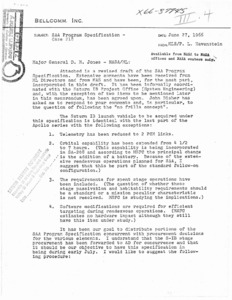
"SAA program specification - case 218."
Memo sent to Major General D. M. Jones - NASA/ML. -
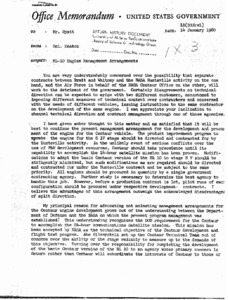
"Office memorandum : United States Government : RL-10 engine management arrangements."
Memorandum regarding potential arguements and disagreements over the technical direction between two "customers." -
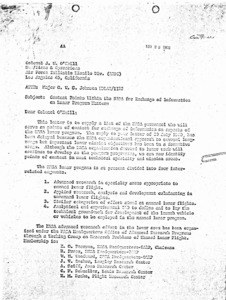
Contact points within the NASA for exchange of information on lunar program matters.
Memorandum to Colonel J. W. O'Neill, Plans & Operations, Air Force Ballistic Missile Div. (ARDC).; Archive copy is a poor reproduction. -
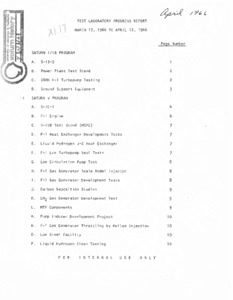
"Test Laboratory progress report" March and April.
Monthly rogress report for the test laboratory regarding the Saturn 1B program between March and April. -
"Test Laboratory progress report" Febuary and March.
Monthly rogress report for the test laboratory regarding the Saturn 1B program between Feburary and March -
"Test Laboratory progress report" May and June.
Monthly rogress report for the test laboratory regarding the Saturn 1B program between Feburary and March -
"Structural problems of large space boosters."
Report discussing the flaws in having large rocket boosters. -
"Saturn Vehicle Cryogenic Programs."
Paper from the 1965 Cryogenic Engineering Conference at Rice University, Houston, Texas, paper K-4. The abstract states, "This paper covers the cryogenic propellant and gaseous application to the George C. Marshall Space Flight Center Saturn Programs. Emphasis is placed on the overall application and the resultant logistic considerations. The planning of facilities, storage, and transportation required to ensure an adequate supply of cryogenic fluids when needed is traced from the engine and stage requirements. The entire cycle of technical requirements, estimating the quantities required from production and management of the program is developed, spacecraft application and other trends that affect cryogenic production are reviewed." -
"Why internal insulation for the Saturn S-IV liquid hydrogen tank?."
Prepared for presentation at the Cryogenic Engineering Conference, Los Angeles, California, August 14-16, 1962.; There is no page 8. -
"The IBM Clean Room Comes of Age."
A history of the IBM's Space Systems Center clean room and a description of its uses. -
"IBM Mobile Room Lends Flexibility to Apollo Saturn Unit Fabrication."
This article was published in the April 1967 issue of Contamination Control, Volume VI, Number 4. States: "The extreme sensitivity of critical parts in the Apollo /Saturn Instrument Unit (IU) has demanded unique clean room techniques by International Business Machines Corporation." -
"Methods for cleaning electronic components and subassemblies."
In describing the cleaning of electronic components and subassemblies, it must be taken into consideration that each part to be cleaned presents an individual problem. The method of cleaning must be tailored to the type of part to be cleaned as well as to the type of soil to be removed. This paper reviews some of the methods used in cleaning electronic arts, particularly printed circuits, as well as other critical hardware which is used in support of electronic assemblies. Some of the methods covered include the use of abrasives, acids, solvents and alkalies, and the employment of these in combination with ultrasonic and other automatic systems. The clean room in use at IBM Huntsville is described briefly, along with the solutions and solvents used in cleaning electronic and supporting parts. Cleanliness- requirements for the area and the materials, together with procedures for meeting them give added emphasis to the critical nature of today's contamination control programs. The paper concludes with a summary of the cleaning procedures and the cleanroom benefits to be obtained by using present day technologies to improve them.