
Browse Items (970 total)
Sort by:
-
Saturn AS-501 evaluation bulletin No. 1, November 14, 1967.
The findings herein are the results of the combined evaluation efforts of the various Laboratories of Research and Development Operations at MFSC, The Boeing Company, North American Rockwell/Space Division, Douglas Aircraft Company, International Business Machines, and Rocketdyne. -
Saturn and lunar flight.
Speech by K.K. Dannenberg at American Society of Civil Engineers, Huntsville, November 2.; Projectionist's copy (photocopy) - slide numbers are included. -
"Saturn Apollo guidance error estimation."
A brief sketch of the development of the equations for a weighted least squares estimator is given, the equations for both collective and recursive estimators being included. Four possible problem sources that may be encountered in the application of the estimator are identified. Various "success" parameters are defined in an attempt to predict the success with which, the method has been applied. The application of the estimation technique to the problem of computing various error parameters associated with the ST-124M guidance platform is described with the numerical results obtained using a manufactured data case are presented. These results are used to form conclusions about the effectiveness of the "success" parameters and preferred approaches to the problem of system evaluation using techniques of estimation theory. -
"Saturn base heating review."
The Saturn I booster which is powered by a cluster of eight rocket engines has been successfully flown on four successive flights. The early success of this large launch vehicle is a strong indication of the soundness of its base heating program. This paper summarizes the thinking that went into the design of our base configuration. Flight test results indicate that pressures, temperatures and heating rates were generally as expected. New techniques have been investigated for generating design data. It has been found experimentally that pressure and thermal fields establish themselves in one to three milliseconds and that data from the "short duration" technique compare favorably with "long duration" type tests. As a result, the new "short duration" technique has become the standard for generating design data for the Saturn vehicle. -
"Saturn IB SA-217 reference launch vehicle."
This document contains a definition of a reference Saturn IB launch vehicle designated SA-217. The Saturn IB SA-217 is a projected reference vehicle, based on Saturn IB SA-212, incorporating the latest proposed product improvements. The two-stage payload capability of this vehicle to a 100-nautical-mile circular orbit is 44,965 pounds. The Saturn IB SA-217 launch vehicle is to be used as the baseline vehicle for advanced studies requiring the use of the standard or modified Saturn IB launch vehicle. This vehicle definition does not necessarily represent approved changes to any specific vehicle. This document supersedes the Saturn IB SA-213 reference Launch Vehicle, described in memorandum R-P&VE-DIR-65-92. -
"Saturn launch vehicle presentation."
Speech to be presented by C. L. Bradshaw, Deputy Director, Computation Division at Supervisor's Club, Knoxville Utilities Board. Speech praising the progress of space-based technologies and advancements. -
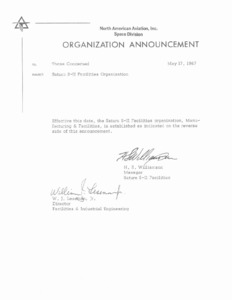
"Saturn S-II facilities organization."
Organizational chart for the Saturn II facilities. -
"Saturn SA-1 flight and its instrumentation."
Presentation focusing on empahsising the importance of space programs such as Saturn. -
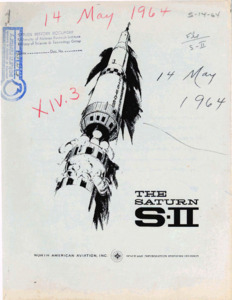
"The Saturn S-II."
The S-II is the second stage of NASA's Apollo moon-landing rocket - the giant Saturn V. The most powerful hydrogen-fueled booster under production, the S-II is destined for Apollo manned lunar missions and will help power three Americans to the moon. The S-II is being developed and manufactured at Seal Beach, Calif., by North American's Space and Information Systems Division, Downey, Calif., under the technical direction of NASA's Marshall Space Flight Center, Huntsville, Ala. -
"Saturn V interface management."
The purpose of the Saturn V Interface Management System is to establish and maintain interface design compatibility between interfacing items under the design responsibility of different agencies. It provides the management tools for effective change control over the design of designated systems and equipment that have critical interface design requirements. -
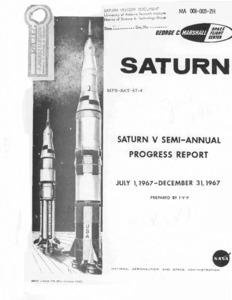
"Saturn V semi-annual progress report July - December, 1967."
This Saturn V Semi-Annual Progress Report describes progress and major achievements from July 1, 1967 in the Saturn V Program. -
"Saturn V service arms : preliminary engineering report."
This report presents the manufacturing requirements for fabricating Saturn V service arms and contains design and operating details of the service arms and associated equipment. Part 1 defines the areas of responsibility necessary for the manufacture of Saturn V service arms and associated equipment. Capability requirements, manufacturing processes, special techniques, schedules, and other areas are detailed in Part 1. The manufacturer selected to fabricate the arms and related equipment must meet the requirements (stated in Part 1. Part 2 contains design and operation details of the service arms, Command Module Access Arm, and related equipment used on or in support of the Launcher-Umbilical Tower for the Saturn V Vehicle at Complex 39. The design and construction of all basic arms is similar. Eight service arms are being designed. The arms are being designed to support all umbilical lines necessary to service the various stages of all Saturn V Vehicles. The arms are also being designed to allow personnel access to the vehicle. Some of the arms must be retracted before vehicle lift-off and others will retract following lift-off. This requirement necessitated the design of umbilical disconnect and arm retract devices which would ensure clearance between the arms and vehicle during lift-off. The Command Module Access Arm is a separate design concept. The arm is used only for astronaut access to the Command Module. Part 2 presents the preliminary design directed toward meeting the requirements stated above. -
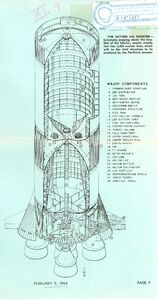
"Saturn S-IC booster : schematic."
This is page 7 of the Marshall Star : Space Information Digest. -
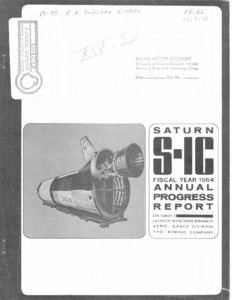
"Saturn S-IC annual progress report, 1964."
This report encompasses the progress made by The Boeing Company on the Saturn S-IC Program for the fiscal year 1964 (From July 1, 1963 through July 2, 1964). The main objective of this report is to serve as an historical presentation stressing Boeing accomplishments and present capabilities under Contract NAS8-5608. -
"Saturn S-IC annual progress report, 1965."
This Annual Progress Report has been prepared by the Boeing Company to fulfill the requirement under Article XXX, Paragraph A and C, Modification 100 of Contract, NAS8-5608 as amended by NASA letter I-MICH-DB, dated May 19, 1965, B. H. Aldridge to E. S. Olason. Subject: Change of NAS8-5608 to incorporate Quarterly Technical Progress into the Annual Progress Report. -
"Saturn S-II general manual."
This manual contains information covering the second stage of the Saturn V launch vehicle. -
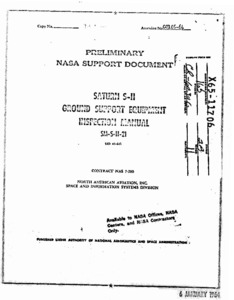
"Saturn S-II ground support equipment inspection manual."
This publication has been prepared to provide preliminary inspection requirements and limitations on all ground support equipment to support the Saturn II stage of the Saturn V launch vehicle. -
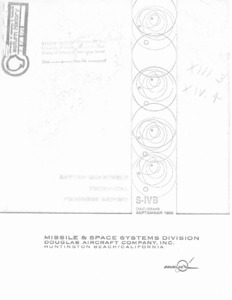
"Saturn S-IVB quarterly technical progress report."
Douglas Aircraft Company Report DAC-56445, Saturn S-IVB Quarterly Technical Progress Report, covers design and development progress on the Saturn IB and Saturn V configurations of the S-IVB stage during August and September 1966. This report is prepared for the National Aeronautics and Space Administration under Contract NAS7-101. -
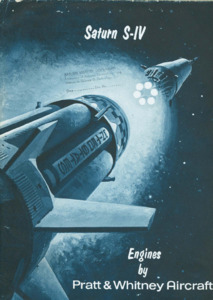
"Saturn S-IV engines."
Folder of information. -
"Saturn and the NASA space program."
Given at the Birmingham Chapter National Defense Transportation Association. Focuses chiefly on moon-missions.