
Browse Items (970 total)
Sort by:
-
"Juno V Space Vehicle Development Program (Phase I): Booster Feasibility Demonstration."
The initial phase of the JUNO V space vehicle development program, as presented herein, provides for a static demonstration and a total of four flight feasibility tests. The latter two flights will give the U.S. its first payload capability in excess of 10,000 lb in mid 1961. The objective of the overall program is to provide a reliable, economical, and flexible carrier vehicle with relatively large payload capability for orbital and space missions at the earliest possible date. -
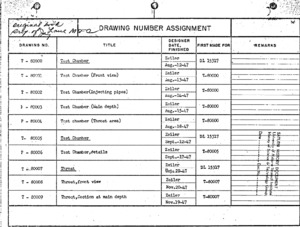
"Drawing number assignment"
The document is a photocopy of the Drawing Number Assignments from August 1947 to May 1953. Categories include but are not limited to the drawing number, title, designer, and date finished. Inscribed on the front is "original book property of Jay Laue, MSFC." -
"Carbon-Burning Nucleosynthesis at Constant Temperature."
"Carbon-Burning Nucleosyntesis at Constant Temperature" is part of the Orange Aid preprint Series in Nuclear Astrophysics, August 1968. The abstract states "Syntesis of elements during thermonuclear burning of carbon is examined at a series of temperatures (T=0.6, 0.8, 1.0, 1.2, 1.4) and for several initial compositions. Recent eperimental results (Ptterson, Winkler, and Zaidins 1968) for the 12C+!@C reaction are used. A general method for numerical solution of nuclear-reaction networkds is described. At the higher temperatures in the range now thought to be appropriate for carbon burning in stars, -
Saturn Launch Vehicles Astrionics System Handbook, 2nd revised edition.
This updated edition of the Astrionics System Handbook instructs, "The enclosed pages change, delete, or supplement the information in the Astrionics System Handbook (1 August 1965). Insert these pages and destroy the pages they replace." -
Saturn Launch Vehicles Astrionics System Handbook.
Includes change pages. Contract NAS8-14000. Second revised edition. V66-15610. NASA-CR71607. The introduction notes, "This second revised edition of the Astrionics System Handbook has been developed under the direction and overall supervision of Dr. Rudolf Decher of the Astrionics Systems Engineering Office. This description of the Saturn Astrionics System has been generated by personnel of the Astrionics Laboratory, the staff of the Astrionics Systems Engineering Office, and by personnel of the International Business Machines Corporation working under Contract NAS8- 14000. The handbook will be updated and expanded as it becomes necessary due to changes or refinements in the system concept and hardware. Sections not contained in the first release of this document will be made available within three months." Signed by Ludie G. Richard, Chief, Systems Engineering Office, Astrionics Laboratory. The document is missing pages in the following locations: Chapters 8, 9, 12. Sections 15.2, 15.3, 15.4-1 thru 15.4-16, 15.5-1 thru 15.5-2, 15.5-5 thru 15.5-8. -
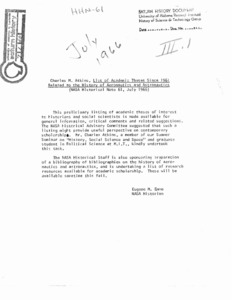
"List of Academic Theses Since 1961 Related to the History of Aeronautics and Astronautics."
This preliminary listing of academic theses of interest to historians and social scientists is made available for general information, critical comments and related suggestions. The NASA Historical Advisory Committee suggested that such a listing might provide useful perspective on contemporary scholarship. Mr. Charles Atkins, a member of our Summer Seminar on "History, Social Science and Space" and graduate student in Political Science at M.I.T., kindly undertook this task. The NASA Historical Staff is also sponsoring preparation of a bibliography of bibliographies on the history of aeronautics and astronautics, and is undertaking a list of research resources available for academic scholarship. These will be available sometime this fall. Eugene M. Emme, NASA Historian.; NNH-61.; FOREWORD: This listing represents a first attempt to compile academic theses of relevance to the history of aeronautics and astronautics. It has been estimated that almost 70,000 doctoral dissertations have been completed in American universities since 1961, so this select compilation must be regarded as preliminary. In accord with the desire of the Historical Staff of the National Aeronautics and Space Administration to assist scholarly research, it is hoped that this list may be suggestive. It will, hopefully, stimulate a response which will permit additions to this listing of interest to historians and other scholars concerned with science, technology, and public policy in the twentieth century. -
"The development of a checkout language : ATOLL."
ATOLL was developed to fulfill the requirements for a common computer language that could be used by the test engineers for launch and factory checkout. "ATOLL" is the abbreviated name for Acceptance, Test, Or Launch Language. -
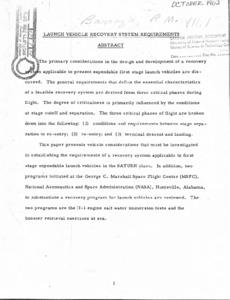
"Launch Vehicle Recovery System Requirements."
The primary considerations in the design and development of a recovery system applicable to present expendable first stage launch vehicles are discussed. The general requirements that define the essential characteristics of a feasible recovery system are derived from three critical phases during flight. The degree of criticalness is primarily influenced by the conditions at stage cutoff and separation. The three critical phses of flight are broken down into the following: (1) conditions and requirements between stage separation to re-entry; (2) re-entry; and (3) terminal descent and landing. -
"Failure Investigations of Large Liquid Propelled Rocket Engine Components."
Case histories of seven typical failures in large liquid propelled rocket engines components have been prepared. Quite simple to complex investigations are presented covering a variety of failure modes in a variety of materials. Included are successful solutions to the failure problems investigated.; Archive copy is a poor photocopy. -
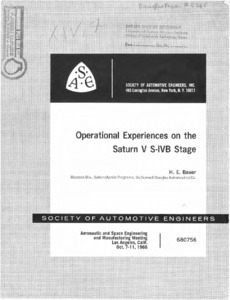
"Operational Experiences on the Saturn V S-IVB stage."
This paper presents a light, but reverent, discussion of some of the Douglas operational experiences on the Saturn V/S-IVB stage. Certain relevant aspects of earlier work on the Thor intermediate range ballistic missile, the Saturn I S-IV stage, and the Uprated Saturn I S-IVB stage are also discussed.; Aeronautic and Space Engineering and Manufacturing Meeting, Los Angeles, Calif., Oct. 7 - 11, 1968. -
"History of MSFC Reliability Philosophy."
Paper given to North East Chapter , Mississippi Society of Professional Engineers. Essay discussing the history of the MSFC Reliability Philosophy. -
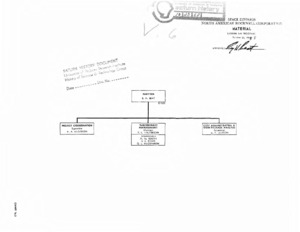
"Material : Saturn S-II program."
Saturn S-II Program Organizational chart. -
"Vibration and acoustic environment characteristics of the Saturn V launch vehicle."
This paper presents representative examples of vibration and acoustic data from flights of the Saturn V launch vehicle and static firings of Saturn V launch vehicle stages. The purpose of the paper is to provide vibration and acoustic environment characteristics which are pertinent to the design of launch vehicles -
Telegraphic message containing an Apollo Program Flash Report.
This message for the Apollo Program Director contains a report of the Apollo launch vehicles, problem that occurred, and actions required. The photocopy is difficult to read. -
"Apollo Vehicle Propulsion Systems."
This paper discusses the propulsion requirements for various stages of the Apollo vehicles and the development of these engines. -
"Recent NASA experience with hydrogen engines."
This paper presents a review of the experience which has accumulated in the development of the Liquid Hydrogen J-2 and RL10 rocket engines. These engines are being developed by the Rocketdyne Division of North American Aviation and Pratt & Whitney Aircraft, a Division of United Aircraft Corporation respectively.; On NASA Technical Reports Server (NTRS) as Unclassified; No Copyright; Unlimited; Publicly available. Also found on AIAA site. -
"Recent NASA experience with hydrogen engines."
This paper presents a review of the experience which has accumulated in the development of the Liquid Hydrogen J-2 and RL10 rocket engines. These engines are being developed by the Rocketdyne Division of North American Aviation and Pratt & Whitney Aircraft, a Division of United Aircraft Corporation respectively.; On NASA Technical Reports Server (NTRS) as Unclassified; No Copyright; Unlimited; Publicly available. Also found on AIAA site. -
Telegraphic message containing an Apollo Program Flash Report.
This message for the Apollo Program Director contains a report of the Apollo launch vehicles, problem that occurred, and actions required. The photocopy is difficult to read. -
"Preliminary skeletal operations plan for Apollo :" a systems engineering support document.
The Preliminary Skeletal Operations Plan is a statement of the operational concept for Apollo. This draft contains a description of the conduct of the Apollo LOR landing mission and a mission profile. It provides the basis for more detailed mission planning, for generating functional criteria for equipment design, and for measuring the adequacy of the current Apollo hardware for satisfying operational needs. -
"Saturn IB ESE interlock system."
The results of an OMSF AS-201 Interlock and RCA 110A Computer Review were published. Recognizing that this was a "quick look", it was determined that a more detailed approach should be taken with respect to interlocks for the duration of the Saturn IB-V program.