
Browse Items (970 total)
Sort by:
-
"Apollo 10 to simulate lunar landing mission."
A news article describing that Apollo 10's goal is to simulate a lunar landing in preparation for the real mission. -
"NR executives hail technology exchange."
A news article detailing a Technology Exchange event held by North American Rockwell Corperation. -
"Some computer applications in Saturn stage checkout."
This paper discusses a number of interesting applications of digital computers in the checkout of individual Saturn stages and in the prelaunch checkout of the complete Saturn vehicle. It discusses the concepts of automation in Saturn checkout, the unique two-computer mode of operation at the launch site and the operations of the high speed data link connecting the two computers. Also discussed are the functions of the computer while propellants are loaded automatically on one of the stages; the functions of the display computer in the newest and largest Saturn display system, and operations and utilization of the Digital Events Evaluator, the main recording device utilized during stage checkout. -
"Some select physiological, anthropometric, and human engineering data useful in vehicle design and logistic problems of space flight operations."
Report No. DSP-TM-2-60 31 p.; Pages which were blank (not scanned): 2, 26, 28 -
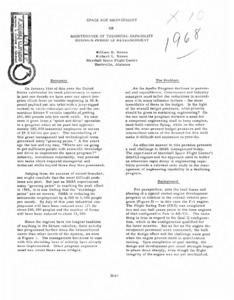
"Space age management or maintenance of technical capability during a period of retrenchment."
On January 3Ist of this year the United States celebrated its tenth anniversary in Space. In just one decade we have seen our space program climb from an humble beginning (a 30.8-pound payload put into orbit with a jury-rigged rocket) to extra-vehicular-activity and the tremendous Saturn V vehicle capable, of putting 250,000 pounds into low earth orbit. We have seen it grow from a "quick and dirty" operation to a program which at its peak had approximately 380,000 industrial employees in excess of {dollar}5.O billion per year. The marshalling of this great management and technological team generated many "growing pains". A few years ago the hue and cry was, "Where are we going to get sufficient people with scientific knowledge and drive to implement the space program?" Industry, sometimes reluctantly, was pressed into tasks which required managerial and technical skills beyond those they then possessed. -
"Space and the working woman."
Memorandum prepared for the honoring Amelia Earhart by the Zonta Club, Birmingham, Alabama. -
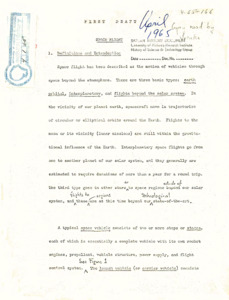
"Space flight : first draft."
Appears to be a rough dfraft with editorial comments and revision notes. Includes references to figures and tables.; Page 31 is missing. Pages 37 through 44 do not exist; there is a note about this on page 36. Page 67 also does not exist. -
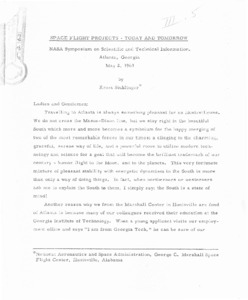
"Space flight projects - today and tomorrow."
NASA symposium on scientific and technical Information. -
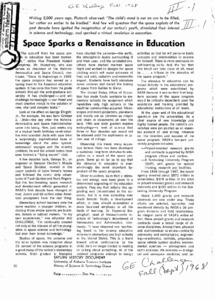
"Space sparks a renaissance in education."
An article which comments on the increasing interest in science and education due to the greater understanding of space. -
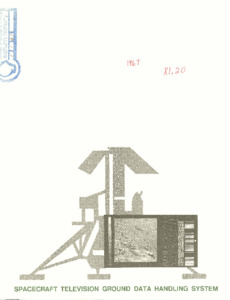
"Spacecraft television ground data handling system."
A design report which displays and explains how the Spacecraft Television Ground Handling System functions, is designed and what it might be used for in the future. -
Space vehicles for the peaceful exploration of the inner solar system; Memorandum to Mr. K. K. Dannenberg from Joe M. Jones.
Review of speech to be presented in Tampa, FL. Speech included references to slides. -
"Space vehicle systems" research and technology.
A collection of various graphs, resumes and recordings for space vehical systems. -
"Space vehicle test stands."
One of the pacing items in this Nation's accelerated space program is the construction of facilities for the manufacture, development, testing, check-out, transportation and launching of space vehicles. Behind each successful launching are countless hours of effort in development, quality and reliability checks and tests of engines, components, boosters, and stacked stages; including pressure tests, cold-flow tests and hot firing (or static) tests; all to assure the safest possible trip for the men or instrumentation in the space craft. -
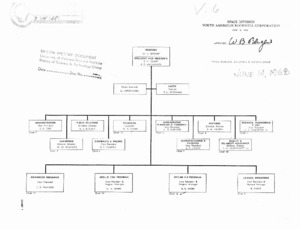
"Space Division, North American Rockwell Corporation Organizational Chart."
Organization chart for North American Rockwell, 1968 -
"Sperry Rand monthly progress report for July, 1969."
The following pages contain reports for each of the individual contract appendices covering technical progress and accomplishments, related problems, and staffing progress. The report of manhours expended against each appendix by schedule order is being submitted as a part of the financial management report. -
"A new telemetry technique."
A technique new to telemetry is discussed which promises to alleviate an enigma facing the telemetry engineer : How to adequately transmit the avalanche of vibration and other wideband data desired in the development phase of large missiles and launch vehicles. The data channels are stacked in the frequency spectrum as single sideband subcarriers which frequency modulate the RF carrier. The system design utilizes to advantage the statistical properties of vibration data to achieve maximum data transmission efficiency from the available RF carrier deviation. However, in contrast to proposed statistical predigestion techniques, the data is transmitted in raw form. -
"Stability analysis of Apollo - Saturn V propulsion and Structure feedback loop."
The propulsion and the structure of a space vehicle form a feedback loop through inertial coupling referred to as the pogo phenomenon and experienced with the Thor , Titan, and Apollo-Saturn V space vehicles. -
"Standards of conduct for NASA employees."
NASA handbook which establishes what code of conduct is acceptable as a representative of the company and what behavior is not. -
"Standard procedure for using units of mass, weight, force, pressure and acceleration."
Report No. DT-TM-1-60. ; FORWARD: The field of missiles and rockets deals with quantities of matter at various locations with different accelerations of gravity. The weight of these masses changes with gravity and the measurements of liftoff weight, fuel weight, etc., result in different values, depending on whether mass or weight units are used. Pressure and thrust are independent of the acceleration of gravity, but the instruments for measuring these values are calibrated with standard masses, producing different weight forces and calibration curves at different locations. Most sections of ABMA and other agencies or companies use pounds or kilograms as units of mass, weight or force, and the influences of different accelerations of gravity are often disregarded or treated incorrectly. These discrepancies become increasingly unacceptable with larger missiles and greater distances between operation sites. Therefore, the following Standard Procedure has been prepared to insure consistent and uniform terms and units of mass, weight, force, pressure and acceleration. All sections and individuals concerned are urged to use these units andprocedures. This is signed by Dr. Wernher von Braun, Director Development Operations Division. -
"Statement of George E. Mueller, Associate Administrator for Manned Space Flight before the Committee on Aeronautical and Space Sciences, United States Senate."
Presentation of George Mueller before congress. Contains illustrations.