
Browse Items (970 total)
Sort by:
-
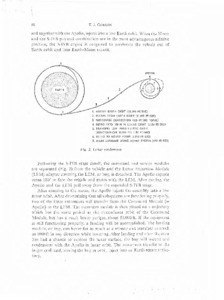
"A survey of propulsion problems as related to space vehicle design."
Incomplete document. Displays errors in space-vehicle design as they relate to space travel. -
"Systems applications in orbital launch operations."
The objective is to examine the technical requirements and feasibility of conducting orbital launch operations with systems now in the development phase. In order to maintain realistic constraints on the analysis, the Saturn S-IVB stage has been used as an example of present stage technology. The requirements, procedures and complexity of operations for orbital assembly and launch are discussed. The primary design requirement for orbital assembly and launch operations is increased orbital stay time (from hours to days or weeks). -

"System description for Saturn vehicle (SA-1 through SA-4)."
Missing pages iv, 3, 6 to 8. Photocopy of files containing sections of the project. -
"System engineering propulsion, III-C-1."
Page numbering is inconsistent; there are no pages numbered 14 - 17. Some pages have handwritten numbers, others have no numbers at all.; The print quality of many pages is poor. Discusses the definition and function of propulsion as well as how to most effectively employ it . -
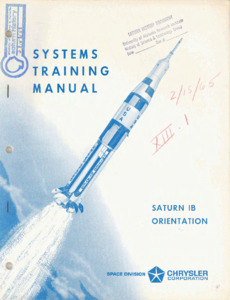
"Saturn IB orientation training manual."
Prepared through joint efforts of Personnel Department, Education and Development Branch, Systems Training Unit, Michoud Operations and Engineering Communications Department, Technical Information Branch, Applied Communications Engineering Section, Huntsville Operations.; This publication presents a brief descriptive summary of the Saturn IB vehicle and Chrysler's Corporation's accomplishments in the missiles and space field. The Saturn IB information presented herein is based on current plans for each of the stages. Although there may be design changes from vehicle to vehicle, the basic components, systems, and operating principles will remain similar to previous models. -
"System safety handbook."
The testing of a hardware system consists of' subjecting it to carefully controlled operating conditions for the purpose of demonstrating that this system performs its function properly. -
Technical facilities and capabilities 1969.
This brochure is being distributed to colleges and universities to acquaint and interest their students, at all acadmic levels, with the wide variety of professional and technical skills that are essential to accomplish the complex mission of the Army Missile Command, located at Redstone Arsenal, enar Huntsville, Alabama. -
"Technical facilities & equipment digest."
This document portrays the capability of technical facilities and equipment at the George C, Marshall Space Flight Center (MSFC) , one of three basic field centers under the NASA Office of Manned Space Flight. -
"Techniques of implementing launch automation programs" (Saturn IB space vehicle system).
This paper identifies the methods and equipment through which automation is becoming a major factor in testing and launching Saturn IB space vehicles. The merits of a digital guidance computer and its impact in extending automated checkout are stressed; also a logical basis is established for computer and manual test control. Hardware and software elements of the automated system are described, and details pertaining to reliability are emphasized. A concluding appraisal suggests that automation will play an expanding role in future test and launch operations. -
"Technical information summary Apollo-10 (AS-505) Apollo Saturn V space vehicle."
The document presents a brief and concise description of the AS-505 Apollo Saturn Space Vehicle. Where necessary, for clarification, additional related information has been included. -
"Technical Information Summary Apollo-9 (AS-504) Apollo Saturn V Space Vehicle."
The document presents a brief and concise description of the Apollo 9 Saturn Space Vehicle. -
"Technical information summary concerning Saturn vehicle SA-3."
This memorandum outlines, through a series of sketches, some of the important features and sequences concerning the third SATURN flight vehicle. The sketches are devoted primarily to the control and instrumentation aspects of the vehicle but also touch on the launch facility and countdown schedule. -
"Technician inspects an RL10 liquid hydrogen engine."
A technician inspects an RLlO liquid hydrogen rocket engine OD the assembly floor. of Pratt & Whitney Aircraft's Florida Research and Development Center. The 115,000-pound-thrust RLlO was designed and developed for the National Aeronautics and Space Administration's Saturn S-IV azld Centaur space vehicles. -
"Technique for reliability circuit design review in space electronics."
Design review is becoming a basic requirement during the design and development of military systems. The main purpose of the design review is to increase the system's inherent and operational reliability. The major portion of this paper is the result of reliability's effort to comply with Paragraph 3.6 of NPC 250-1 Reliability Program Provisions for Space Contractors. The design review to be discussed is a reliability circuit design review with emphasis placed on what should be reviewed and the review techniques employed. The basic circuit design review prerequisites, component parts and their ratings, are discussed at the beginning of this paper. The remainder deals with the organization and reviewing of circuits. The review items include worst-case circuit performance, component applications, failure mode analysis, noise rejection, electrical stress, and the determination of component temperatures. Many examples are included to illustrate how each item was accomplished. This paper is intended not only to give the reliability analyst cognizance of basic design problems and troublesome circuits, but also, to aid him in formulating a design review program. -
"Technical problems in on-board checkout systems."
For the purposes of this paper, an onboard checkout system is defined as a system which is built into prime flight equipment, flies with it, and permits a checkout capability to exist during all the major phases of the test and mission life of that prime equipment. Varying degrees of capability may exist in such a system, depending on what is designed into it. This, in turn, is generally dependant on life and mission requirements of the prime equipment, degree of mission checkout required, reliability restrictions,redundancy levels, data management scheme, and equally important, state of the art . Not all checkout can be accomplished with onboard equipment. Mechanical system problems such as leak detection, for example, require techniques that cannot be remotely controlled and evaluated today. On the other hand, such things as in-flight telemetry have been used for quite a long time and will continue to be used for onboard checkout. -
"Technological problems of the Saturn class vehicle."
Aerospace Workshop. University of Hawaii.; Includes references to slides. -
"Technical information summary concerning Saturn vehicle SA-3."
This memorandum outlines, through a series of sketches, some of the important features and sequences concerning the third SATURN flight vehicle. The sketches are devoted primarily to the control and instrumentation aspects of the vehicle but also touch on the launch facility and countdown schedule. -
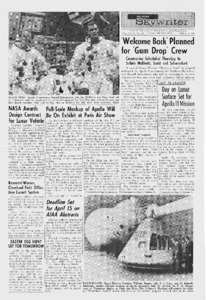
"Welcome back planned for 'Gum Drop' crew."
A news article detailing the festivities planned upon the return of nine astronauts returning from a 10-day mission. -
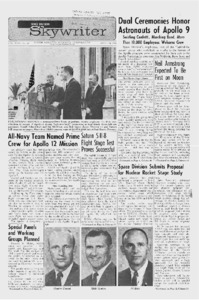
"Dual ceremonies honor astronauts of Apollo 9."
A news article detailing the 'welcome back' ceremony for the nine astronauts who had just returned from a 10-day mission. -
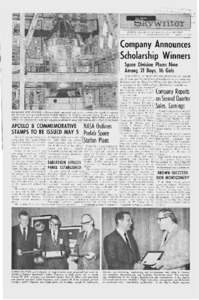
"Company announces scholarship winners: Space Division places 9 of 21 boys and 16 girls."
A news article detailing the winners of scholarships from a competition held by Space Division. This contest was held for the children of Space Division employees.