
Browse Items (970 total)
Sort by:
-
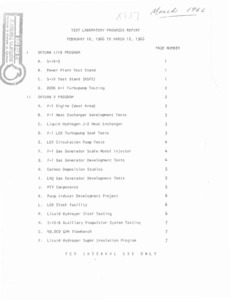
"Test Laboratory progress report" Febuary and March.
Monthly rogress report for the test laboratory regarding the Saturn 1B program between Feburary and March -
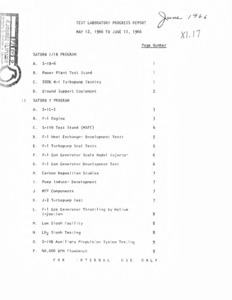
"Test Laboratory progress report" May and June.
Monthly rogress report for the test laboratory regarding the Saturn 1B program between Feburary and March -
"Test Laboratory monthly progress report" August.
Laboratory monthly progress report for the Saturn 1B program between dates August 1st through August 31st, 1967. -
"Test Laboratory monthly progress report" July.
Laboratory monthly progress report for the Saturn 1B program between dates July 1st through July 31st, 1967. -
"Test Laboratory monthly progress report" December.
Laboratory monthly progress report for the Saturn 1B program between dates December 1st through December 31st, 1967. -
"Test Laboratory monthly progress report" October.
Laboratory monthly progress report for the Saturn 1B program between dates October 1st through October 31st, 1967. Page 17 missing. -
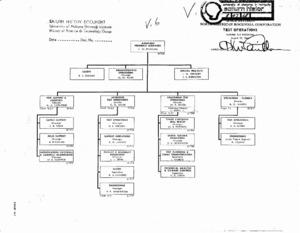
"Test operations:" Organization Chart.
Organization Chart of the North American Rockwell Test Operations. -
"Test procedure validation by computer simulation."
Digital computer simulation of the Saturn I Instrument Unit electrical networks was accomplished using the Discrete Network Simulation programs. The schematics were analyzed and a logic model prepared which consisted of a series of Boolean equations. The test procedures, which are written in the Acceptance, Test, or Launch Language (ATOLL), consist of a sequential set of computer instructions for the RCA llOA checkout computer to control the operation of the electrical networks. The procedures also contain the predicted results for each operation. The driving functions for the simulation of the model are generated from the ATOLL test tape by the Input Generator Program. The time sequenced operation of the networks is indicatedby the output from the simulation program in addition to the number of times each component in the system changes state. The results of the simulation are compared to the test procedure predictions on the ATOLL tape by the Comparator Program and any differences are listed. The Comparator Program also lists any component which did not change state at least once. -
"The development of a checkout language : ATOLL."
ATOLL was developed to fulfill the requirements for a common computer language that could be used by the test engineers for launch and factory checkout. "ATOLL" is the abbreviated name for Acceptance, Test, Or Launch Language. -
"The development of a bonded common bulkhead for Saturn."
A Part of the development of the Saturn S-IV/S-IVB stage the Douglas Aircraft Company has pioneered in the development of the cryogenic common bulkhead. The term common bulkhead is derived from the design function of the bulkhead, which is to separate the two cryogenics, liquid hydrogen and liquid oxygen, in a single tank, thereby shortening the stage and eliminating the necessity for two separate bulkheads and the associated interstage structure. The common bulkhead is structurally adequate to withstand both the thermal and the pressure loads from both the hydrogen and the oxygen tanks, and it has sufficient insulation properties to prevent the liquid hydrogen from freezing the liquid oxygen. Another benefit from the common bulkhead is that it permits a reduction in the total length of the vehicle, thereby reducing the bending moments. -
"The ease (E's) of implementation of the Safety Program at the Marshall Space Flight Center."
Presented at the 19th Annual Federal Safety Conference, National Safety Congress, Chicago, Illinois. A rundown of the new safety protocols, chiefly favoring the letter 'E.' -
"The history of Army missile development."
Published as "Army Missile Development," Army Information Digest, XI. Establishes the development and history of weaponized rocket ordenance. -
"Statistical model for Saturn electrical support equipment mission availability."
This report presents the logic leading to a mathematical expression for mission availability. Mission availability is treated as the probability that the cumulative downtime occurring during a mission of given length will be less than the time constraint. This is opposed to more general approaches such as steady state or instantaneous availability or operating time versus real time. We intend to present a practical and usable mathematical model by deduction and demonstration. The development is based on exponentially distributed downtimes. Experience shows that certain systems follow exponential downtime distributions except near zero. This error is often so small that it may be neglected. A future report will present a downtime distribution which will account for this small error. -
"Static test of Saturn V S-IC : news release.
Report after second Saturn V flight test. -
"Structural problems of large space boosters."
Report discussing the flaws in having large rocket boosters. -
"Structure of the NASA/Grumman lunar module."
Describes the structure and function of each part of the NASA Lunar Module -
"A summary of major NASA launchings" between October 1st and December 31st, 1968.
This is the first Quarterly Supplement to the October 1968 edition of GP 381, ''A Summary of Major NASA Launchings (Eastern Test Range and Western Test Range)." This Supplement covers the period from October 1 to December 31, 1968. Two additional Quarterly Supplements will be issued during 1969. Each of these will list those major NASA launchings occurring during the three-month period it covers. The basic publication will be revised and reissued, incorporating the information contained in the Supplements, as well as covering the final three-month period, subsequent to October 1, 1969. William A. Lockyer, Jr. -
"Propulsion and Vehicle Engineering Laboratory monthly progress report" April.
Monthly progress report for the Propulsion Division, April 1st through April 31st -
"Propulsion and Vehicle Engineering Laboratory monthly progress report" May.
Monthly progress report for the Propulsion Division, May 1st through May 31st -
"Survey of Saturn stage test and checkout computer program development."
This survey of the Saturn Stage Test and Checkout Computer Program Development contains a summary description of the systems developed for factory and static test of the stages of the SATURN IB and SATURN V Vehicles. The responsibilities of the MSFC and stage contractor organizations that are involved in test and checkout computer program development are briefly described. The test and checkout hardware and software (computer program) systems are given for each stage and for each site where tests are conducted. The systems and procedures that are used for program production verification, documentation, and change control required for the implementation of planned computer programs are included. Notes are included in the report to indicate what material is missing or incomplete. No attempt has been made to draw any conclusions regarding the automatic test and checkout systems being developed for each stage and the manner in which the efforts are organized, scheduled, and implemented. This document has been based on material provided by stage contractors and by components of MSFC through May 1, 1966. COMPUTER SYSTEMS SECTION. VEHICLE SYSTEMS INTEGRATION BRANCH. VEHICLE SYSTEMS CHECKOUT DIVISION.; SR-QUAL-66-3.