
Browse Items (395 total)
Sort by:
-
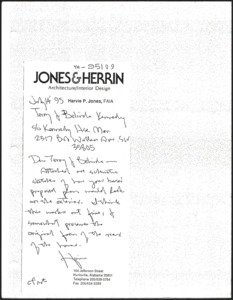
Architecture notebook 58: Fisher Oldfield House, at 14202 Meridian Pike, Hazel Green, Alabama.
Oldfield Towry House, built c. 1885. Built in a symmetrical Victorian style. Located at 14202 Meridian Pike, Hazel Green, Alabama. -
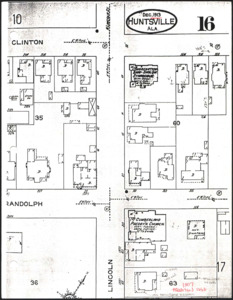
Architecture notebook 58: Freeman House, at 205 Lincoln St., Huntsville, Alabama.
Freeman House, built 1907, is neoclassical design mimickking the 18th-century Georgian style, also known as "Colonial Revival." Some Victorian style features as well. Servants cottages remain in the backyard. Located at 205 Lincoln St., Huntsville, Alabama. -
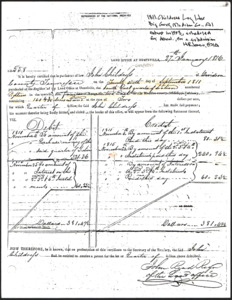
Architecture notebook 58: Childress Log House, at Ripple Lane, Big Cove, Alabama.
Childress Log House, built in 1811. Moved from original location in 1832. Owner Robert Childress had 17 children. House had asphalt siding and a Victorian style porch. Located at Ripple Lane, Big Cove, Alabama. -
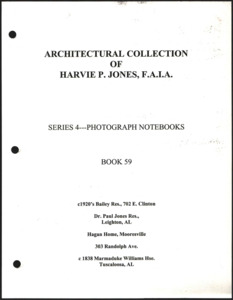
Architecture notebook 59: Bailey Residence, at 702 E. Clinton Ave., Huntsville, Alabama.
Bailey Residence, built in the 1920s. Renovation was never executed by Jones and Herrin, Architectures. Located at 702 E. Clinton Ave., Huntsville, Alabama. -
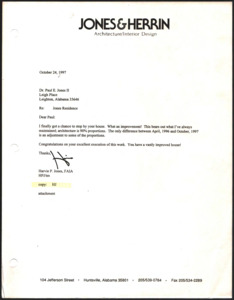
Architecture notebook 59: Leigh Place, or Jones Residence, in Leighton, Alabama.
Leigh Place, or Jones Residence, first floor was build in 1820s as a log house, second floor and extension built c. 1960. Jones and Herrin, Architects did proportional refinements in 1997. Includes a early 19th century servants house that was planned to be demolished by owner. Located in Leighton, Alabama. -
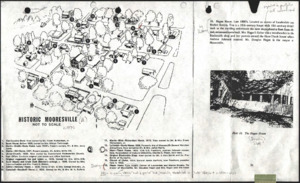
Architecture notebook 59: Hagan House, at 24937 Lauderdale St., Mooresville, Alabama.
Hagan House, built circa 1820 in Federal period style with additions in Victorian style. Expanded throughout the 19th century. Owned by Mr. Douglas Hagan, mayor of Mooresville. Located at 24937 Lauderdale St., Mooresville, Alabama. -
Architecture notebook 59: Marmaduke-Williams House, at 907 17th Ave., Tuscaloosa, Alabama.
Marmaduke-Williams House, built in 1838, also known as the Owen-Williams-Brown House. Land was once owned by the University of Alabama. Built by Thomas Owens shortly after purchasing the land. Owens moved to Aberdeen, Mississippi upon the purchase of a plantation and this house was occupied by his in-laws, the Marmaduke Williams. During the renovation project (1994-1997) in 1996, the house was the victim of arson and destroyed the interior. A previous fire 1992 had already caused considerable damage. Located at 907 17th Ave., Tuscaloosa, Alabama. -
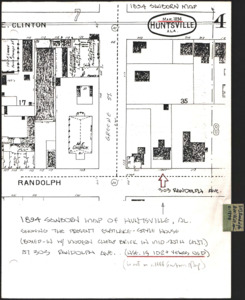
Architecture notebook 59: House at 303 Randolph Ave., Huntsville, Alabama.
Eastlake style house built affter 1888 and before 1894. A brick wing was enlarged after 1894. Renovated to be an office. Located at 303 Randolph Ave., Huntsville, Alabama. -
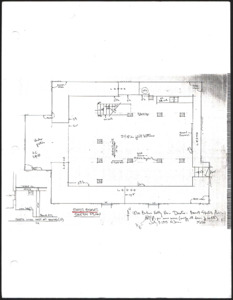
Architecture notebook 60: Kelly Residence at 508 8th Ave., Decatur, Alabama.
Kelly Residence, built c. 1915. Remodeled in 1995-6. Located at 508 8th Ave., Decatur, Alabama. -
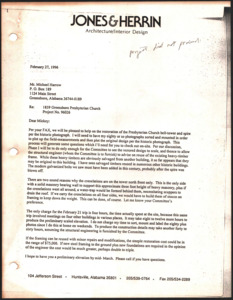
Architecture notebook 60: Presbyterian Church, on Main St., Greensboro, Alabama.
Greensboro Presbyterian Church, built in 1859. The original spire and belfry was lost before restoration project after "Mission style Gothic" remodeling occurred in the 1920s. The restoration saw the return of a spire and tower. Located on Main St., Greensboro, Alabama. -
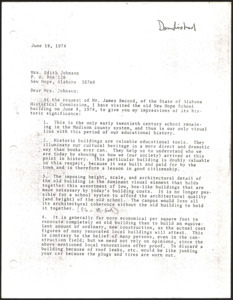
Architecture notebook 60: New Hope High School, in New Hope, Alabama.
New Hope High School, built in the early twentieth century (c. 1920). Despite Harvie Jones' attempt to demonstrate the benefit of renovation, funds were unable to be raised and the school is demolished in 1975. Located in New Hope, Alabama. -
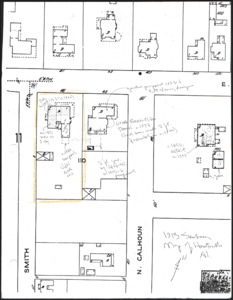
Architecture notebook 60: Dr. Hash Residence, at 514 E. Holmes Ave., Huntsville, Alabama.
Dr. Hash Residence, built c. 1870 and c. 1900. Renovation included a potting shed and three car garage. Located at 514 E. Holmes Ave., Huntsville, Alabama. -
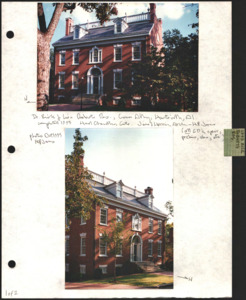
Architecture notebook 60: Rick Roberts House, at 10 Cruse Alley, Huntsville, Alabama.
Rick Roberts Residence, built in 1995 by Jones and Herrin, Architects. Includes a terrace and courtyard. Located at 10 Cruse Alley, Huntsville, Alabama. -
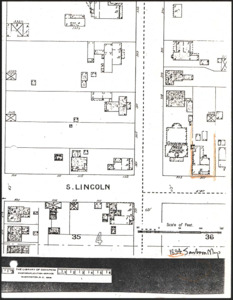
Architecture notebook 60: Feeney-Brooks House, at 203 S. Lincoln St., Huntsville, Alabama.
Feeney-Brooks House, or the Miller House, built in 1829. Original structure added onto in 1861, and again in the eary 20th century. The house was demolished in 1983 by Central Presbyterian Church despite objections from the Huntsville Historical Preservation Commission, for an elaborate garden the Church never built. Located at 203 S. Lincoln St., Huntsville, Alabama. -
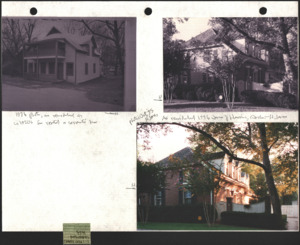
Architecture notebook 60: Haws Carriage House, at 606 Greene St., Huntsville, Alabama.
Haws carriage house, built c. 1900. Remodeled for rental or servants' house and again by Jones and Herrin, Architects in 1976. Located at 606 Greene St., Huntsville, Alabama. -
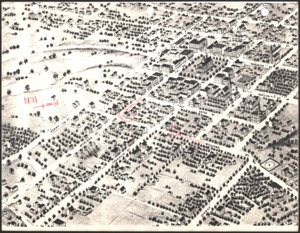
Architecture notebook 60: Public Inn, at 205 Williams Ave., Huntsville, Alabama.
Public Inn, built c. 1818 at the northeast corner of Madison and Williams and moved to current site in November 1926. Opened to the public on October 29, 1819 by William E. Phillips. There was an addition in 1832. Built in the "Neo-Classical" style with English influences. Another addition to the rear of the houses was built in 1927 after it was moved. Restoration was completed in 1991. Located at 205 Williams Ave., Huntsville, Alabama. -
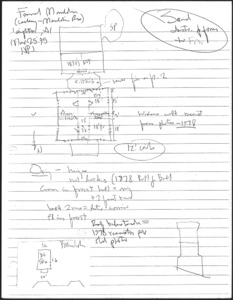
Architecture notebook 60: Leckey House, at southwest corner of AL 20 and Co. 48 (County Line), Leighton, Alabama.
Leckey House, or the Leckey-Mauldin house, built 1872-73 for Hugh C. Leckey, an Irish-born merchant. Single story home with Italiante style details. Renovated in 1991-1992 with additions made including a carport. Located at the southwest corner of AL 20 and Co. 48 (County Line), Leighton, Alabama. -
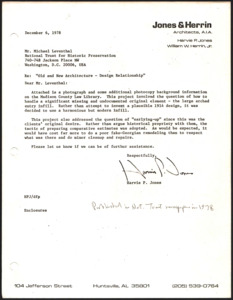
Architecture notebook 60: Law Library, at 205 East Side Square, Huntsville, Alabama.
Elbert H. Parsons Madison County Law Library, built 1914, was originally a Deparment store and an adult movie theater. A skylighted window was installed on the walkway in front of the building when c. 1830 brick was uncovered 12 inches below the present walkway. Located at 205 East Side Square, Huntsville, Alabama. -
Architecture notebook 60: Railroad Bridge, at Beaverdam Creek near AL 20, Greenbriar, Alabama.
Stone arch railroad Bridge, built 1873, presumably built from local limestone. Located at Beaverdam Creek near AL 20, Greenbriar, Alabama. -
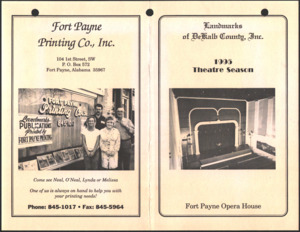
Architecture notebook 60: Opera House, at 510 N Gault Ave., Fort Payne, Alabama.
Fort Payne Opera House, built c. 1885, set to be partially renovated in 1979 but never executed due to small budget. Located at 510 N. Gault Ave., Fort Payne, Alabama.