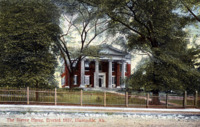
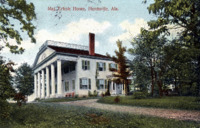
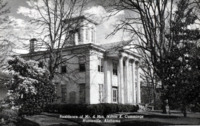
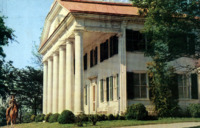
Front: Residence of Mr. & Mrs. Milton K. Cummings, Huntsville, Alabama Back: This residence was built in 1860 by Major Robert H. Watkins. In 1863 became the headquarters of General John A. Logan of U. S. Army during the time he was Federal Commander of Huntsville.
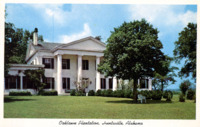
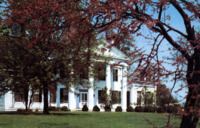
Front: Oaklawn Plantation, Huntsville, Alabama Back: OAKLAWN PLANTATION, HUNTSVILLE, ALABAMA This is but one of many outstanding Ante-Bellum homes in the area. Its present owner, Mr. Max Luther, has modernized the building without losing any of its gracious beauty, surrounded by almost 200 acres which is now being operated as a stock farm.
Back: OAKLAWN PLANTATION - one of the most beautiful ante-bellum homes in Huntsville, Alabama - was built around 1844 and served as a hospital during the Spanish-American War. The late Max Luther transformed the 175 acre estate into a stock farm. He also maintained a very fine stable for his noted five- and three-gaited saddle horses.
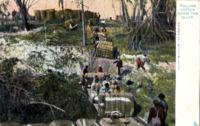
Front: Rolling Cotton Down the Bluff, Huntsville, Alabama Back: ROLLING COTTON DOWN THE BLUFF. This picture shows the negroes rolling the cotton down the bluff to be loaded on the waitiug steamer. The average bale weighs 500 pounds. One hundred years ago it would have taken a person working night and day two years to separate the seed from the cotton in one bale; to-day a battery ginnery has a capacity of 155 hundred pound bales in twelve hours.
Back: Pope-Scragins [sic] Home, Huntsville, Ala. This home was built in 1815 by Col. Leroy Pope, "The Father of Huntsville", and overlooks a hill. Later it became the home of Leroy Pope Walker, who as Secretary of War for the CSA, gave the order to fire on Fort Sumter, which began the War Between the States.