
Browse Items (42 total)
Sort by:
-
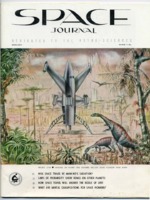
Space Journal, vol. 1, no. 5, March-May 1959.
This issue includes a statement announcing Space Journal's termination of all connections with the U.S. military and with the Rocket City Astronomical Association. At the time, commander of the Army Ballistic Missile Agency (ABMA) at Redstone Arsenal Gen. John B. Medaris was concerned that the publishers and writers, all in the employ of ABMA, were using their government positions for personal gain through the magazine. Topics covered in the issue include the dangers and feasibility of space travel, designing buildings for life on the Moon, and the existence of life elsewhere in the universe. -
-
-
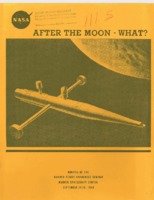
"After the Moon - What? Minutes of the Manned Flight Awareness Seminar."
The seminar was held at the Manned Spacecraft Center, September 25-26, 1969. -
"Application of the Saturn V Launch Vehicle to Unmanned Scientific Exploration of the Solar System."
According to the foreword, "This paper presents the results of a twelve-week mission and systems analysis of a combined Jupiter orbiter/solar probe mission utilizing the Saturn V launch vehicle." -
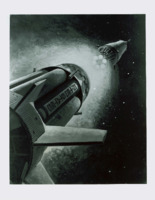
Artist's Conception of the RL10-powered Saturn S-IV Stage.
This artist's rendering of the RL10-powered Saturn S-IV stage is depicted as heading toward deep space after separation from the booster. The drawing is accompanied with a brief description of the Saturn S-IV. -
Saturn Illustrated Chronology, 1965
NASA and MSFC -

Oral History Interview With Allen Ware
Allen Ware is originally from Atlanta Georgia. He attended Auburn University where he studied Industrial Design . He moved to Huntsville, AL in 1983 to work for a company called "Essex." He worked there from 1983-1991. There, he produced a variety of things. First, he helped produce the Hubble Space Telescope mock-up and crew trainers. Then, he produced some other shuttle mock-ups. After leaving "Essex," he started to work at Boeing in Huntsville where he worked on the International Space Station. There, Ware was an internal and external packager configurator. He did that job for 15 years. He then transitioned to support the Delta IV launch vehicle out of Decatur. There, he did secondary structure design for Delta IV components. Ware is currently an Engineering manager of a Mechanical design team. He has about 15 engineers under him that do spacecraft, aircraft, and launch-vehicle design.Tags Oral History -
Oral History Interview With Joe Phillipauldy
Joe Phillipauldy is originally from Central, New Jersey. He did his undergraduate training at the University of Richmond in Virginia, and then he received his Master's degree at Villanove University. He then when on to get his graduate degree, and completed the program in 1984. His degree was in Experimental Psychology. In 1986, he accepted a job position with the Creatis Systems Tech Staff at Boeing Military Airplanes in Kansas. His first Human Engineering job was with Tech Staff. A project he spent a lot of time on was the Airforce I VC25 747 Presidential Replacement Program. With this, he did a workload analysis of the navigator crew station. After this work, Joe got involved with the Human Factors and Industrial Applications group. There, he ran task terms around the factory floor doing analyses and reporting on ergonomics issues on assembling vehicles. Later, he was able to work on the Space Station Vehicle Integration Contract in Huntsville, AL.Tags Oral History -
Oral History Interview With George Hamilton
George Hamilton has lived in Huntsville, Alabama all of his life, and his father was a Charter Marshall Member in Huntsville. When he was working, George's father was chosen as a "guinea pig" to go up in the Pregnant Guppy, which was a large, wide-bodied cargo aircraft. Because of George's father's career and interest with NASA, it made George interested in the career as well. George has a lot of family stories like this, which all have inspired him to take on his career that he has now. After high school, George went to The University of South Alabama in Mobile to study Marine Biology. Over the summer he had a change of heart, so he decided to transfer to Auburn University for Mechanical Engineering. After he finished up with his degree, he started working in small, manufacturing spare parts for missiles. After this career, he started to work at Avco Electronics in Huntsville where he worked at the plant on the design side. After this, Avco started looking for people to go overseas on the construction side of the house, so George went overseas with them. Then he came back, got married, and received his Phd in Biomedical Engineering at The University of Alabama in Birmingham.Tags Oral History -
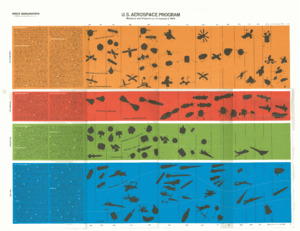
"U.S. Aerospace Program: missions and projects as of January 1, 1966."
The document contains four charts labeled "Investigation", "Exploration", "Utilization", and "Control". Each chart is organized chronologically, contains drawings of U.S. Aerospace Program Projects, and incudes written descriptions of each project. -
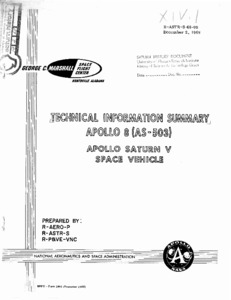
"Technical Information Summary Apollo 8 (AS-503) Apollo Saturn V Space Vehicle."
This document is prepared jointly by the Marshall Space Flight Center laboratories R-AERO-P, R-ASTR -S, and R-P&VE-VN . The document presents a brief and concise description of the AS-503 Apollo Saturn Space Vehicle. Where necessary, for clarification, additional related information has been included. It is not the intent of this document to completely define the Space Vehicle or its systems and subsystems in detail. The information presented herein, by text and sketches, describes launch preparation activities, launch facilities, and the space vehicle. This information permits the reader to follow the space vehicle sequence of events beginning a few hours prior to liftoff to its journey into space. -
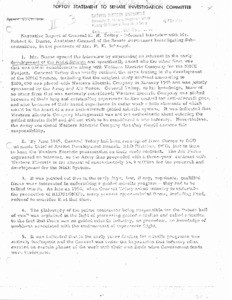
"Toftoy statement to Senate Investigation Committee": Development of the Nike system.
Narrative report of general H.N. Toftoy - Informal interview with Mr. Robert E. Dunne, Assistant Counsel of the Senate Permanent Investigating Subcommittee, in the presence of Mr. P. K. Schaeppi. -
"Technical information summary Apollo-10 (AS-505) Apollo Saturn V space vehicle."
The document presents a brief and concise description of the AS-505 Apollo Saturn Space Vehicle. Where necessary, for clarification, additional related information has been included. -
"Technical Information Summary Apollo-9 (AS-504) Apollo Saturn V Space Vehicle."
The document presents a brief and concise description of the Apollo 9 Saturn Space Vehicle. -
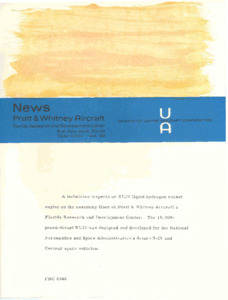
"Technician inspects an RL10 liquid hydrogen engine."
A technician inspects an RLlO liquid hydrogen rocket engine OD the assembly floor. of Pratt & Whitney Aircraft's Florida Research and Development Center. The 115,000-pound-thrust RLlO was designed and developed for the National Aeronautics and Space Administration's Saturn S-IV azld Centaur space vehicles. -
"Technique for reliability circuit design review in space electronics."
Design review is becoming a basic requirement during the design and development of military systems. The main purpose of the design review is to increase the system's inherent and operational reliability. The major portion of this paper is the result of reliability's effort to comply with Paragraph 3.6 of NPC 250-1 Reliability Program Provisions for Space Contractors. The design review to be discussed is a reliability circuit design review with emphasis placed on what should be reviewed and the review techniques employed. The basic circuit design review prerequisites, component parts and their ratings, are discussed at the beginning of this paper. The remainder deals with the organization and reviewing of circuits. The review items include worst-case circuit performance, component applications, failure mode analysis, noise rejection, electrical stress, and the determination of component temperatures. Many examples are included to illustrate how each item was accomplished. This paper is intended not only to give the reliability analyst cognizance of basic design problems and troublesome circuits, but also, to aid him in formulating a design review program. -
"Space flight : first draft."
Appears to be a rough dfraft with editorial comments and revision notes. Includes references to figures and tables.; Page 31 is missing. Pages 37 through 44 do not exist; there is a note about this on page 36. Page 67 also does not exist. -
"Selected methods for uprating Saturn vehicles."
This paper will discuss selected methods for increasing the Saturn launch vehicle payload capabilities. These methods involve system changes or additions that give large step performance'increases aver those which can be obtained by product improvements. The selected philosophy of approach and the established designed systems wil1,be described, as well as anticipatedsystem concepts that may be used to increase the Saturn vehicles' capabilities. -
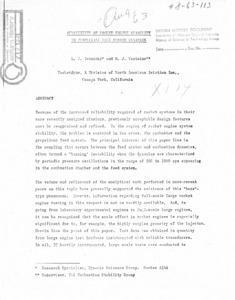
"Sensitivity of rocket engine stability to propellant feed system dynamics."
Because of the increased reliability required of rocket systems in their more recently assigned missions, previously acceptable design features must be reappraised ad refined. In the region of rocket engine system stability, the probles is centered in two areas, the combustor and the propellant feed system The principal interest of this paper lies in the coupling that occurs between the feed system and combustion dynamics, often termed a "buzzing" instability then the dymics are characterized by periodic pressure oscillations in the range of 200 to 1000 cps appearing in the combustion chamber and' the feed system.