
Browse Items (716 total)
Sort by:
-
Saturn Illustrated Chronology, 1965
NASA and MSFC -
Convective Energy Transport in Stellar Atmospheres: A Convective Cell Model.
One of the Orange Aid Preprint Series in Nuclear Astrophysics, September 1968.; Supported in part by the National Science Foundation [GP-7976], the Office of Naval Research [Nonr-220(47)]. ; ABSTRACT: The motion in a convectively unstable region is expanded into an ensemble of convective cells. Each of these cells interacts with the surrounding medium according to the semiempirical model proposed by Turner (1963 ). Possible detailed models of the flow patterns within each cell are presented. The radius and velocity of these cells are given as functions of distance moved. The convective flux and rms velocity are given as averages over the ensemble of cells. As in the standard mixing length theory the principle uncertainty remains the average initial radius of the cells. -
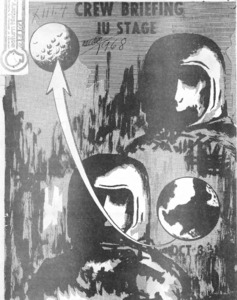
"Crew Briefing : Instrument Unit Stage Presentation".
Document outlining different slides of a presentation containing numerous organizational charts, diagrams and bullet-list points. -
"Film script for Saturn I/IB quarterly film report no. 15."
Unclassified film script of the Saturn I/IB Quarterly Film Report covering January, February, March, 1963. There are handwritten notes and edits throughout the document. -
"Film script for Saturn I/IB quarterly film report no. 16."
Unclassified film script of the Saturn I/IB Quarterly Film Report covering April, May, June, 1963. There are handwritten notes and edits throughout the document. -
"Film script for Saturn quarterly film report no. 18."
Unclassified film script of the Saturn I/IB Quarterly Film Report covering October, November, December, 1963. A handwritten note at the top of the title page lables this copy as the "Final Draft". -
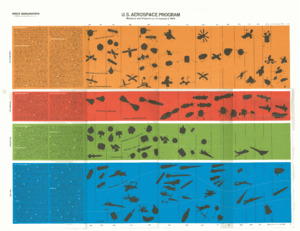
"U.S. Aerospace Program: missions and projects as of January 1, 1966."
The document contains four charts labeled "Investigation", "Exploration", "Utilization", and "Control". Each chart is organized chronologically, contains drawings of U.S. Aerospace Program Projects, and incudes written descriptions of each project. -
"Use of tank mounted booster pumps for providing NPSH to turbopumps operating in a radiation environment."
This paper outlines the results of a test program which was planned to demonstrate the feasibility of using a tank mounted, all-inducer, high speed liquid hydrogen booster pump to provide NPSH for the turbo pump in a reactor-powered vehicle. The cavitation problem associated with pumpoing liquid hydrogen, when used as a propellant, is further aggravated by localized heating caused by radiation from the reactor. -
"Uses of Saturn."
Saturn and Apollo hardware will not have realized their ultimate potential for space exploration after the project lunar landing is complete. To accomplish the Apollo lunar landing program, an immense backlog of technology, facilities, and booster capability will have been built up, and we believe proper utilization of this resource will fill the needs for planetary, lunar and earth orbital space exploration for years to come. -
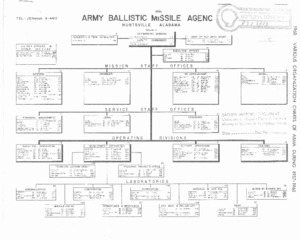
Organization charts of ABMA during 1957-1960.
Includes letter to Mr. David Christensen, University of Alabama Research Institute. -
"Vibration and acoustic environment characteristics of the Saturn V launch vehicle."
This paper presents representative examples of vibration and acoustic data from flights of the Saturn V launch vehicle and static firings of Saturn V launch vehicle stages. The purpose of the paper is to provide vibration and acoustic environment characteristics which are pertinent to the design of launch vehicles -
Visual aids library slide guide.
This document includes revisions. There are missing pages from page 237-238. This reference document catalogues all MSFC oriented visual aids filed in the Visual Aids Library of Marshall Space Flight Center. These visual aids are updated by the Graphic Engineering & Models Branch, Industrial Operations Program Management Information Office, and the Research and Development Operations Management Office. The purpose of the Visual Aids Library is to provide management data visuals in the form of slides (3 X 4 and 2 X 2), or black and white prints, to MSFC offices and laboratories, and other centers, who have a valid requirement. The visual aids are issued on a loan basis in order to obtain as wide a use for each visual and to assure that the latest revisions are incorporated in the issued item. Visuals may be ordered from the Visual Aids Library, located on the 10th floor of building 4200 (Phone 876-7237, 876-6960, 876-0983). In addition to the visuals published in this book, photographs from prime contractors are available from Industrial Operations, Program Management Information Office, Room 621, building 4201. Visuals with erroneous or obsolete information should be brought to the attention of the Visual Aids Library, preferably in writing, so that corrections can be made immediately. This publication will be kept current through distribution of pages of new visuals and notification will be made on obsolete visuals so they may be crossed out in the catalogue. Comments and suggestions concerning this publication will be greatly appreciated. Changes in the distribution lists should be directed to Mr. Gordon 0. Willhite, or Mrs. Opal Tabor, Visual Aids Library, MS-G. -

-
"Welding cryogenic materials for aerospace applications."
Cryogenic propellant rocket engine hardware and the related test facilities will be described. Methods used for selection of alloys for liquid oxygen and liquid hydrogen service will be discussed. Unique equipment and welding procedures are reviewed with emphasis on welding problems and their solutions to assure reliable hardware and facilities. Examples of specific welding procedures and methods of quality assurance will be given for joining application ranging in size from .001" to 11" thick sections. -
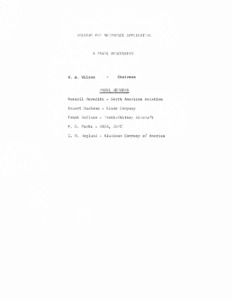
"Welding for aerospace application : a panel discussion."
Original is a photocopy; W. A. Wilson, Chairman; Russell Meredith, North American Aviation; Robert Hackman, Linde Company; Frank Wallace, Pratt-Whitney Aircraft; P.G. Parks, NASA, MSFC; G. O. Hoglund, Aluminum Company of America. -
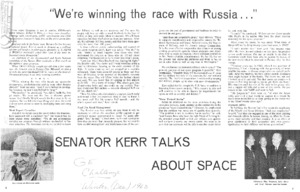
"We're winning the race with Russia."
Partial article discussing the United States' victories in the space-race over Russia. -
"Where are we going in space management."
Presented to the First Space Congress, Cocoa Beach, Florida, April 21, 1964 by Joseph H. Reed, Chief, Management Analysis Office, Executive Staff, Marshall Space Flight Center at the request of the Associate Administrator for Manned Space Flight, NASA -
"Why internal insulation for the Saturn S-IV liquid hydrogen tank?."
Prepared for presentation at the Cryogenic Engineering Conference, Los Angeles, California, August 14-16, 1962.; There is no page 8. -
"X-ray television inspection of aerospace weldments : Television x-ray image enlargement system for inspection."
A sensitive new television X-ray image enlargement system has been developed under sponsorship of Watertown Arsenal Laboratories (Army Materials Research Agency) by the Department of Welding Engineering of The Ohio State University. Now commercially-available through Philips Electronics Instruments (Norelco), complete systems have been in service since January 1963 in aerospace, electronic, and other facilities. Such users report highly- satisfactory performance and unusual reliability in service. The new X-ray system permits in-motion or stationary examination of critical aerospace materials, components, and systems such as sheet materials, weldments, brazed joints, electronic components, printed circuit assemblies, small mechanisms, and biological specimens. -
"A 'Zero Stage' for the Saturn IB Launch Vehicle."
To meet the demands of increasing payload size and weight, and to fill the large payload gap between the Saturn IB and Saturn V, a number of methods of uprating the Saturn IB have been studied by NASA and Chrysler Corp. of providing increased payload capability is discussed in this paper. Four 120 in. United Technology Center UA-1205 solid propellant motors, originally developed for the Air Force Titan III program, are clustered around the S-IB first stage of the Saturn IB launch vehicle. These four solid propellant motors provide the total thrust for liftoff of the vehicle, with S-IB stage ignition occurring just prior to burn-out and separation of the solid propellant motors. The term "Zero Stage" is applied to this added stage.