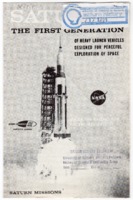
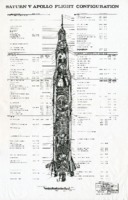
The leaflet outlines the history of Saturn launches and gives a physical description of the rocket. The description includes a diagram of each stage; specifications of each stage's thrust, propellants, liftoff weight, and burning time; and engine specifications.
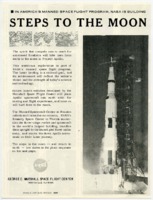
This flier highlights Marshall Space Flight Center's role in the lunar landing and illustrates each step of a successful mission, from liftoff at Kennedy Space Center to splashdown in the Pacific Ocean.
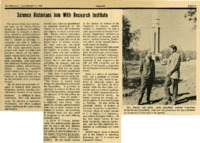
Clipping from the UAH Exponent, Wednesday, December 10, 1969, vol. 2, no. 10, page 3. The article highlights the work of Barton C. Hacker and John S. Beltz to collect historical documents from the Saturn program. The documentation they collected is available at UAH Archives and Special Collections in the Saturn V Collection.
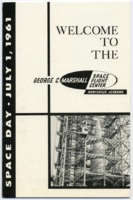
The program includes "Marshall Center Highlights" from the Center's first year, a message from director Wernher von Braun, a photograph of the Space Queen and Princesses, and a guide to the Center's buildings.
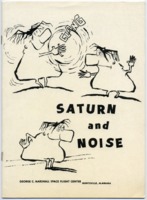
The pamphlet uses a cartoon character named "D. B. Noyes" to explain to the public "the nature and effects of the noise which Saturn makes during static firing tests."
This document is a compilation of abstracts of NASA Technical Memorandums and MSFC Internal Notes, written by personnel of the Materials Division and released during 1965.
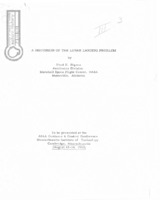
Digesu worked in the Astrionics Division of MSFC. This paper was presented at the AIAA Guidance & Control Conference, Massachusetts Institute of Technology, Cambridge, Massachusetts, August 12-14, 1963.
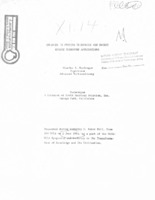
Presented by Charles A. MacGregor, Supervisor, Advanced Turbomachinery during Workshop D, Royce Hall, Room 160 at UCLA on 2 June 1964, as a part of the NASA-UCLA Symposium and Workshop on the Transformation of Knowledge and Its Utilization. The introduction notes, "This report is divided into two general parts. The first part is a description of turbopumps for liquid rocket engines as they exist today. For completeness and understanding, some background information is included on why turbopumps have evolved to their present configurations. The second part suggest portions of this effort that may have some applicability to the general economy."
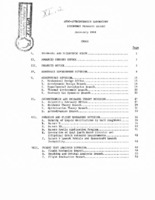
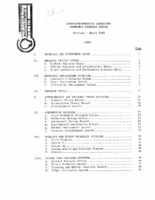
Includes Technical and Scientific Staff; Advanced Studies Office; Projects Office; Aerospace Environment Division; Aerophysics Division; Astrodynamics and Guidance Theory Division; Dynamics and Flight Mechanics Division; Flight Test Analysis Division.
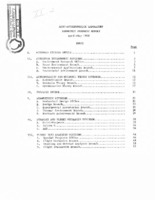
Includes Advanced Studies Office, Aerospace Environment Division, Astrodynamics and Guidance Theory Division, Projects Office, Aerophysics Division, Dynamics and Flight Mechanics Division, Flight Test Analysis Division.