
Browse Items (74 total)
Sort by:
-
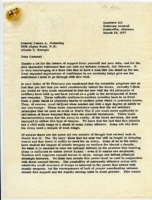
Letter from Col. John C. Nickerson at Redstone Arsenal in Huntsville, Alabama, to Gen. James A. Pickering in Atlanta, Georgia.
In this letter, Nickerson thanks Gen. Pickering for his support and explains why he believes the Army is the best service branch to develop ballistic missiles. He also discusses the need for missiles in case of war with the Soviet Union. Nickerson was a staff officer at the Army Ballistic Missile Agency at Redstone Arsenal assigned to work on the Jupiter, the United States' first mid-range ballistic missile. He was arrested and court martialed for espionage in 1957 after releasing sensitive documents about the United States missile program to the press. At the time, Secretary of Defense Charles E. Wilson granted the Air Force sole authority to develop intermediate range ballistic missile systems. Nickerson disagreed with this policy, and in response, leaked documents that demonstrated the superiority of Army missiles compared to those developed by the Air Force. He eventually pled guilty to lesser charges and was suspended from the Army for one year and was fined $1,500. Dr. Wernher von Braun was among those who testified on Nickerson's behalf. -
-
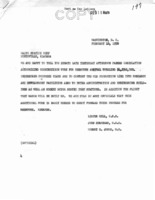
Letter from Sen. Lister Hill, Sen. John Sparkman, and Rep. Bob Jones to Huntsville radio stations.
Addressed to stations WBHP and WFUN, the letter announces that the U. S. Senate passed "legislation authorizing construction work for Redstone Arsenal totaling $4,250,000." The letter also mentions building rocket test stations and a flight test range. -
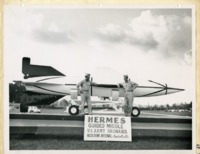
Hermes guided missile on display.
The sign in front of the missile reads, "Hermes Guided Missile, U.S. Army Ordnance, Redstone Arsenal, Huntsville, Ala." -
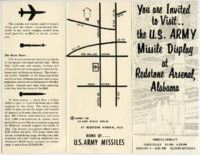
-
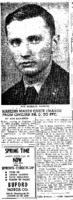
"Haskins Makes Quick Change from Civilian Ph.D. to Pfc."
Clipping from the Redstone Rocket, March 2, 1954. The article highlights Haskins' background as a physicist and his role in the 9330 Technical Service Unit. -
U.S. Army Ordnance Missile Command Armed Forces Day 1961 After-Action Report.
The report outlines highlights of the Armed Forces Day, including attendance, media, and the parade lineup. The theme of the day was "Power for Peace." The report includes news clippings, a Redstone Arsenal welcome brochure, and photographs of the festivities in downtown Huntsville and at Redstone Arsenal. -
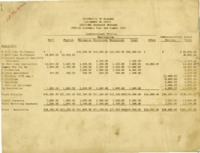
University of Alabama Statement of Costs, Redstone Graduate Program, 1963-1964.
The document outlines costs associated with laboratories and graduate coursework in math, physics, mechanical engineering, and electrical engineering. -
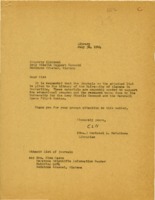
Letter from Christel L. McCanless at the UAH Library to the Army Missile Support Command at Redstone Arsenal in Huntsville, Alabama.
In the letter, McCanless requests the transfer of scientific and engineering journals from Redstone to support research and teaching at the University. A list of the journals is enclosed. -
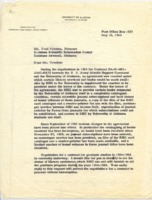
Letter from George W. Croker at the University of Alabama in Tuscaloosa, Alabama, to Fred Croxton, director of the Redstone Scientific Information Center in Huntsville, Alabama.
In the letter, Croxton discusses an agreement made between the University of Alabama and Redstone Scientific Information Center (RSIC) to share library services and materials, including journal subscriptions, messenger service, and access to the RSIC facility. -
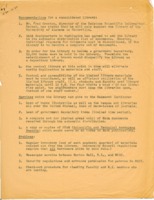
"Recommendations for a consolidated library."
The flier discusses coordination of library services between the UAH Library, the Research Institute, and Redstone Scientific Information Center. -
-
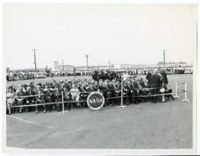
NASA personnel wait to greet President John F. Kennedy during his second visit to Huntsville.
Kennedy visited Huntsville on Armed Forces Day 1963. He first visited the area on September 11, 1962. -
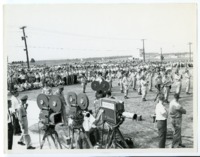
Crowds and television cameras wait for President John F. Kennedy during his second visit to Huntsville.
Kennedy visited Huntsville on Armed Forces Day 1963. He first visited the area on September 11, 1962. -
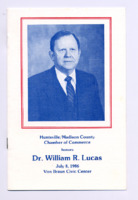
"Huntsville/Madison County Chamber of Commerce honors Dr. William R. Lucas."
From a dinner held in honor of the retirement of MSFC director William R. Lucas in 1986. It includes a biographical sketch and photographs of Lucas. -
Charles A. Lundquist Journal No. 1.
This is the first of Charles A. Lundquist's journals in which he wrote various things during his time as a NASA scientist where he managed research on satellites and rockets at the Army Missile Ballistic Agency. It contains various notes on the satellite program, conversations with Dr. Ernst Stuhlinger, tracking flare problems, notes from the presentation at Planeto Cocoa, more notes and various equations, photoflash notes, two purposes of initial tracking, orbit distance and times, time accuracy from stars, the Reinbolt-14, questions for Dr. Schmid, the JPL Transmitter, radio schemes, a phone call transcript to Resnick, photocell questions, notes from a meeting with Dr. Wernher von Braun, the contents of the RSA Proposal, a comparison of light sources, other various phone call transcripts, multiple proposals, notes on the Whipple Report, Missile #29, photography on Missile #27, an illustration of Redstone Arsenal, RF Ignition Tests, and other various notes, proposals, equations, experiments, calls, correspondence, and tests relating to the space program. -
Charles A. Lundquist Journal No. 2.
This is the second of Charles A. Lundquist's journals in which he wrote various things during his time as a NASA scientist where he managed research on satellites and rockets at the Army Missile Ballistic Agency. It contains various notes and equations relating to the satellite program, multiple calls and conversations with NASA and military officials, notes on conferences and trips Lundquist took, test results, notes from the JPL-ABMA Conference, data from Missile #29, various proposals and test proposals, and graphs of satellite lifetimes. -
Charles A. Lundquist Journal No. 3.
This is the third of Charles A. Lundquist's journals in which he wrote various things during his time as a NASA scientist where he managed research on satellites and rockets at the Army Missile Ballistic Agency. It contains various notes and equations relating to the satellite program, multiple calls and conversations with NASA and military officials, notes on conferences and trips Lundquist took, test results, schedules, notes from the JPL meetings, the trajectory of Missile #29, and various predictions. -

Charles A. Lundquist Journal No. 4.
This is the fourth of Charles A. Lundquist's journals in which he wrote various things during his time as a NASA scientist where he managed research on satellites and rockets at the Army Missile Ballistic Agency. It contains various notes and equations relating to the satellite program, multiple calls and conversations with NASA and military officials, notes on conferences and trips Lundquist took, test results, the Hambree Research Program, lab notes, and a satellite positions map. -

Charles A. Lundquist Journal No. 5.
This is the fifth of Charles A. Lundquist's journals in which he wrote various things during his time as a NASA scientist where he managed research on satellites and rockets at the Army Missile Ballistic Agency. It contains various notes and equations relating to the satellite program, multiple calls and conversations with NASA and military officials, notes on conferences and trips Lundquist took, test results, the lunar probe and corresponding log, radar, the firing of #49, and various presentations attended.