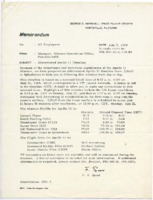
The timeline includes a memorandum from Friedjof A. Speer, manager of the Missions Operations Office, to employees of Marshall Space Flight Center. Speer notes that "astronaut Neil Armstrong is scheduled to be the first man to step onto the moon's surface." The timeline outlines the entire mission from liftoff at 8:32 AM on Wednesday, July 16, 1969 to splashdown at 11:49 AM on Thursday, July 24, 1969.
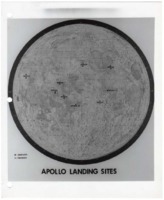
The map shows landing locations on the moon's surface, including proposed landing sites of the cancelled Apollo 18 and Apollo 19 missions. This map was created as part of the Lunar Roving Vehicle (LRV) Project.
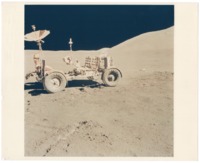
This photo shows the LRV on the moon at the Hadley-Appenine mountain range landing site during the Apollo 15 mission. Developed by Marshall Space Flight Center and built by Boeing, the LRV was an electric vehicle used to explore the Moon's surface during the Apollo 15, 16, and 17 missions.
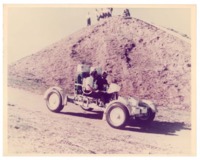
Developed by Marshall Space Flight Center and built by Boeing, the LRV was an electric vehicle used to explore the Moon's surface during the Apollo 15, 16, and 17 missions.
Developed by Marshall Space Flight Center and built by Boeing, the LRV was an electric vehicle used to explore the Moon's surface during the Apollo 15, 16, and 17 missions.
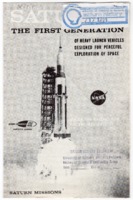
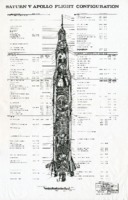
The leaflet outlines the history of Saturn launches and gives a physical description of the rocket. The description includes a diagram of each stage; specifications of each stage's thrust, propellants, liftoff weight, and burning time; and engine specifications.
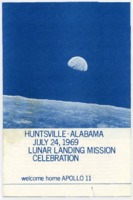
The pamphlet includes biographical information on the three Apollo 11 astronauts as well as Wernher von Braun, then director of Marshall Space Flight Center. The back of the pamphlet congratulates the NASA and aerospace employees in Huntsville "who have made this historic achievement possible."
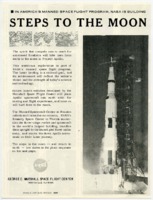
This flier highlights Marshall Space Flight Center's role in the lunar landing and illustrates each step of a successful mission, from liftoff at Kennedy Space Center to splashdown in the Pacific Ocean.
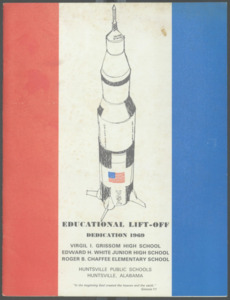
The program dedicates three new Huntsville schools, each named for a member of the Apollo crew that died in the pad fire of February 21, 1967. This program was included in one of two scrapbooks that Christel and George McCanless made for UAH history professor Frances Roberts in 1969.