
Browse Items (47 total)
Sort by:
-
"Advances in Pumping Technology and Rocket Engine Turbopump Applications."
Presented by Charles A. MacGregor, Supervisor, Advanced Turbomachinery during Workshop D, Royce Hall, Room 160 at UCLA on 2 June 1964, as a part of the NASA-UCLA Symposium and Workshop on the Transformation of Knowledge and Its Utilization. The introduction notes, "This report is divided into two general parts. The first part is a description of turbopumps for liquid rocket engines as they exist today. For completeness and understanding, some background information is included on why turbopumps have evolved to their present configurations. The second part suggest portions of this effort that may have some applicability to the general economy." -
-
"The Challenge of Change vs the Control of the Process."
The introduction states, "This paper is designed to present the Rocketdyne engine program as it applies to the Saturn launch vehicles and will apply to the Apollo program of manned flight to the moon (Fig. 1). The vehicle that will launch this flight is the Saturn V, the largest and most powerful of the Saturn family. This vehicle, 362 feet tall and 33 feet in diameter, will be capable of sending a 45-ton payload to the moon or placing a 120-ton payload in earth orbit. Five F-1 engines power the first stage of the Saturn V; five J-2 engines, the second stage; and one J-2 engine, the third stage. The thrust of the first-stage engines alone will be equivalent to 160 million horsepower. Both of these engines, the F-1 and the J-2, were designed at, and are currently being produced by Rocketdyne." -

Telegraphic message containing an Apollo Program Flash Report.
This message for the Apollo Program Director contains a report of the Apollo launch vehicles, problem that occurred, and actions required. The photocopy is difficult to read. -

Telegraphic message containing an Apollo Program Flash Report.
This message for the Apollo Program Director contains a report of the Apollo launch vehicles, problem that occurred, and actions required. The photocopy is difficult to read. -
"Apollo Vehicle Propulsion Systems."
This paper discusses the propulsion requirements for various stages of the Apollo vehicles and the development of these engines. -
"Why internal insulation for the Saturn S-IV liquid hydrogen tank?."
Prepared for presentation at the Cryogenic Engineering Conference, Los Angeles, California, August 14-16, 1962.; There is no page 8. -
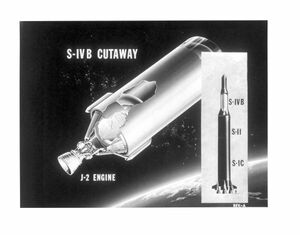
S-IVB cutaway and J-2 engine."
8 x 10 inch black and white diagram of the JII engine and the Saturn IV. -
"Saturn I : the first generation of heavy launch vehicles designed for peaceful exploration of space."
A basic description of the Saturn rockets alongside diagrams for context. -
"S-IVB Saturn high energy upper stage and its development."
The development of carrier rockets For manned space missions has been one of the major activities in the aerospace field during the past decade. The early space efforts were made possible by the existence of large ballistics missiles. It soon became obvious that the delivery of weapons and the launch of large spacecraft could not be combined into one operational system in an efficient way; therefore, a family of spacecraft boosters had to be created. -
"Saturn S-IV cryogenic weigh system. Part IV : safety."
During cryogenic weigh system operation, hydrogen when combined with oxygen can create an unsafe condition. Therefore the concentration of the residual oxygen and hydrogen from leaks in the cryogenic weigh environmental bags must be known at all times during the cryogenic weigh. Hydrogen and oxygen detectors will provide the optimum method for maintaining safe conditions. Hydrogen properties and safe mixtures are reviewed. The method selected to analyze the oxygen content is discussed. The selection, development, and testing of a hydrogen detector system is examined. -
"Saturn S-IV cryogenic weigh system. Part I : propellant utilization."
In order to achieve maximum vehicle efficiency, it is essential that the vehicle propellants be loaded to desired values and that these propellants approach simultaneous depletion at the end of powered flight. To accomplish precise loading and assure minimum residuals, a highly accurate and repeatable, vehicle located, propellant management (PM) or propellant utilization (PU) system must be used. As the ability to load propellants to predetermined values depends directly on the ability of the system to accurately sense the propellant masses, it is essential that the system be calibrated with respect to propellant mass under conditions resembling those to be experienced during final loading and powered flight. The use of a cryogenic weight system will reduce the unknown factors in capacitance sensor element shaping, tank geometry, and propellant properties to a degree which will permit the determination of propellant masses to with .025%. -
"Reliability and quality management."
The role of Reliability and Quality in NASA program management is well defined by the NPC 200 series and complimentary procurement regulations. -
"Rocket engine selection criteria."
This paper considers many of the factors and criteria which have to be considered and evaluated when selecting a specific rocket engine for a given vehicle application. The lists of criteria can be helpful as checklists in design and systems engineering of a rocket propulsion device. About ten different applications are examined to illustrate the relative importance of some of these selection criteria. There will be groupings of our major types of criteria; namely, performance, operational, economic and so-called judgment criteria. In many cases the last three categories are equally or more important than the performance criteria in selecting one of several rocket engines for a specific application. The actual selection usually is a compromise to make the rocket engine responsive to several important criteria. -

"Rocket engine turbo pumps for space travel."
Finding the turbopump arrangement which is best suited for a given rocket engine - space travel applications - constitutes an important task. The arrangement depends upon a large variety of different factors, such as, the engine cycle, weight, the liquids to be pumped, the cavitation performance, the bearings and their lubrication, the seals and the turbine. In this report these factors and their influence on the turbopump configuration are discussed. It is shown that three of them: weight, propellants to be pumped and obtainable suction performance have the largest influence on the selection of the turbopump. A systematic approach is outlines for the design process, which allows to arrive at a turbopump arrangement best suited for a given application. -
"Propulsion lecture."
Lecture discussing the types of propellant used in space rockets. -
"Recent NASA experience with hydrogen engines."
This paper presents a review of the experience which has accumulated in the development of the Liquid Hydrogen J-2 and RL10 rocket engines. These engines are being developed by the Rocketdyne Division of North American Aviation and Pratt & Whitney Aircraft, a Division of United Aircraft Corporation respectively.; On NASA Technical Reports Server (NTRS) as Unclassified; No Copyright; Unlimited; Publicly available. Also found on AIAA site. -
"Recent NASA experience with hydrogen engines."
This paper presents a review of the experience which has accumulated in the development of the Liquid Hydrogen J-2 and RL10 rocket engines. These engines are being developed by the Rocketdyne Division of North American Aviation and Pratt & Whitney Aircraft, a Division of United Aircraft Corporation respectively.; On NASA Technical Reports Server (NTRS) as Unclassified; No Copyright; Unlimited; Publicly available. Also found on AIAA site. -
"Problems in cryogenic pump design for space application."
Report detailing the problems surrounding cryogenic pump design for space travel and missions. -
"Next stop : the moon."
Release describing the launch of the Apollo 11.