
Browse Items (35 total)
Sort by:
-
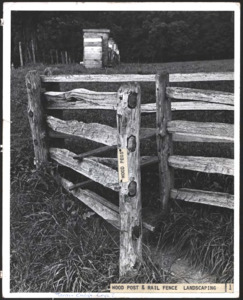
Architecture notebook 1A: Architectural details and elements.
Assorted photographs of posts and fences, gates, brick patterns, foot scrapers, coach mounts, cut stone, dairy troughs, vents, chimneys, brick bonds, gutters, cornices, clapboards, backboards, windows, trim, hinges, building frames, siding, carriage houses, rafters, flooring, mantles, stairs, handrails, and doors. -
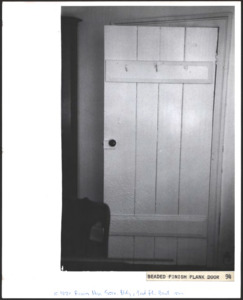
Architecture notebook 2: Early nineteenth-century architectural details, doors, and windows.
Assorted photographs of doors, shutters, windows, plaster finishes, gates, latches, locks, hasps, hinges, rods, door pulls, racks, and bolts. Includes details from the Fearn House, Phelps Jones House, Kelly House, Grove-Bassett House, Chapman House, McCrary-Thomas House, Mooresville Post Office, Mooresville Store, Erskine-McMains House, and Cades Cove. -
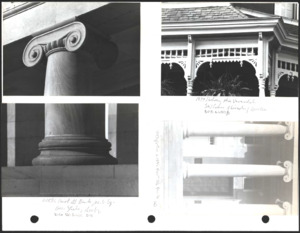
Architecture notebook 13: Miscellaneous building exteriors, stores and gas stations.
Miscellaneous building exteriors. -
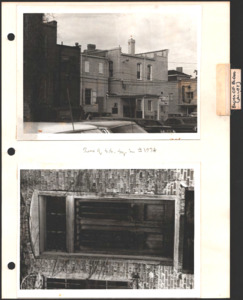
Architecture notebook 13: Backs of Buildings (Alleys), in Huntsville, Alabama.
South Side Square Alley and Jefferson West Alley. -
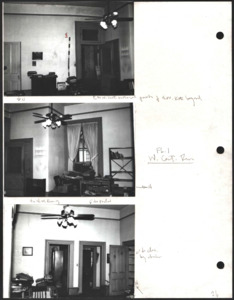
Architecture notebook 56: Miller House, at 1601 Alaca Place, Tuscaloosa, Alabama.
The Miller House, also known as the Miller-Harrison-Laseter House, built in 1857, is a two-story house build in the shape of a Maltese Cross with three entrances and three porches. Utilizes Gothic architectural details. Located at 1601 Alaca Place, Tuscaloosa, Alabama. -
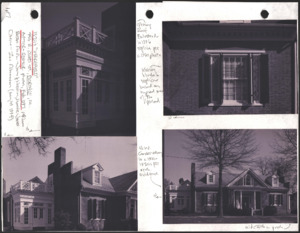
Architecture notebook 56: Wakefield, at 450 N. Court St., Florence, Alabama.
"Wakefield," or Zac Abramson Residence, built in 1825 by James Sample. Thought to be the first brick residence in Florence, Wakefield was built with Adamesque detail. Prominent visitors include William L. Yancey and General Steven D. Lee. Located at 450 N. Court St., Florence, Alabama. -
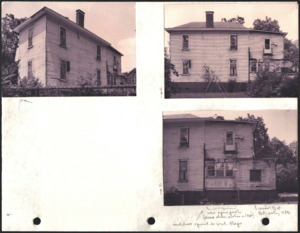
Architecture notebook 57: House at 715 Adams St., Huntsville, Alabama.
This house was built c. 1840 and had an addition built in 1890. Parts of the home are late-Federal to early Greek Revival and other parts are late Victorian. The house was bought and demolished in 1998 by Dr. Aust after easily fixable "dry rot" was found in parts of the wood. Located at 715 Adams St., Huntsville, Alabama. -
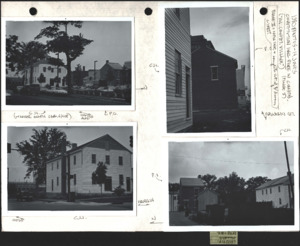
Architecture notebook 57: Constitution Hall Park, Phase II, in Huntsville, Alabama.
Constitution Hall Park, or Constitution Village, Phase II construction took place between 1970-1982. Includes the Walker Allen Cabinet Shop and the Boardman Building. Located in Huntsville, Alabama. -
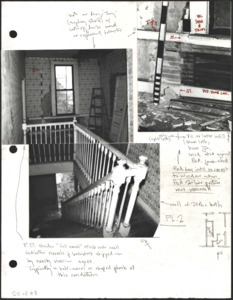
Architecture notebook 57: Draper Residence, on Clinton Ave., Courtland, Alabama.
Draper Residence, built c. 1830 in Federal and Victorian style. Records indicate the presence of a outbuilding, servants house, shed, barn, and well at one point. Colonial Revival Tabernacle style frame built around the front door and a Victorian veranda added c. 1920. Located on Clinton Ave., Courtland, Alabama. -
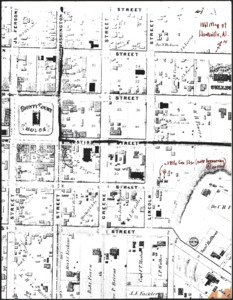
Architecture notebook 57: Cox-Hilson House, or the Cox-Hilson-Whitten House, at 311 Lincoln St., Huntsville, Alabama.
Cox House, also known as Cox-Whitten-Hilson home, built in 1826, in the large, symmetrical antebellum style for Joshua Cox. This house has 14 and 16 foot high ceilings, contributing to its nickname of the "Spite House" since the unusually high ceilings resulted in the owners spiteful wish to block the Leroy Pope house. It was later used as apartments. Located at 311 Lincoln St., Huntsville, Alabama. -
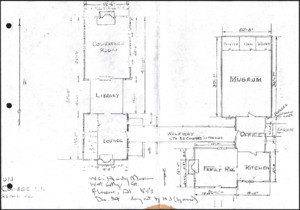
Architecture notebook 57: W.C. Handy Log House and Museum, in Florence, Alabama.
W.C. Handy Log House and Museum, built in the early 19th century. Home of W.C. Handy, famous blues composer born in 1873. Popular compositions such as "St. Louis Woman" and "Bride St. Blues" were composed here. It was rebuilt in the 1960s on the current site with the addition of the museum. Only the logs of the actual house remain authentic from when W.C. Handy owned the house. Located in Florence, Alabama. -
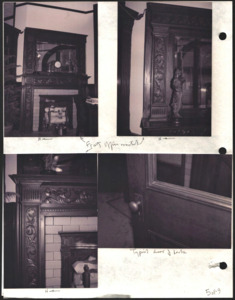
Architecture notebook 58: Schiffman Building, at 205 East Side Square, Huntsville, Alabama.
Schiffman Building, built in 1845 and remodeled in 1895. Stone details and interior mostly original. Located at 205 East Side Square, Huntsville, Alabama. -
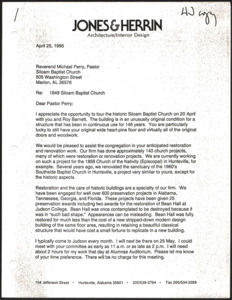
Architecture notebook 58: Siloam Baptist Church, at 505 Washington St., Marion, Alabama.
Siloam Baptist Church, built in 1849. Known for being in original condition though the building had been in continuous use for 146 years. The church was founded in 1822. Chapel woodwork presumed to be from the 1920s. Located at 505 Washington St., Marion, Alabama. -
Architecture notebook 60: Law Library, at 205 East Side Square, Huntsville, Alabama.
Elbert H. Parsons Madison County Law Library, built 1914, was originally a Deparment store and an adult movie theater. A skylighted window was installed on the walkway in front of the building when c. 1830 brick was uncovered 12 inches below the present walkway. Located at 205 East Side Square, Huntsville, Alabama. -
Architecture notebook 60: Railroad Bridge, at Beaverdam Creek near AL 20, Greenbriar, Alabama.
Stone arch railroad Bridge, built 1873, presumably built from local limestone. Located at Beaverdam Creek near AL 20, Greenbriar, Alabama. -
Architecture notebook 61: Hendricks Hardware Store, at 122 W. Market St., Athens, Alabama.
Hendricks Corner Hardware and Furniture Store, built 1902, restored in 1995 by Athens computer firm, The Pinnacle Group Inc. The Hendricks building was mostly destroyed by a 1994 fire. Restored for office space. Designed in the Italiante style. Located at 122 W. Market St., Athens, Alabama. -
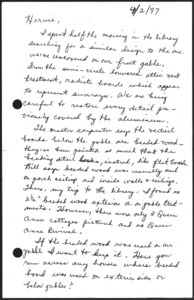
Architecture notebook 62: Clanton House, at 701 Adams St., Huntsville, Alabama.
Clanton House, built 1892. Restoration of building details began in 1996. Aluminum siding was replaced with narrow vinyl siding rather than recommended restoration replacement due to budget constraints. Located at 701 Adams St., Huntsville, Alabama. -
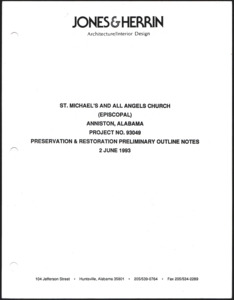
Architecture notebook 62: St. Michael's & All Angels Episcopal Church, at 1000 W. 18th St., Anniston, Alabama.
St. Michael's and All Angels Episcopal Church, built c. 1888 by John Ward Noble. Selected as a state historical site. Preservation included stain glass windows, interior, exterior, and other various details on the property. Located at 1000 W. 18th St., Anniston, Alabama. -
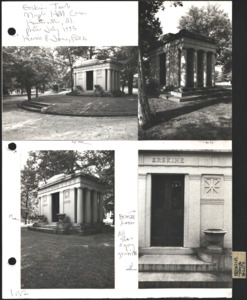
Architecture notebook 62: Erskine Tomb, at Maple Hill Cemetery, Huntsville, Alabama.
Erskine Tomb, built in the 1820s. Mausoleum complete with bronze doors and granite stone. Located at Maple Hill Cemetery, Huntsville, Alabama. -
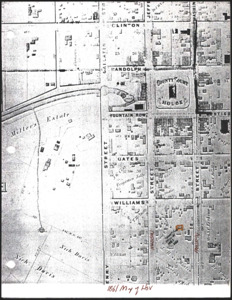
Architecture notebook 62: Goldsmith-Donovan House, at 506 Franklin Ave., Huntsville, Alabama.
Goldsmith-Donovan House, built c. 1887 by Oscar Goldsmith. Sold in 1890. Tower and porch added 1894-98. Rear addition added in 1997-8 renovation. Located at 506 Franklin Ave., Huntsville, Alabama.